


AIRLESS BOTTLES
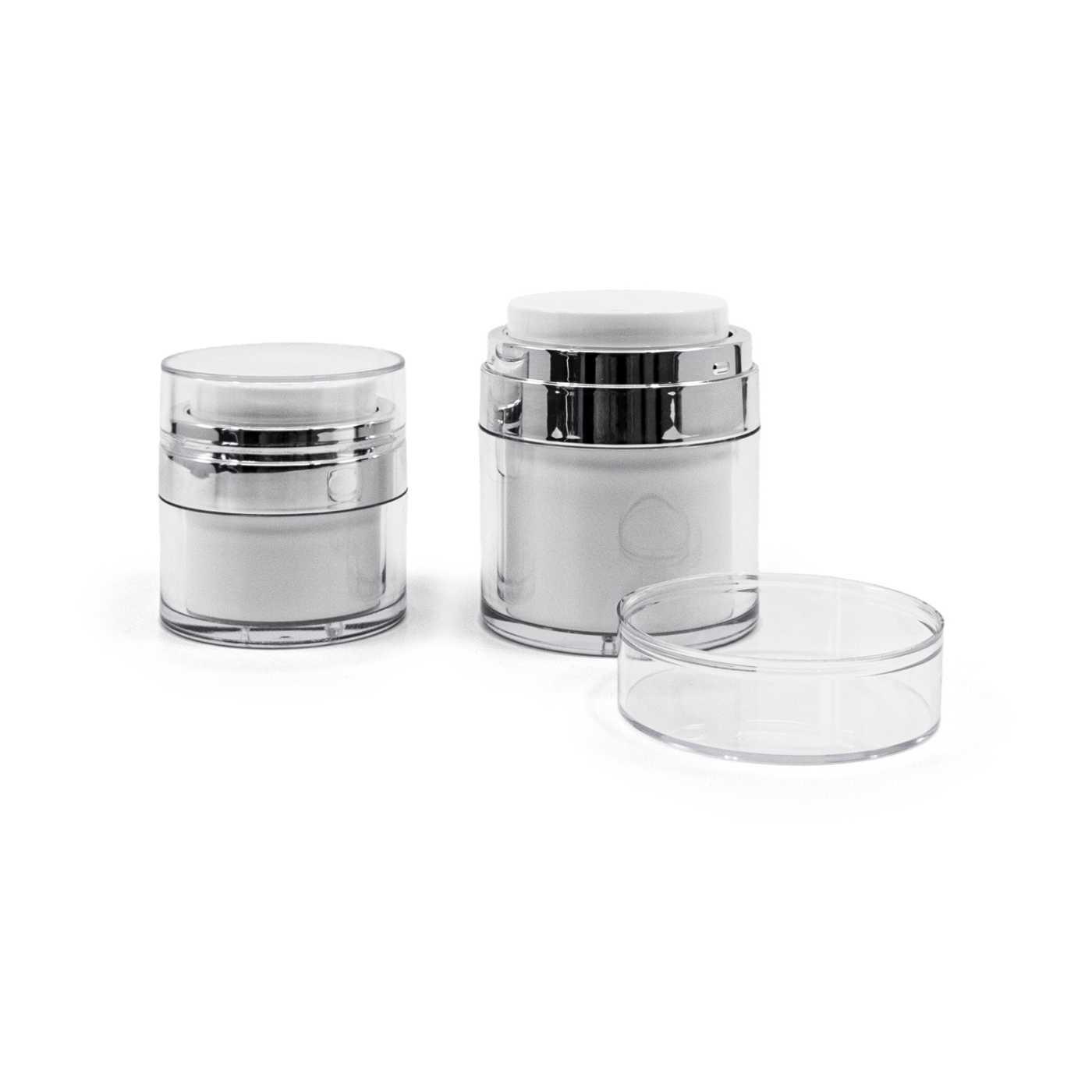
Airless jar, white plastic with silver rim, 15 ml
The airless jar with a volume of 15 ml is a container for creams and gels that should remain in contact with air and fingers as little as possible. The contents are not scooped out but dispensed by pressing . full description
Lowest price in the last 30 days: €5.19
Total for 1 pcs: €5.19
Product description
The airless jar with a volume of 15 ml is a container for creams and gels that should remain in contact with air and fingers as little as possible. The contents are not scooped out but dispensed by pressing. The bottom of the jar moves upward and air does not return inside. Sensitive formulations therefore oxidise less during use.
The small volume is particularly suitable for eye creams, facial creams with active ingredients, gel serums, travel sizes, and samples. The jar is suitable for contact with cosmetic products.
How airless dispensing works
In a standard jar, air reaches the contents every time it is opened, and microorganisms from the hands enter when scooping. The airless system works differently:
- Piston instead of a dip tube – each press creates negative pressure inside the jar, pushing the bottom with the contents upward. Nothing is drawn back in.
- Consistent small dose – each press always delivers approximately the same amount. The exact dose value is listed in the product parameters.
- Less waste – the piston gradually pushes out almost all of the contents, so no cream is left on the walls or at the bottom.
- Hygienic use – the contents are never touched by fingers or a spatula.
Which formulations it suits
The mechanism works best with emulsions and gels of medium viscosity. These include facial and eye creams, thicker lotions, gel creams, and gel serums. It is particularly relevant for formulations with oxidation-sensitive ingredients, such as vitamin C derivatives, retinoids, coenzyme Q10, or vegetable oils with a high proportion of unsaturated fatty acids.
Less suitable are very thin liquids that may leak around the piston. Solid balms, anhydrous butters, and products with solid particles (scrubs, clay masks) are also not suitable. These either clog the mechanism or cannot be dispensed by it.
Airless packaging does not replace preservation. Formulations containing water require a preservation system just as they would in a standard jar; the packaging only reduces the microbial load during use.
Nominal and total volume
Nominal volume is the amount of product the jar is designed for when filled normally. Total volume to the rim is the physical volume of the interior space. With airless containers, the difference is more pronounced than with standard jars because part of the space is taken up by the dispensing mechanism and the piston travel. Fill to the nominal volume, not to the rim. If overfilled, the mechanism cannot be seated correctly and the contents will leak out.
What to know when filling
- Preparation before first filling – wash the parts, briefly disinfect with isopropyl alcohol or 70% ethanol, and allow to dry completely. Do not boil or sterilise the plastic with hot air.
- Filling without air bubbles – fill the cream from the top with the piston in the lower position, preferably using a syringe or piping bag. Tap the jar against the surface periodically to settle the contents.
- Filling temperature – only fill with a cooled product. Hot material can deform the plastic, and after cooling it shrinks in volume, creating an air pocket inside the jar.
- Material sensitivity – the jar is made of polypropylene and acrylate (PMMA). Acrylate tolerates prolonged contact with alcohol, solvents, and concentrated essential oils poorly. For formulations with a higher proportion of these ingredients, we recommend testing compatibility on a sample.
- Appearance – the white body with a silver trim looks neat even without any labelling.
- Recycling – the packaging is made of multiple types of plastic, so disassemble it into individual parts before sorting, where the construction allows.
After filling and assembly, press the dispensing part several times without dispensing. This primes the mechanism and fills it with product; the first dose usually appears after a few presses.
Before producing a larger batch, we recommend filling a test unit to verify the seal, dosage, and behaviour of the packaging with the specific formulation.
Frequently asked questions
Verified by customers.
No reviews yet.
Only customers with a delivered order can write reviews.