


Closures DIN24
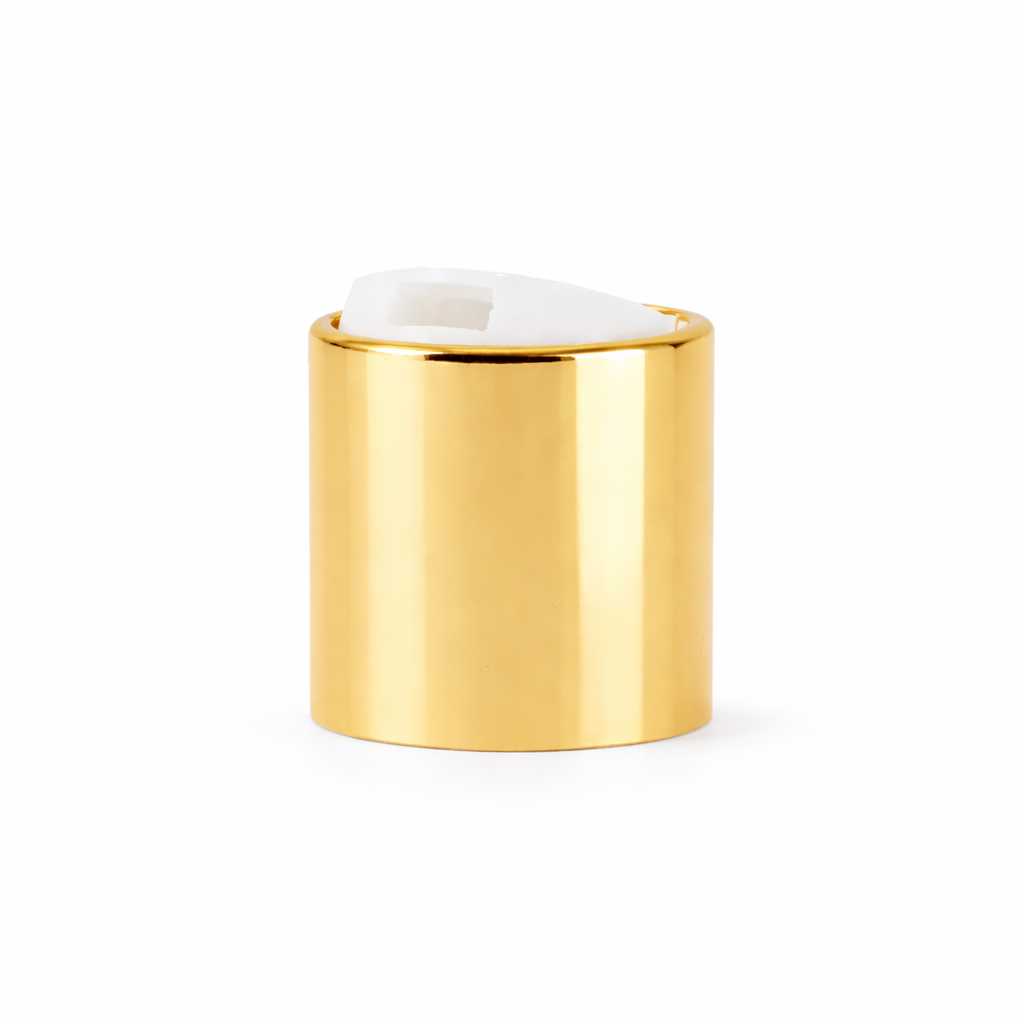
White Plastic Disc Top Cap with Golden Aluminium Collar, 24/410
Disc top cap aluminium/PP gold with white center 24/410 is an aesthetic and functional closure for various types of bottles and vials intended for liquid and slightly viscous products. full description
Lowest price in the last 30 days: €0.70
Product description
Disc top cap aluminium/PP gold with white center 24/410 is an aesthetic and functional closure for various types of bottles and vials intended for liquid and slightly viscous products. Thanks to the practical “disc top” system, it enables convenient, controlled dispensing without the need to completely unscrew the cap, which reduces the risk of spillage and contamination of the contents.
The combination of metal and plastic material provides a professional appearance and reliable sealing during long-term use. The closure is suitable for water- and oil-based cosmetic formulations and, when combined with a properly selected compatible bottle, creates a representative and durable packaging system.
Possible uses
- closing bottles with liquid cosmetic preparations, such as facial toners, cleansing waters, facial and body serums
- dispensing gentle facial and hair oils, light emulsions and leave-on preparations
- practical closure for aromatherapy blends, flower waters, body sprays without propellant gas (in a suitable combination with the corresponding container)
- suitable for home and small artisanal product batches where a professional appearance and user comfort are important
- use in laboratory and workshop production for dispensing auxiliary solutions, test samples and working solutions in smaller flacons
Packaging advantages
- Material stability – the robust construction combining aluminium and PP plastic ensures mechanical resistance and a stable shape during normal use and transport.
- Protection of contents – a correctly fitted cap helps to limit the contact of the contents with air and impurities, thereby supporting longer stability of more sensitive formulations.
- Controlled dispensing – the disc top system allows convenient one-handed opening and closing and better control of the amount when pouring out or dispensing the preparation.
- Universal use – suitable for a wide range of liquid cosmetic products and auxiliary solutions according to the selected bottle type and formulation.
- Representative appearance – the combination of the golden surface and white center looks elegant and highlights the premium character of the final packaging.
Combining with closures and dispensers
The disc top cap is intended for use with compatible bottles and vials with a matching neck type. The bottle thus created with a disc top closure is suitable for convenient dispensing of liquid preparations directly into the palm or onto a pad without the need to completely unscrew the lid.
Combinations of packaging and closures created directly on Handymade are tested and functional. However, for all combinations we always recommend carrying out your own compatibility test – checking the sealing, dispensing and behaviour of the packaging in contact with the specific formulation (viscosity, pH, alcohol content or content of active substances).
Technical parameters
All technical parameters of the packaging are given in the attached packaging quality certificate and in the product parameters.
FAQ – Most frequently asked questions
The disc top cap is ideal especially for less viscous to medium-viscosity liquids such as toners, light facial and body milks, serums or oil blends with lower density. For very thick emulsions or gel textures, we always recommend performing a trial filling and testing the smoothness of dispensing as well as the sealing during long-term storage.
The cap can be used repeatedly if hygiene principles are observed, provided that it is not mechanically damaged and the sealing is still fully functional. Before each new filling, we recommend thoroughly cleaning the packaging, including the closure, and disinfecting it with a suitable alcohol-based preparation, for example IPA 99% isopropyl alcohol or 96% denatured plant-based ethanol. This will reduce the risk of microbial contamination and extend the stability of your cosmetic formulations.
If you decide not to reuse the cap, we recommend recycling it according to the type of material specified in the product parameters. As a rule, it is necessary to separate the plastic and metal parts, if technically possible, and place them in the appropriate collection containers according to the locally valid waste-sorting rules. Before handing it over for recycling, it is advisable to remove any product residues to facilitate further processing of the packaging in the recycling process.
When selecting suitable packaging, we recommend using the advanced filter in the packaging material categories. After clicking on the relevant category, you will find the filter at the top of the page, where you can conveniently narrow down the products according to neck type, size, colour and material. In this way, you can easily choose a compatible bottle, vial or jar for the selected closure and adapt the final packaging to the specific formulation as well as to the visual style of your brand.
When filling, we recommend not overfilling the bottle and leaving a small expansion zone between the surface of the liquid and the closure in order to minimise the risk of leakage in case of pressure or temperature fluctuation. After closing, always check that the cap is tightly screwed on and the disc top part is completely closed. During storage, avoid direct sunlight and extreme temperatures; the packaging should be kept in a dry place, at a stable room temperature and away from sources of highly volatile chemicals that could affect the material of the closure in the long term.
Parameters
- Country of origin
- European Union
- Diameter
- 28 mm
- Thread type
- 24/410
- Height
- 29 mm
Product documentation
- PDSProduct Data Sheet
- PDF ↓
Verified by customers.
No reviews yet.
Only customers with a delivered order can write reviews.