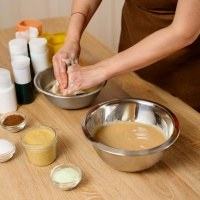
Liquid soap is one of the basics of our hygiene habits — you come home from work, you travelled by bus and the first thing you do when you step into the house is wash your hands. That is why at Handymade we decided to share with you an excellent recipe together with the procedure and make a homemade liquid soap. We bring you two recipes at once — a moisturising hand soap and a coconut soap for dishes and surfaces.
About this recipe
The recipe and the procedure were prepared at Handymade. Since coconut oil on its own can dry out the skin, we bring you two recipes at once. One is made purely with coconut fat and with the addition of orange essential oil — it is suitable for washing dishes and cleaning various surfaces. But since we mainly wanted to make a hand soap so that the skin stays supple and at the same time hydrated, we tried several versions with the addition of different oils. The soap calculator helped us with this.
We liked the version with the addition of castor, almond and olive oil the most. We tested this version at our company workshop and the soap turned out nicely transparent.
Key benefits
- It stays liquid
Potassium hydroxide ensures the softness of the paste, its easy dissolution in water and also the fact that the soap stays liquid.
- Two recipes in one guide
A moisturising hand soap with castor, almond and olive oil, and a coconut soap suitable for washing dishes and cleaning various surfaces.
- Nicely transparent
Solid oils with a content of saturated fatty acids, for example coconut, leave the soap nicely transparent.
- Colour and scent your way
You can colour and scent your homemade natural liquid soap exactly according to your wishes.
- Antibacterial properties
By adding tea tree and lavender essential oil, your soap will have antibacterial properties.
- The paste keeps
You can dissolve only part of the paste and store the rest in a bag in the fridge to use later.
Product properties
Key raw materials in the recipe
The essence of soap making, whether liquid or solid, is saponification — that means that by using potassium hydroxide we turn oils into a soap paste and then dissolve it in demineralised water. Below we go through the individual raw materials and their role in the recipe.
Potassium hydroxide (KOH)
By using potassium hydroxide — KOH we turn oils into a soap paste. It is precisely potassium hydroxide that ensures the softness of the paste, its easy dissolution in water and also the fact that the soap stays liquid. But be careful! KOH is also a caustic substance and when working with it you must observe safety precautions. Superfatting — that is, a higher fat content than the hydroxide is able to saponify — is not recommended; on the contrary, a slight excess of KOH, roughly 3 %, is recommended.
Coconut oil
Among oils, it is suitable to use solid oils with a content of saturated fatty acids, for example coconut — then the soap will stay nicely transparent. However, coconut oil on its own can dry out the skin, which is why we add further oils in the moisturising recipe. In the second recipe coconut fat makes up the entire oil share and the resulting soap is suitable for washing dishes and cleaning various surfaces.
Castor oil
Castor oil is part of the version we liked the most — together with almond and olive oil. We tested this version at our company workshop and the soap turned out nicely transparent.
Almond oil
Almond oil complements the coconut fat in the moisturising recipe. The aim was to make a hand soap so that the skin stays supple and at the same time hydrated — that is why we tried several versions with the addition of different oils.
Olive oil pomace
Olive pomace oil rounds off the oil part of the moisturising recipe — together with castor and almond oil it complements the coconut fat. The soap calculator helped us find this version.
Other raw materials
Demineralised water is used to dilute the hydroxide and to dissolve the finished soap paste. You dilute the mass in a ratio of 1:1 in warm demineralised water.
Essential oils are used as needed for fragrancing. Add rather less and gradually, max. 0.5 – 1 % of the mass. By adding tea tree and lavender essential oil, your soap will have antibacterial properties.
Mica powder is used for colouring. Disperse mica powders in a little liquid soap and then mix them into the desired amount. That way you can colour your homemade natural liquid soap exactly according to your wishes.
Citric acid is used as a 20 % solution to adjust the pH — it is diluted with water in a ratio of 1:4 (acid : water).
pH test strips will help you measure the pH of the finished soap. Do you not know how to measure the pH of a product correctly? You can read about it on our blog in the article Measuring the pH of a product.
Formulation
The quantities of raw materials are given in grams — exactly as we made the soaps ourselves. We tried several versions with the addition of different oils and the soap calculator helped us with this. We bring you two recipes — a moisturising hand soap and a coconut soap for dishes and surfaces.
Recipe 1 — moisturising soap
| Phase / raw material | Quantity |
|---|---|
| Oils | |
| Coconut oil | 600 g |
| Almond oil | 400 g |
| Castor oil | 320 g |
| Olive oil pomace | 100 g |
| Hydroxide solution | |
| Potassium hydroxide 90 % | 326 g |
| Demineralised water | 652 g |
| Finishing — as needed | |
| Essential oils | max. 0.5 – 1 % |
| Mica powder | as needed |
| 20 % citric acid solution | 100 ml |
Recipe 2 — coconut soap
| Phase / raw material | Quantity |
|---|---|
| Oils | |
| Coconut fat | 475 g |
| Hydroxide solution | |
| Potassium hydroxide 90 % | 143 g |
| Demineralised water | 400 g |
| Finishing — as needed | |
| Orange essential oil | for fragrancing |
| 20 % citric acid solution | 100 ml |
Equipment
Scales, a thermometer, one large and a slightly smaller pot with a lid for a water bath, a whisk for stirring, a hand blender, possibly a potato masher if the paste is too thick, a container for diluting the hydroxide, pH test strips, protective gloves and goggles for working with hydroxide.
The preparation is quite time-consuming, so set aside enough time. The cooking of the soap paste alone takes at least 3 hours and you will then still dissolve the paste in water, adjust the pH and finish it. The production of liquid soap can be divided into 2 phases: 1. production of the basic paste and 2. dilution of the paste in water.
Safety when working with hydroxide
Hydroxide is a caustic substance, therefore when working with it use protective equipment — goggles, gloves, clothing with long sleeves — and work in a ventilated room so that you do not inhale the fumes.
Always pour the hydroxide into the water, never pour water into the hydroxide! The reaction causes a high temperature of up to around 90 °C. Beware of the fumes — when stirring, it is better to turn your head away.
How to make it
Phase 1 — production of the basic paste
- Heating the oils Phase 170 °C
In a water bath, let the oils heat up to 70 °C, trying to maintain this temperature.
- Hydroxide solution up to around 90 °C
In the meantime, prepare the hydroxide solution. Weigh out 400 g of demineralised water, preferably into a glass container, and slowly sprinkle the hydroxide into the cold water. This reaction causes a high temperature of up to around 90 °C. Beware of the fumes. When stirring, it is better to turn your head away.
- Evening out the temperatures 60 – 70 °C
Measure the temperature of the solution and wait until it reaches 60 – 70 °C. At the same time, also measure the temperature of the oil. If it too is at 60 – 70 °C, stop heating it.
- Combining and stirring 70 °C
Then slowly add the hydroxide solution to the oil. Stir with a whisk; you can use a hand blender to help. If the mixture starts to boil up (too high a temperature), cool it down in cold water — cool it by stirring. Keep the mixture at 70 °C until it thickens.
- Cooking in a water bath 3 hours
Cover with a lid and let it cook in a water bath for 3 hours. Every 30 minutes check whether any fat has separated out of the mass; if so, stir it back in and continue cooking.
- Testing the paste 30 – 60 min extra
After 3 hours do a test: dilute 40 g of the mass in 80 g of warm demineralised water and let it cool. If the liquid is cloudy, cook it for another 30 – 60 minutes. Then repeat the test.
Phase 2 — dilution of the paste in water
- Dilution 1:1 Phase 2
Dilute the mass in a ratio of 1:1 in warm demineralised water, stirring until it dissolves, or let it dissolve freely. You can dissolve only part of the paste and store the rest in a bag in the fridge to use later.
- pH adjustment pH 8 – 9
Measure the pH and adjust it using a solution of citric acid and water (1:4 acid : water). Add rather less, spoon by spoon, stir, let it stand for a while and measure again until you reach a pH value of 8 – 9. Do you not know how to measure the pH of a product correctly? You can read about it on our blog in the article Measuring the pH of a product.
- Colour and scent max. 0.5 – 1 %
Then you can add essential oils and colours according to what each person likes. Mica powders are suitable; disperse them in a little liquid soap and then mix them into the desired amount. Add essential oils rather less and gradually, max. 0.5 – 1 % of the mass.
- Maturation 1 to 2 weeks
An essential step in the whole creation of liquid soap is to let the soap mature and stand for at least 1 to 2 weeks.
Maturation and use
Maturation is important so that all the mixed ingredients stabilise and the entire soap obtains the correct pH. If maturation did not occur and the soap were used straight away, it could have adverse effects on our skin. Let it rest and it will repay you with its quality.
Tips and tricks
Cloudiness, however, is not a defect — it occurs when not all fatty acids go through the saponification process. That is why superfatting — that is, a higher fat content than the hydroxide is able to saponify — is not recommended. On the contrary, a slight excess of KOH, roughly 3 %, is recommended. You can cleverly mask this small imperfection, for example by adding mica powder.
You can colour and scent your homemade natural liquid soap exactly according to your wishes. By adding tea tree and lavender essential oil, your soap will have antibacterial properties.
Liquid soap and its creation is not rocket science, it only looks that way. However, the whole process is subject to rules without which you will not reach the final result. You need to follow all the steps and work gradually so that the result is as it should be.
Frequently asked questions about the recipe
Practical questions about homemade liquid soap — potassium hydroxide, cloudiness, pH, safety, and colouring and scent.
Why is potassium hydroxide used for liquid soap?
By using potassium hydroxide — KOH we turn oils into a soap paste and then dissolve it in demineralised water. It is precisely potassium hydroxide that ensures the softness of the paste, its easy dissolution in water and also the fact that the soap stays liquid.
Why is my liquid soap cloudy?
Cloudiness is not a defect — it occurs when not all fatty acids go through the saponification process. That is why superfatting is not recommended; on the contrary, a slight excess of KOH, roughly 3 %, is recommended. You can cleverly mask this small imperfection, for example by adding mica powder.
What pH should the finished liquid soap have?
You adjust the pH using a solution of citric acid and water (1:4 acid : water), until you reach a pH value of 8 – 9. Add rather less, spoon by spoon, stir, let it stand for a while and measure again.
How long does it take to make liquid soap?
The preparation is quite time-consuming, so set aside enough time. The cooking of the soap paste alone takes at least 3 hours and you will then still dissolve the paste in water, adjust the pH and finish it. On top of that, the soap needs to mature and stand for at least 1 to 2 weeks.
How do you work safely with hydroxide?
KOH is a caustic substance, therefore use protective equipment — goggles, gloves, clothing with long sleeves — and work in a ventilated room so that you do not inhale the fumes. Always pour the hydroxide into the water, never pour water into the hydroxide. The reaction causes a high temperature of up to around 90 °C.
How do you colour and scent the soap?
Mica powders are suitable; disperse them in a little liquid soap and then mix them into the desired amount. Add essential oils rather less and gradually, max. 0.5 – 1 % of the mass. By adding tea tree and lavender essential oil, your soap will have antibacterial properties.
What is coconut soap suitable for?
The recipe made purely with coconut fat and with the addition of orange essential oil is suitable for washing dishes and cleaning various surfaces. For hands, the moisturising version with castor, almond and olive oil is more suitable, because coconut oil on its own can dry out the skin.
Conclusion
We believe that you enjoyed making liquid soap with us. We hope that our post with the procedure and important advice has helped you throughout the entire creation process.
Have you made liquid soap according to our procedure? Share your tricks and tips with us. What ingredients did you use? What is your favourite scent? We are interested in all of this. Let us discuss, create a community and learn from one another.
Until the next saponification, friends.
You will find the potassium hydroxide, vegetable oils, essential oils and mica powders from this recipe in the Handymade raw materials range.