
PLASTIC JARS
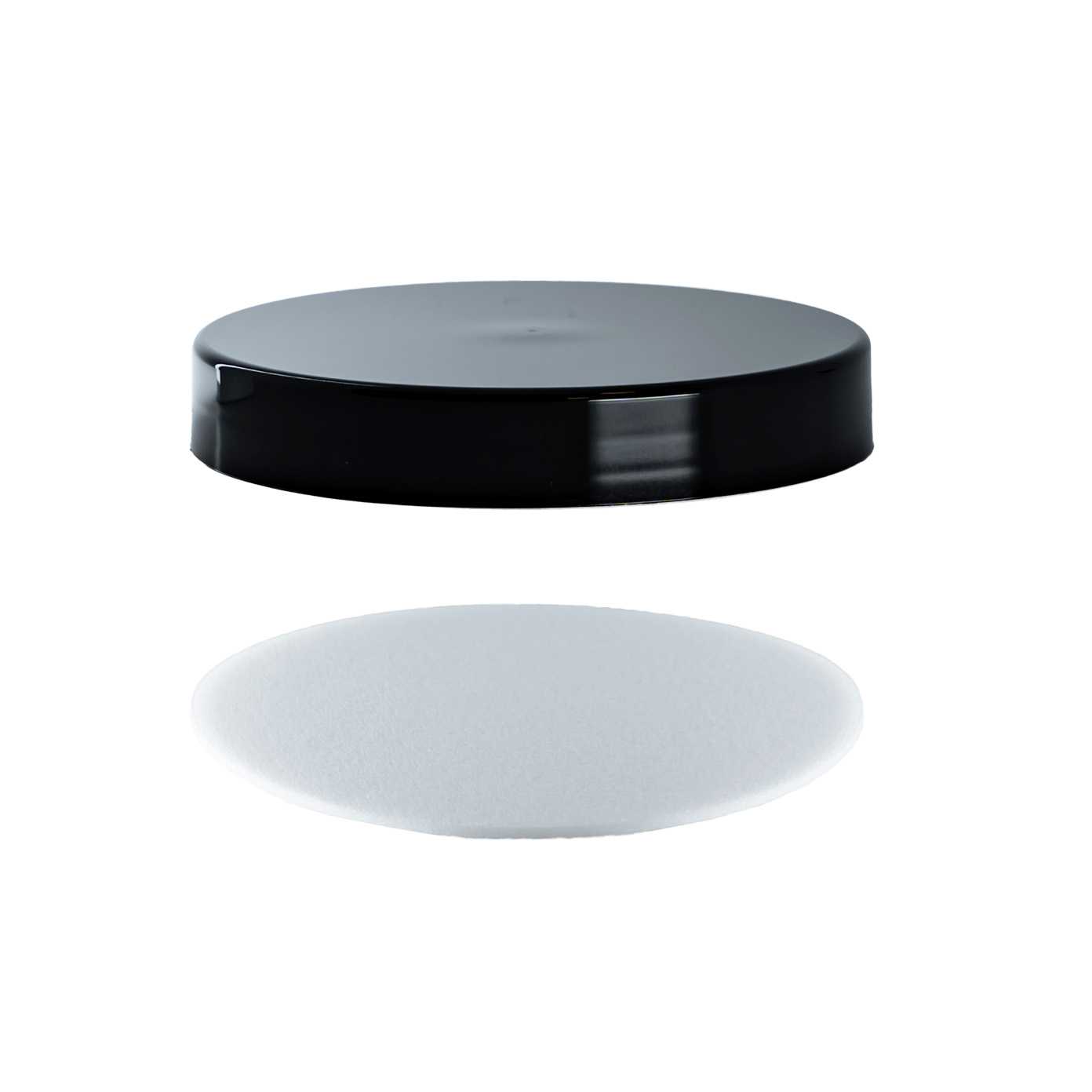
Plastic cap for jar 70/400, black with induction liner
A plastic lid for 70/400 jars with an induction seal liner closes wide jars and containers so that, once sealed, the contents stay under a tightly welded foil . full description
Lowest price in the last 30 days: €0.54
Total for 1 pcs: €0.54
Product description
A plastic lid for 70/400 jars with an induction seal liner closes wide jars and containers so that, once sealed, the contents stay under a tightly welded foil. Cream, butter or scrub will not leak or get into the thread during transport, and the customer sees an intact foil when opening it for the first time. The black lid with a 70/400 thread fits jars with the same neck type, which are filled with body creams, masks, salt and sugar scrubs, balms and food.
How the induction seal liner works
The lid contains a one-piece multilayer liner made of PET, aluminium and polyethylene. The side that is welded is silvery, and the outer side facing the lid is white. The filled jar is closed with the lid and passed through an induction sealer. Its electromagnetic field heats the aluminium layer, and the sealing layer bonds to the rim of the neck. This creates a tight seal around the whole circumference, which tears off when the jar is opened for the first time.
The liner is designed for sealing to PET jars. For jars made of other materials, we recommend first testing the tightness of the seal on several pieces.
Use during filling
The lid is screwed onto the filled jar with normal force so that the liner sits against the rim of the neck over its whole surface. The closed jar then passes under the sealing head. The power, cycle length and head position are set individually according to the sealer model, the batch of packaging and the specific combination of jar and lid. One setting does not apply to all lines.
Before a larger run, seal test pieces from the same batch of jars and lids on your own equipment. Check that the foil peels off evenly around the whole circumference and that there is no leaking spot underneath it.
It is advisable to keep the lids and jars in the workplace for 24–48 hours before filling so that the material adjusts to room temperature.
The most common reasons for a poor seal are a dirty or deformed neck rim, too low sealer power, a short cycle, a loosely tightened lid or a badly positioned sealing head. The neck of the jar should be dry and free of product residues before closing.
What it is suitable for
- Creams and body butters – the contents stay protected under the foil against leaking and contamination until the customer opens it for the first time.
- Scrubs and masks – thicker fillings with salt, sugar or clay do not get into the thread of the lid during transport.
- Food – both the lid and the liner are approved for direct contact with food, whether dry, moist or fatty. It is suitable, for example, for nut butters, honey, spices or dried blends. The person who fills the packaging is responsible for ensuring that the finished packed product complies with the migration limits for food.
- Products for sale – an intact foil shows the customer that nobody has opened the packaging yet.
The lid is also suitable for contact with cosmetic products. The declaration of conformity is available with the product.
Good to know
The lid can also be used without an induction sealer. In that case the foil is not welded to the neck, and the jar is closed only by the thread and the liner sitting against it. The tightness of such a closure must be verified for the specific filling, just as with an ordinary lid.
The liner is one-piece and is welded to the neck in full, so nothing remains in the lid after the foil is torn off. The jar can then be closed with it as usual. Before first use, check that the liner is not bent or deformed, and clean the neck of the jar and let it dry.
You will find jars with a 70/400 neck and ready-made jar and lid combinations in the Handymade range. For your own combination, we recommend verifying the tightness of the seal and the behaviour of the packaging with your specific formulation.
Frequently asked questions
Parameters
- Product colour
- Black
- Country of origin
- European Union
- Diameter
- 71,9 mm
- Thread type
- 70/400
- Height
- 11,9 mm
- Closure type
- Screw cap
Product documentation
Verified by customers.
No reviews yet.
Only customers with a delivered order can write reviews.