Your first candle rarely turns out right. The wax pulls away from the glass, the flame is either as thin as a pin or the wick above it branches out into a black mushroom, and the fragrance you could smell so nicely from the bottle almost disappears in the burning candle. And yet you chose the wick carefully according to the diameter of the vessel.
The problem is often not the wick. It is that the wick and the wax form a single system, and each type of wax asks something different of it. Soy wax melts differently from paraffin, beeswax is thicker when molten than either of them, and palm wax crystallises as it cools. All of this changes how much molten wax the wick can draw up to the flame and how much fragrance composition is released into the room in the process.
In this article, we look at how individual waxes behave when burning, what they do to fragrance and why the same wick burns differently in different waxes. We are following on from the article on choosing a wick [DOPLNIŤ: odkaz na publikovaný článok o výbere knôtu], this time from the other side – the wax.
Why this matters to anyone who pours candles at home
A beginner usually tries one wax, one type of wick and one vessel. When something is not right, they change the wick. That is logical, but it leads to endless trial and error, because the other half of the equation – the wax – goes unnoticed.
A small maker who is already selling has a different problem. They change their wax supplier or move from candles in vessels to pillar candles, and suddenly nothing they had tested works any more. The same applies here: when the wax changes, the wick must be tested again. Understanding why will save you a series of failed tests.
What candle wax is and what we expect from it
In a candle, wax is the fuel. It does not burn directly: the heat of the flame melts it, the wick draws up the liquid wax by capillary action, and only in the flame does the wax vaporise and burn. This gives rise to three properties that determine how a candle behaves:
- Melting point
the temperature at which the wax turns liquid and how quickly the melt pool forms.
- Viscosity of the molten wax
how easily the liquid wax travels up the wick.
- Structure once set
whether the wax is smooth, crystalline, flexible or hard.
Important: The waxes we offer as candle waxes (soy, coconut, rapeseed and palm wax, paraffin, gel wax, stearin) are intended exclusively for candle making, not for cosmetics. The only exception is beeswax, which also has cosmetic uses.
Soy wax burns slowly and is more forgiving than others
Soy wax has become the go-to wax for candles in vessels. It generally has a lower melting point than paraffin, so the melt pool forms more quickly and the candle burns more slowly and at a lower temperature. This is good news for the wick: the flame does not have to be large to melt the wax all the way to the wall of the vessel.
There is, however, another side to this. Molten soy wax is thicker than molten paraffin, so the same wick draws less fuel up to the flame in soy. In practice, this means that soy wax needs a slightly larger wick than paraffin in the same vessel. If you choose a wick from a chart intended for paraffin, the candle in soy will burn weakly and tunnelling will occur.
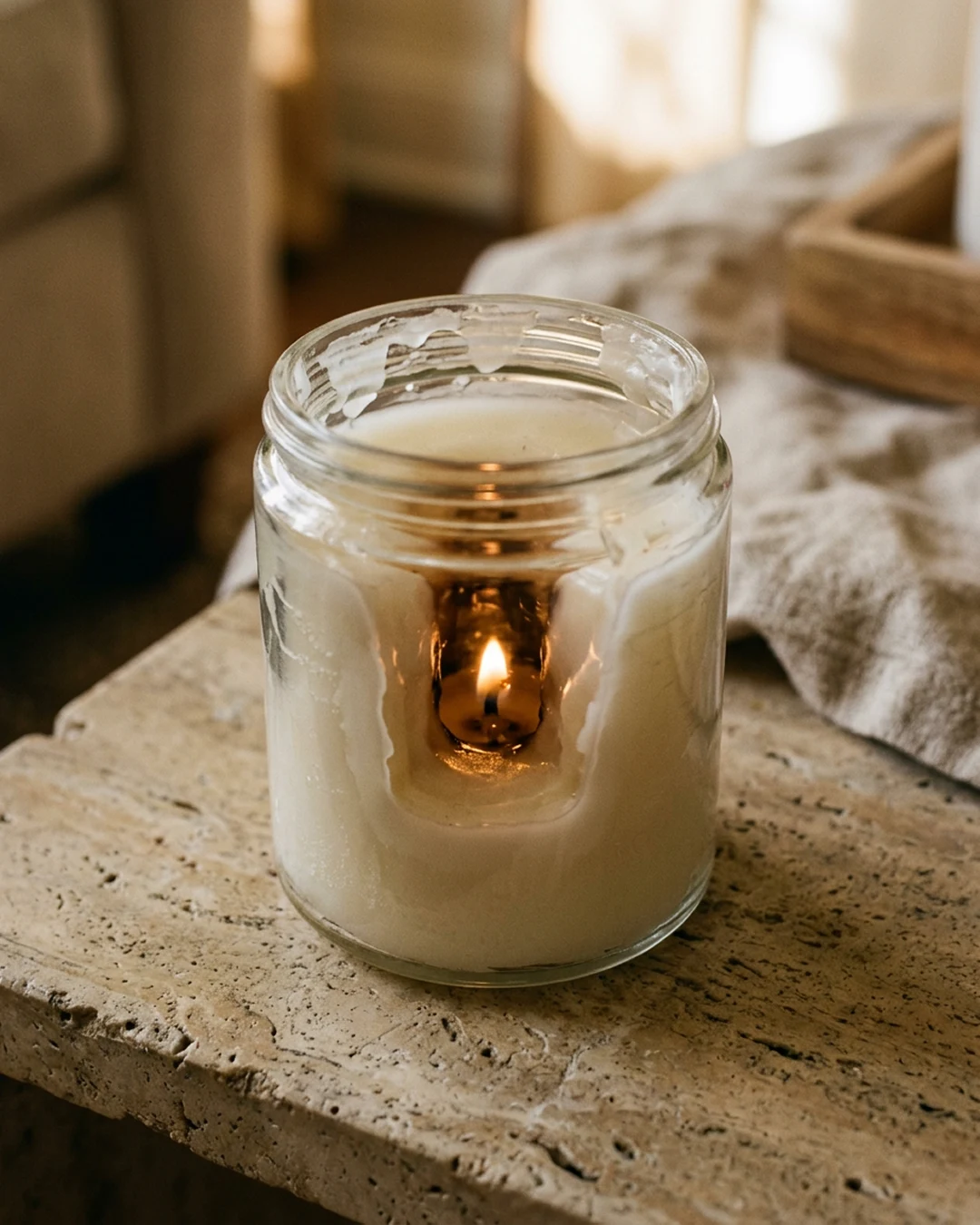
Soy also has cosmetic flaws that do not affect burning: a white bloom on the surface (crystallisation, commonly known as frosting) and wet spots where the wax has pulled away from the glass. Both are related to the cooling rate and pouring temperature, not to the wick. For candles in vessels, we offer for example [PRODUKT: sójový vosk KeraSoy container 4130] and [PRODUKT: sójový vosk NatureWax C-3], and for pillar candles [PRODUKT: sójový vosk KeraSoy pillar 4120] or [PRODUKT: sójový vosk EcoSoya pillar blend]. The pouring temperature and recommended proportion of fragrance composition are given in the manufacturer’s technical data sheet [DOPLNIŤ: hodnoty z TDS jednotlivých sójových voskov].
Paraffin gives the strongest fragrance but needs a precise wick
Paraffin is a petroleum-based wax, and for the candle maker it has one big advantage: a good hot throw. The molten wax is thin, the wick draws it up easily and the flame has plenty of fuel. This is why paraffin has long been used as the benchmark against which other waxes and wick charts are judged.
A thin melt, however, means that a mistake in wick size shows up quickly. A wick that is too large gives a big, smoking flame in paraffin and an overheated melt pool, which is dangerous next to glass. With paraffin, it is therefore worth starting with a smaller wick and gradually working upwards until the melt pool reaches the wall of the vessel within a reasonable time.
Beeswax burns hot and long
Of all the common waxes, beeswax generally has the highest melting point and a thick melt. A beeswax candle burns longer and the flame is hotter, which is why beeswax needs a considerably larger wick than soy at the same diameter. An undersized wick in beeswax is the most common reason why such a candle extinguishes itself after a while.
Beeswax has its own delicate honey scent, which blends with the added fragrance composition, and you need to take this into account when designing the fragrance. We stock it in two versions: [PRODUKT: žltý granulovaný včelí vosk] with its natural tint and scent, and [PRODUKT: biely včelí vosk], which is more neutral in both colour and scent.
Palm and pillar wax: hardness that holds its shape
For candles without a vessel, you need a wax that, once set, holds its own shape and does not soften at room temperature. This is why pillar versions of soy waxes exist, and why palm wax is used – as it cools, it forms a distinctive crystalline pattern on the surface.
In a pillar candle, the wick has one additional task. The melt pool must not reach the edge, otherwise the wax will run out, so the wick has to be matched so that the centre melts and a thin wall remains. We offer palm wax in two variants, [PRODUKT: palmový vosk BW C07] and [PRODUKT: palmový vosk BW C09] [DOPLNIŤ: rozdiel medzi C07 a C09 z TDS, napr. určenie na nádoby vs. piliere].
How wax changes a candle’s fragrance
A candle’s fragrance takes two forms. Cold throw is what you smell from the set candle in the shop. Hot throw is what is released when it burns. Wax affects both.
When burning, a simple mechanism applies: the larger and hotter the melt pool, the more fragrance composition evaporates from it. A wax with a thick melt and an undersized wick give a small melt pool and a fragrance you can barely smell in the room. The solution is not to add more fragrance composition. Exceeding the proportion the wax can hold causes the fragrance to seep out onto the surface, clogs the wick and makes the flame smoke.
Tip from our world of raw materials: The maximum proportion of fragrance composition is given by the manufacturer in the technical data sheet [DOPLNIŤ: max. podiel vonnej kompozície z TDS pre jednotlivé vosky], and it is worth treating it as a ceiling, not a target.
When you add the fragrance also matters. Wax that is too hot evaporates some of the volatile components before pouring, while wax that is too cool will not mix it in evenly. Manufacturers therefore state the temperature for adding fragrance composition [DOPLNIŤ: teplota pridania vonnej kompozície z TDS]. With fragrance compositions, also check their flash point, which you will find in the safety data sheet.
Wax melts for wax melt burners, where nothing is burned with a wick and the wax is only warmed, call for a different type of wax, for example [PRODUKT: sójový vosk EcoSoya melt]. Here the wick plays no part; all that matters is the melting point and the wax’s ability to hold fragrance.
For advanced makers: wax blends
Paraffin is commonly blended with other waxes, particularly soy or coconut wax, so that the blend combines the good fragrance release of paraffin with the slower burn of a vegetable wax. The ratio of the components changes both the melting point and the viscosity of the melt, and therefore how much fuel the wick draws up. Each such blend therefore behaves like a new wax: the wick, the temperature for adding fragrance and its proportion all need to be set from scratch and verified by a test burn, just as with your first candle.
In practice: how to choose your wax and wick
The tried-and-tested approach has several steps and always ends with a test burn.
- Type of candle and wax
Decide whether you are making a candle in a vessel, a pillar candle or a wax melt, and choose the type of wax accordingly (container, pillar, melt).
- Data from the technical data sheet
From the wax’s technical data sheet, note down the pouring temperature, the temperature for adding fragrance composition and the maximum fragrance load [DOPLNIŤ: hodnoty z TDS].
- Choosing the wick
Choose the wick according to the diameter of the vessel and the type of wax. For soy wax and beeswax, start with a wick one size larger than you would choose for paraffin in the same vessel. With paraffin, start smaller and increase gradually.
- Test burn
Pour a test candle, let it cure completely and light it for several hours. Watch whether the melt pool reaches the wall, whether the flame smokes and whether a carbon mushroom forms on the wick.
- Repeating the test after any change
If the wax, the vessel or the fragrance load changes, repeat the test. A tested combination applies only to that one set-up.
This is exactly why a [PRODUKT: testovacia sada knôtov] makes sense: it contains several sizes and types, from cotton to wooden. It lets you find the right wick for your wax without buying full packs. Wooden wicks behave differently from cotton ones and burn with a wider, flat flame; the manufacturer Makesy recommends the width of the wooden wick according to the type of wax [DOPLNIŤ: odporúčania výrobcu Makesy k výberu šírky dreveného knôtu podľa vosku] [ZDROJ: podklady výrobcu Makesy].
What to combine it with
If you are just starting out, you will make the fewest mistakes with soy wax for vessels and a cotton or wooden wick from a test kit. Choose your fragrance composition from our range of candle fragrance oils and stick to the proportion given in the wax’s technical data sheet. If you want a longer burn and a natural character, reach for beeswax and plan for a larger wick. For pillar candles, use pillar soy wax or palm wax, not a wax intended for vessels.
If you want to get started, choose [PRODUKT: sójový vosk na sviečky v nádobe] and a wick test kit to go with it.
Conclusion
You never choose a wick on its own; you choose it for a specific wax in a specific vessel. Soy asks for a little more wick and patience, paraffin for precision, beeswax for strength, and pillar waxes for discipline over the size of the melt pool. Once you understand how your wax melts and how thick its melt is, you stop guessing and start testing with purpose. Start with one wax, one vessel and a wick test kit. Your first successful candle is then a matter of two or three test burns.
Frequently asked questions
Which candle wax is easiest for a beginner?
The easiest wax for a beginner is soy wax intended for vessels. It has a lower melting point, burns more slowly, and small mistakes in wick choice show up less than with paraffin. Just bear in mind that its melt is thicker, so the wick usually needs to be one size larger than you would choose for paraffin in the same vessel.
Why does my soy candle smell when cold but not when burning?
Most often, the melt pool is too small. An undersized wick in thick soy wax melts only a narrow centre, little fragrance composition evaporates and the fragrance cannot be smelled in the room. Try a larger wick and check whether you added the fragrance at the temperature recommended by the wax manufacturer in the technical data sheet.
Can I use the same wick for soy wax and beeswax?
Generally not – beeswax needs a considerably larger wick. It has a higher melting point and a thick melt, so a wick that burns correctly in soy wax at the same diameter will often extinguish itself in beeswax. Every combination of wax and wick needs to be verified by a test burn.
Can paraffin be blended with soy wax?
Yes, blends of paraffin with soy or coconut wax are common. The aim is to combine the good fragrance release of paraffin with the slower burn of a vegetable wax. However, each blend behaves like a new wax, so you need to set the wick and the proportion of fragrance composition again and test the candle again.
Why is my soy wax white and patchy on the surface?
The white bloom is crystallisation of the soy wax, which is related to the cooling rate and pouring temperature, not to the wick or the quality of the burn. Pouring at the temperature recommended by the manufacturer, a pre-warmed vessel and slow cooling away from draughts all help. This bloom has no effect on the candle’s fragrance or burning.
How much fragrance composition can I add to candle wax?
No more than the maximum stated in the technical data sheet for the specific wax. Exceeding it causes the fragrance to seep onto the surface, clogs the wick and makes the flame smoke. A higher proportion will not fix a weak hot throw; the right wick and a sufficiently large melt pool will.
Sources:
- Manufacturer’s technical data sheet, KeraSoy container 4130 soy wax [DOPLNIŤ: výrobca, verzia a dátum TDS].
- Manufacturer’s technical data sheet, KeraSoy pillar 4120 soy wax [DOPLNIŤ: výrobca, verzia a dátum TDS].
- Manufacturer’s technical data sheet, NatureWax C-3 soy wax [DOPLNIŤ: výrobca, verzia a dátum TDS].
- Manufacturer’s technical data sheet, EcoSoya pillar blend and EcoSoya melt [DOPLNIŤ: výrobca, verzia a dátum TDS].
- Manufacturer’s technical data sheet, BW C07 and BW C09 palm wax [DOPLNIŤ: výrobca, verzia a dátum TDS].
- Guidance from the wooden wick manufacturer Makesy on choosing wick width according to wax type [DOPLNIŤ: názov dokumentu a dátum].
You will find soy wax, beeswax and palm wax, as well as a wick test kit, in our candle making range.