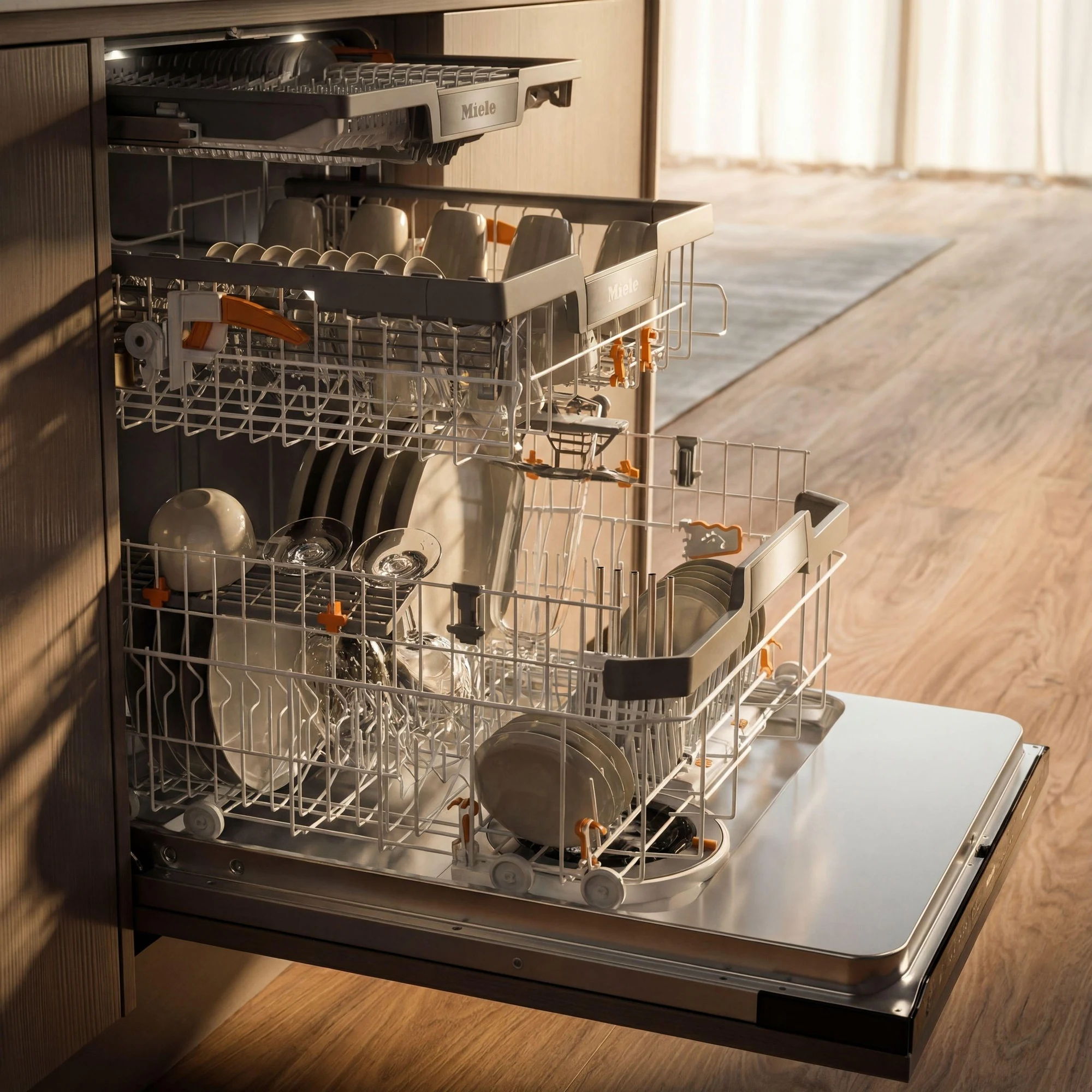
A dishwasher is one of the hardest-working helpers in the home. It runs almost every day, for years, often without any maintenance at all. And then it happens: glasses with a white film, dull dishes, a strange smell when you open the door. At that point, most people reach for a different detergent. However, the cause may not lie in the detergent alone.
In this article, we go through the whole dishwashing system: what the detergent does, what the salt is for, why rinse aid is not an unnecessary extra and how to care for your dishwasher so that your dishes come out clean and shiny.
A dishwasher is not just about the detergent
A good result stands on three legs.
- Detergent
dissolves grease and food residues.
- Salt
takes care of soft water – not by softening it itself, but by keeping the dishwasher’s built-in water softener working, which removes calcium and magnesium from the water.
- Rinse aid
lowers the surface tension of the water during rinsing, so the water runs off the dishes more easily and leaves no drops or streaks.
When one leg is missing, the result wobbles. And because each one does something different, one cannot be replaced by adding more of another. More gel will not solve limescale, and more rinse aid will not solve grease.
Water hardness matters more than you think
Tap water contains dissolved minerals, mainly calcium and magnesium. The harder the water, the more mineral deposits can remain on the dishes, on the heating element and in the dishwasher’s pipework during washing. That is why every dishwasher has a built-in water softener: a container of resin that captures minerals from the water. And it is this resin that has to be regularly regenerated with salt.
An important detail that is often forgotten: the water softener needs to be set according to the hardness of your water. Dishwashers are usually factory-set to a medium value, which may not match what comes out of your tap. You can find the water hardness in your area on your water supplier’s website, and the softener settings in your dishwasher manual. Five minutes’ work that makes a difference to every wash that follows.
How to convert water hardness units
Dishwasher manufacturers most often work with German degrees of hardness (°dH), while water suppliers in Slovakia state it in millimoles per litre. The conversion is simple: 1 mmol/l corresponds to 5.6 °dH. If your manual uses French degrees, 1 mmol/l is 10 °fH.
The division into soft, medium and hard water is based on the German Detergents and Cleaning Agents Act, which many detergent and dishwasher manufacturers work with. You will find the exact softener setting for your dishwasher in its manual.
Dull dishes and white film: what they are telling you
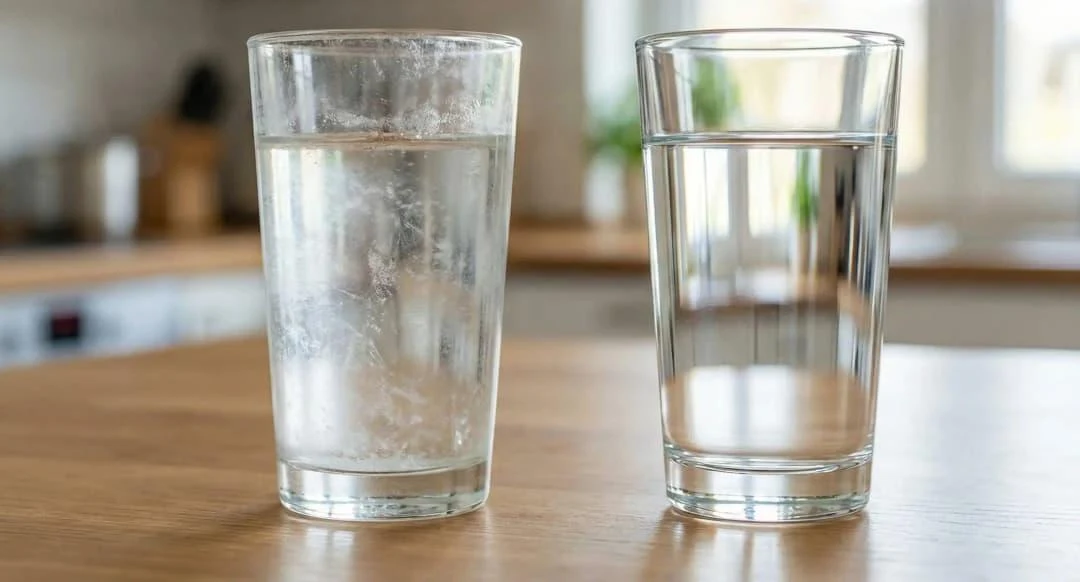
A white film on glasses that can be wiped off or dissolved with a weak acid is most often caused by mineral deposits from hard water. It may signal that the water softener has run out of salt or is set to too low a water hardness. Drip marks and streaks that appear after drying point more to missing or underdosed rinse aid.
Caution – glass corrosion: Watch out, however, for permanent clouding of glass. If the film does not come off even after contact with a weak acid, it may be glass corrosion, which is irreversible. It can occur with water that is too soft in combination with aggressive chemicals, high temperatures or incorrect detergent dosing. This is another reason why the correct softener setting and a sensible detergent formulation matter so much.
Filter, spray arms and seals: when your dishwasher smells
- The filter at the bottom of the dishwasher
It catches food residues. When it becomes clogged, the water circulates less well, the dishes are poorly washed and a smell appears. Remove it, rinse it under running water, brush off any trapped dirt and put it back: once every week or two, depending on how often you run the dishwasher.
- Spray arms
They have tiny nozzles that occasionally get blocked by a grain of rice or a seed. If a nozzle is not spraying, part of the rack stays poorly washed. Carefully clean the nozzle with a thin non-metallic tool or follow the procedure in your dishwasher manual.
- Door seals
Simply wipe them with a damp cloth from time to time. They are exactly where a greasy film likes to cling, and over time it starts to smell.
- Hot empty cycle
Once a month, treat your dishwasher to a hot empty cycle with a product designed for cleaning it. It dissolves grease and mineral deposits in places a cloth cannot reach.
A tip from our world of raw materials: Citric acid can help with mineral deposits and limescale. However, use it only occasionally, in a reasonable amount and always with regard to the dishwasher manufacturer’s recommendations. For greasy deposits, a specialised cleaner that also contains alkaline and degreasing ingredients is more suitable.
Small habits, big difference
Scrape off large food residues before loading, but there is no need to rinse the dishes clean. Modern detergents and programmes are designed for normally soiled dishes.
Many detergents contain proteases and amylases, enzymes that help break down protein and starch residues. Many dishwashers also measure how cloudy the water is after the first rinse and adjust the length and temperature of the programme accordingly. The sensor may judge thoroughly rinsed dishes as less soiled, even though a greasy film you cannot see remains on them. We explain how the enzymes in the gel work in the article what dishwasher gel contains.
Load the dishes so that the items do not overlap and the water can reach everywhere. Turn deep bowls and mugs at an angle facing downwards, otherwise a puddle will remain in them after the programme ends. And check that nothing is stopping the spray arms from rotating: a single tall pan in the upper rack can ruin the whole cycle.
Every now and then, look at the salt and rinse aid indicators. They are there precisely so that you do not have to remember to top up, but they are easy to overlook. If your dishwasher does not have them, white marks or drip patterns may be the first sign that you need to check the salt, the water hardness setting or the rinse aid dose setting.
With rinse aid, it helps to look at the dishes after they have dried. Drip spots suggest there is too little rinse aid, and it is worth increasing the dose setting by one level. Streaks, a sticky film or an iridescent sheen on glass, on the other hand, are usually a sign of too high a dose.
After the cycle ends, leave the door slightly open. Moisture and warmth are exactly what odours and mould thrive on. And if you mostly use low-temperature eco programmes, add a higher-temperature programme from time to time. Low temperatures save energy, but they are less effective at dissolving grease inside the machine.
What is better kept out of the dishwasher
Not everything that fits in the rack survives the dishwasher intact.
- Wood
swells, cracks and loses its finish in hot water and steam.
- Cast iron pans
can lose their seasoning, which gives them their natural non-stick properties.
- Aluminium tins and pots
can darken, because alkaline chemicals act aggressively on their surface.
Take care with silver and stainless steel too. If they touch in the rack, silver can tarnish faster. Knives with glued handles and glasses with painted decoration also deserve hand washing: both the glue and the decoration withstand repeated hot cycles worse than you would expect.
Conclusion
What matters is a correctly set water softener, topped-up salt and rinse aid, a clean filter and a well-chosen detergent. When the whole system works together, the dishwasher cleans better, and deposits and odours build up more slowly.
We have designed our gel, salt and rinse aid to fit into this system, and for each of them you know the full composition. Choose a fragrance-free set or one with a delicate citrus fragrance in the rinse aid.

Frequently asked questions
Do I need to use salt if I use all-in-one tablets?
With very soft water and correct dishwasher settings, combination tablets may be sufficient in some cases. With medium-hard and hard water, however, separate regeneration salt helps keep the water softener working properly.
Why are there white spots on my glasses?
Most often, they are mineral deposits from hard water, an incorrectly set water softener or a lack of salt. If they look more like dried drops and streaks, check the rinse aid dose setting.
Why are my dishes wet after washing?
The cause may be too low a rinse aid dose setting, poor loading or the programme used. Plastic dishes also naturally dry less well than glass, ceramics or metal.
Do I need to rinse dishes before loading them?
No. It is enough to remove large food residues. Pre-rinsing under running water needlessly increases water consumption and, in many modern dishwashers, can also affect the choice of programme.
How often should I clean my dishwasher?
Check the filter roughly once every one to two weeks, depending on how often you use the dishwasher. It is a good idea to check the seals, spray arms and interior parts at least once a month.
Why does my dishwasher smell?
Most often because of a clogged filter, a greasy film on the seals or moisture left in a closed dishwasher. It helps to clean the filter, wipe the seals, leave the door slightly open after washing and run a higher-temperature programme from time to time.
How do I find out the water hardness for my dishwasher?
Your water supplier states the water hardness in your area on its website, usually in mmol/l. Dishwashers most often work with German degrees: 1 mmol/l corresponds to 5.6 °dH. You then set the softener level according to your dishwasher manual.
You will find dishwasher gel, regeneration salt and rinse aid with their full composition in our e-shop.