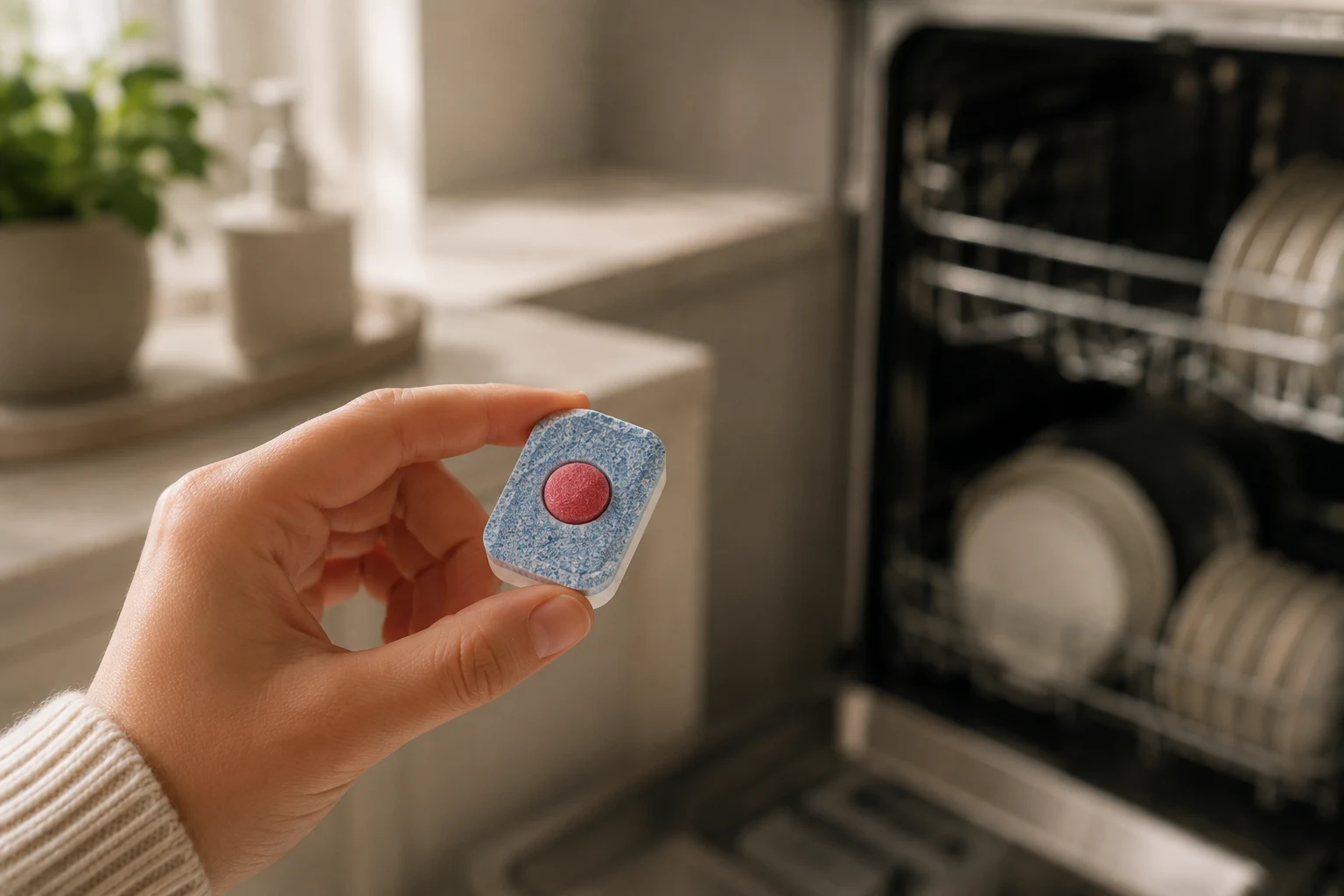
Tablets have won the battle for convenience. One cube, one movement, done. That is exactly why most households use them today, and few people ask whether they are also the best choice for their dishes, their dishwasher and their wallet.
We asked ourselves that question while developing our range, and the answer led us to gel. Not out of habit, and not because tablets are bad. It is because gel gives you back something you handed over to the manufacturer with a tablet: control.
One tablet, a thousand households
A tablet is always the same. The same dose for soft water in the Tatras and hard water in the south, for a half-empty dishwasher and a full one after a family celebration, for two breakfast plates and a roasting tin used for meat.
Yet the reality in your kitchen changes every day. With a half load, a tablet delivers twice the chemicals it needs. Heavily soiled dishes, on the other hand, leave you no way of adding more. You dose gel according to what is actually there: less with soft water and light soiling, more with a full dishwasher and dried-on residue. Fewer chemicals going down the drain, a pack that lasts longer and a result you can influence.
Dosing tip: You do not need to look for a measure, as you already have one in your dishwasher. The detergent compartment is a measuring cup in itself: for normally soiled dishes about 15 ml is enough; for dried-on residue, a full dishwasher or hard water, fill it completely, which is approximately 25 ml.
Short programmes and undissolved tablets
A tablet is a compressed concentrate that needs time to dissolve. In short and cold programmes it may not dissolve completely, so part of the detergent flows down the drain unused or remains at the bottom of the dishwasher.
Gel dissolves quickly in water, even cold water. For modern eco programmes that run at low temperatures, it is the more natural form: the detergent works from the very first minute of the cycle.
The “all-in-one” promise and your water softener
All-in-one tablets promise that you no longer need salt or rinse aid. However, the salt and rinse aid functions in a tablet only work during the wash.
Important: They do not regenerate the water softener built into the dishwasher, which protects both the machine and your dishes from limescale: for that, it needs real salt in its own reservoir.
With harder water, limescale therefore keeps building up – you just do not see it straight away. The gel + salt + rinse aid system is not a step backwards; it divides the tasks exactly as the dishwasher was designed to handle them.
A dissolvable wrapper is not a vanished wrapper
Capsules and some tablets are held together by a film of polyvinyl alcohol (PVA), a synthetic polymer that dissolves in water. It sounds clean. But dissolving is not the same as degrading. A 2021 American study modelled what happens to PVA from laundry and dishwasher capsules in wastewater treatment plants. According to its estimate, approximately three quarters of the PVA reaches the environment undegraded: roughly 61% via sewage sludge and a further 16% or so with the treated water.
How quickly PVA degrades in nature depends on the environment and on whether it contains microorganisms adapted to PVA. In a laboratory test with seawater, PVA-based materials degraded by only 5 to 8% over 28 days. Capsule manufacturers and the experts they have consulted criticise the American study and consider PVA biodegradable. Until science reaches a consensus, one thing is certain: every capsule adds another dose of a synthetic polymer to the water that was not there before.
We do not want to contribute to this experiment. Our gel comes in an ordinary bottle: you can see it, you can sort it for recycling, and none of it pretends to have disappeared.
When a tablet makes sense
The honest answer: there are situations where a tablet is fine. If you run the dishwasher rarely, have soft water and convenience comes first for you, a tablet will do its job. We will not tell you otherwise – not pushing our products on anyone is one of our principles, just like transparent ingredients.
But if you want to dose according to the reality of your household, make full use of eco programmes and know exactly what you are releasing into the water, gel is the more honest form. And that is exactly what we have made.
How we do it
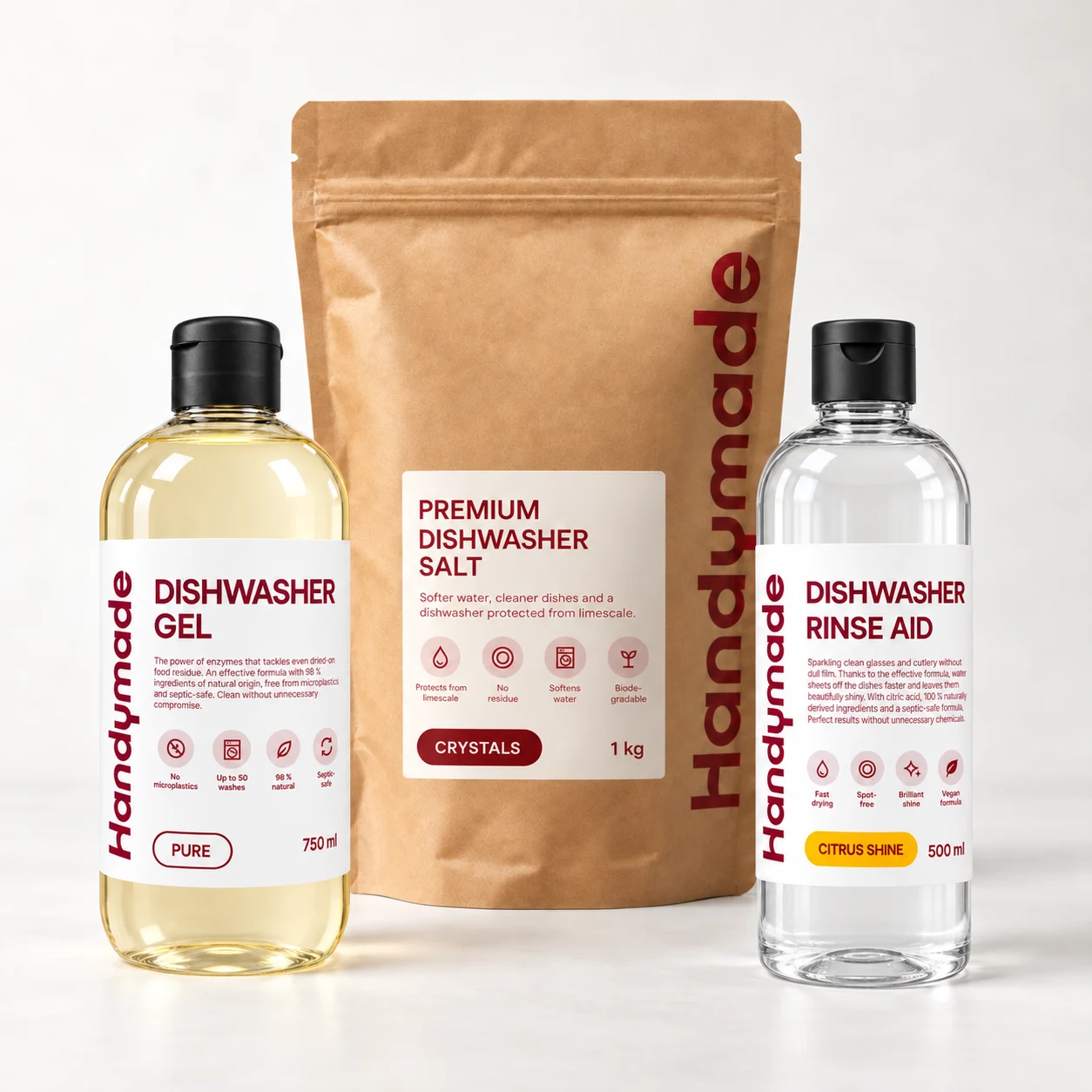
Our dishwasher system is built on three products: a gel with enzymes, regeneration salt for the water softener and rinse aid for dry, streak-free dishes. Each one does its own job, and each one has a complete list of ingredients on the packaging.
If you would rather not put the system together one product at a time, we have combined all three into the Pure set. And if you prefer a gentle citrus fragrance, the same set is also available in a Citrus Shine version.
Pure set – gel, salt and rinse aid — Gel with enzymes, regeneration salt and rinse aid in one set.
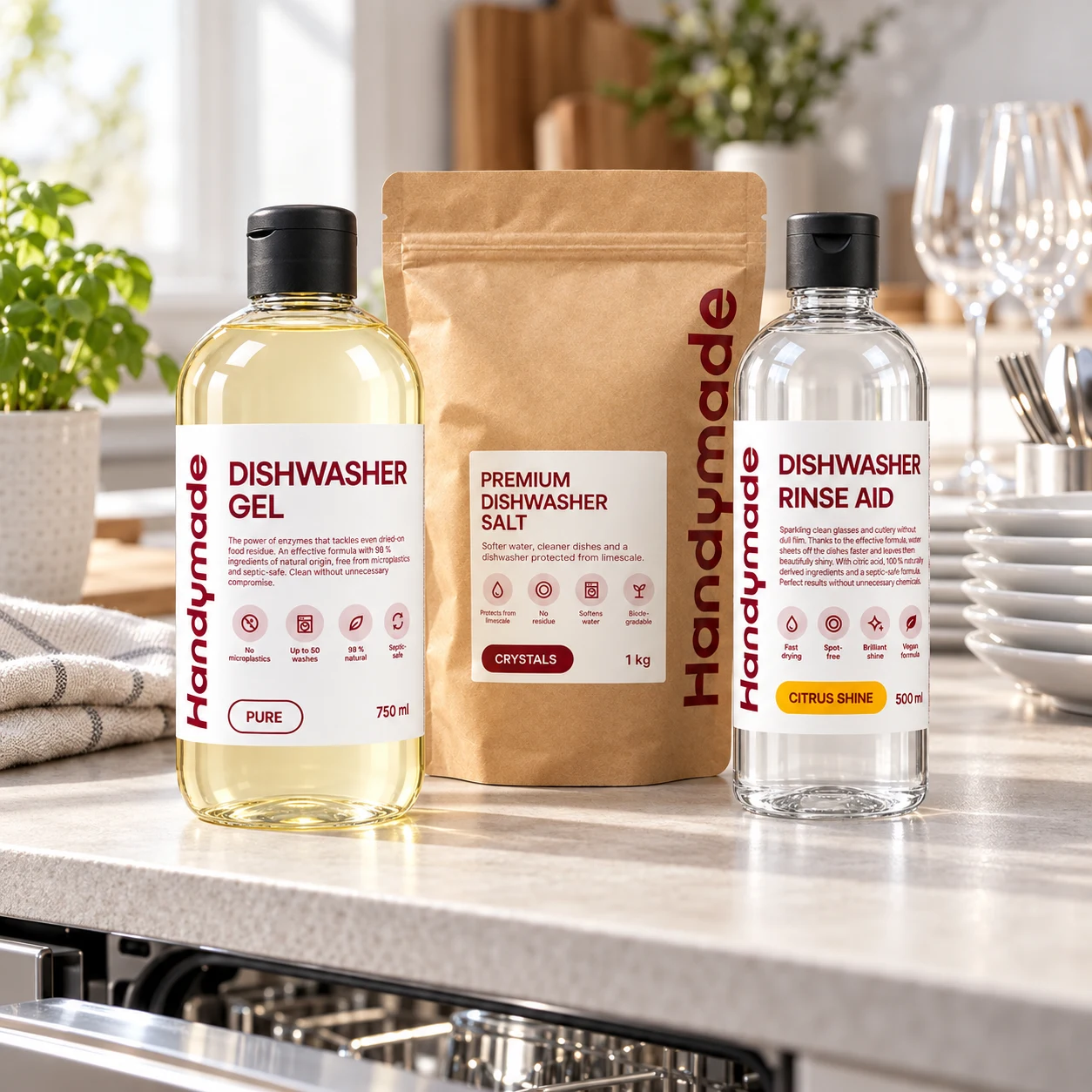
Citrus Shine set – gel, salt and rinse aid — The same set in a version with a gentle citrus fragrance.
Conclusion
A tablet gives you convenience, a gel gives you control. We have chosen control: over the dose, over the ingredients and over what flows from your kitchen into the water. You can now take a look at our gel, salt and rinse aid and choose for yourself. And whatever you decide, after reading this article it will be a decision, not a habit.
Frequently asked questions
Are dishwasher tablets bad?
They are not bad; they are a compromise in favour of convenience. Their weaknesses are a fixed dose regardless of water hardness, load size and soiling, slower dissolving in short programmes and, in the case of capsules, a wrapper made of a dissolvable polymer. If these compromises do not bother you, a tablet will do its job.
What is the PVA film on capsules?
Polyvinyl alcohol is a water-soluble synthetic polymer that holds the capsule together. It does not disappear when it dissolves: according to a 2021 American model, approximately three quarters of this polymer reaches the environment from treatment plants undegraded, and it degrades only slowly in seawater. Capsule manufacturers dispute these conclusions. For our products, we have chosen a conventional bottle that you can see and sort for recycling.
Does your gel contain microplastics?
No. The gel is a liquid formulation without synthetic microparticles and without a dissolvable polymer wrapper. The thickener hydroxyethylcellulose is fully dissolved in water; it is not a particle. You will find the complete list of ingredients, with an explanation of each one, on the product page.
Why does a tablet sometimes not dissolve completely?
Most often because of a short or cold programme, an overloaded basket blocking the detergent compartment door, or a tablet that has hardened due to moisture. Gel does not have these problems; it dissolves quickly in water, even cold water.
Do I need to use salt and rinse aid with the gel?
Yes, that is precisely where the strength of the system lies. Salt regenerates the dishwasher’s water softener and protects it from limescale, rinse aid ensures streak-free drying and the gel takes care of clean dishes. The gel deliberately does not promise to be all-in-one: each function works where it should, in the dose you set yourself.
Does gel save money?
Above all, it saves unnecessary consumption. With soft water and normal soiling you use less, so the pack lasts longer. With a tablet you use a full dose every wash, regardless of whether the dishes needed it.
How much gel should I put in the dishwasher instead of a tablet?
For normally soiled dishes, about 15 ml. For a full dishwasher, dried-on residue or hard water, a full detergent compartment, which is approximately 25 ml. With soft water and a half-empty dishwasher, less is enough.
You will find the gel, regeneration salt and rinse aid in our e-shop in the Pure set or in the Citrus Shine version.