Dishes from the dishwasher are the only surface in the home that we eat from directly. Even so, we usually know the least about the product that washes them. The packaging of an ordinary gel lists only categories: “5–15% oxygen-based bleaching agents, less than 5% non-ionic surfactants”. The label does not tell you what exactly lies behind those percentages.
We do it differently. When we entered the world of cleaning products, we made a promise: we would introduce every product to you ingredient by ingredient. We are starting with dishwasher gel, the first product in our dishwasher system. We will go through the formulation item by item and, for each ingredient, tell you what it does and why we chose it.
How the gel actually cleans your dishes
Washing in a dishwasher is the interplay of four processes.
- An alkaline environment
loosens grease and prepares the soil for removal.
- Surfactants
lower the surface tension of water so that it reaches everywhere and carries the grease away.
- Enzymes
break proteins and starches down into tiny, water-soluble fragments.
- Mineral-binding agents
make sure that hard water does not sabotage the whole process.
Every ingredient in the formulation belongs to one of these tasks. None of them is superfluous.
Dishwasher gel composition: ingredient by ingredient
Demineralised water is the carrier for the whole formulation. It is stripped of minerals so that it does not bring into the wash exactly the hardness the gel is fighting against.
Sugar-based surfactant
The sugar-based surfactant is the heart of the cleaning. It is made from plant raw materials, it is gentle and it is biodegradable. In cosmetics you will find it in mild shampoos and shower gels; in our product it washes dishes. With raw materials, we care about more than a name on a list – we also pay attention to their origin and quality.
Sugar-based surfactants are a group with the technical name alkyl polyglucosides, APG for short. They are made by combining two plant raw materials: a sugar component from starch and a fatty alcohol from vegetable oils. The molecule therefore has one end that loves water and another that grabs onto grease. And that is exactly what makes it a surfactant.
A tip from our world of raw materials: Sugar-based surfactants are non-ionic, meaning they carry no charge in solution, and they tolerate both hard water and alkaline conditions well. They break down quickly and completely, which cannot be said of every surfactant.
Our gel contains one of them: caprylyl/capryl glucoside, with a short carbon chain. It wets well, foams little and stays dissolved in a gel with a high salt content, so the gel remains clear. At the normal dose, foam does not persist in the hot water of the dishwasher.
Enzymes
Enzymes are the most modern part of the formulation. Protease breaks down proteins, such as dried-on egg, milk or meat juices. Amylase takes care of starches: pasta, potatoes, rice and sauces. Enzymes work even at lower temperatures, which means the gel also performs in eco programmes.
Not all enzymes are the same, however. Enzymes differ in their activity and temperature range, and in how long they remain stable in a liquid formulation. This is precisely what decides the washing result.
Our gel contains a blend of protease and amylase from a leading European enzyme manufacturer, which the manufacturer recommends for laundry gels as well as dishwasher gels. After trial batches, we raised its usage rate to the upper part of the range the manufacturer recommends for dishwashers. Both components work at the same time, cope with the low temperatures of eco programmes and remain stable in the liquid gel.
Ingredients against hard water
Sodium citrate is what is known as a builder. It binds calcium and magnesium from hard water so that they do not interfere with the surfactants or settle on the dishes. In the latest version of the formulation, we increased its proportion because it softens the water without raising the alkalinity of the gel. It is a salt of citric acid, a substance that both the body and nature know intimately.
A new-generation chelating agent (MGDA) provides extra protection against hard water and metal ions. It replaces phosphates, which were used for exactly this purpose in the past and no longer belong in our waters, and it is biodegradable.
Sodium silicate gives the formulation the alkalinity that grease dislikes, while also protecting glass and glaze from corrosion. This helps glasses keep their clear appearance for longer.
Consistency, pH and preservation
Glycerine and hydroxyethylcellulose give the gel its consistency, so that it is easy to dispense and stays where you pour it. Hydroxyethylcellulose is a thickener made from cellulose, which you may know from cosmetics. It dissolves completely in water and, unlike xanthan gum, which we used to thicken the gel in the first versions, it releases air bubbles more easily. The gel is therefore clearer.
Citric acid fine-tunes the pH of the formulation to a mildly alkaline value at which the enzymes in the gel remain stable and the alkalinity still helps with grease.
The preservative protects the water-based product from spoiling. It is there because it has to be, and we use it at the lower end of the range recommended by its manufacturer. We use a combination of phenoxyethanol and ethylhexylglycerin, a pairing proven in cosmetics.
What you will not find in our gel
Whether a dishwasher gel is eco-friendly is not revealed by green packaging, but by what is not in it. In our gel you will not find phosphates, which over-feed algae in waterways. You will not find chlorine bleaches, whose fumes have no place in the kitchen. And you will not find any fragrance: dishes should not smell of cleaner – they should be clean and free of the taste and smell of anything they have been through. If you like a fresh scent when you open the dishwasher, you will find it in the Citrus Shine rinse aid with essential oils.
Ethoxylated surfactants and sulfates. Most ordinary gels clean with non-ionic surfactants produced by ethoxylation, that is, by reacting alcohols with ethylene oxide from petrochemistry. Sulfate surfactants are also common in supermarket products. Our sugar-based surfactant is made by combining glucose with plant-derived fatty alcohols. In the surfactants: no ethoxylation, no sulfates.
Isothiazolinone preservatives. Liquid products are commonly preserved with methylisothiazolinone or benzisothiazolinone, which are among the common contact allergens. As we explain above in the composition, we chose phenoxyethanol with ethylhexylglycerin.
Colorants. A green gel does not clean better than a clear one. Our gel has the colour of its ingredients, not a colour added for the shop shelf.
This is not a marketing “free from everything” list. It is the result of a simple question we asked about every ingredient: do the dishes need it, or only the label?
Dose to suit the actual wash, not a tablet
A tablet is convenient, but it is always the same. A half-full dishwasher gets a full dose of chemicals, and with soft water you use far more than necessary. With gel, you dose to suit the actual wash: for normally soiled dishes, about 15 ml is enough; for a full dishwasher, dried-on residues or hard water, approximately 25 ml, which is usually a full detergent compartment. Fewer chemicals down the drain, a pack that lasts longer and a result you can influence.
The gel is only part of the result
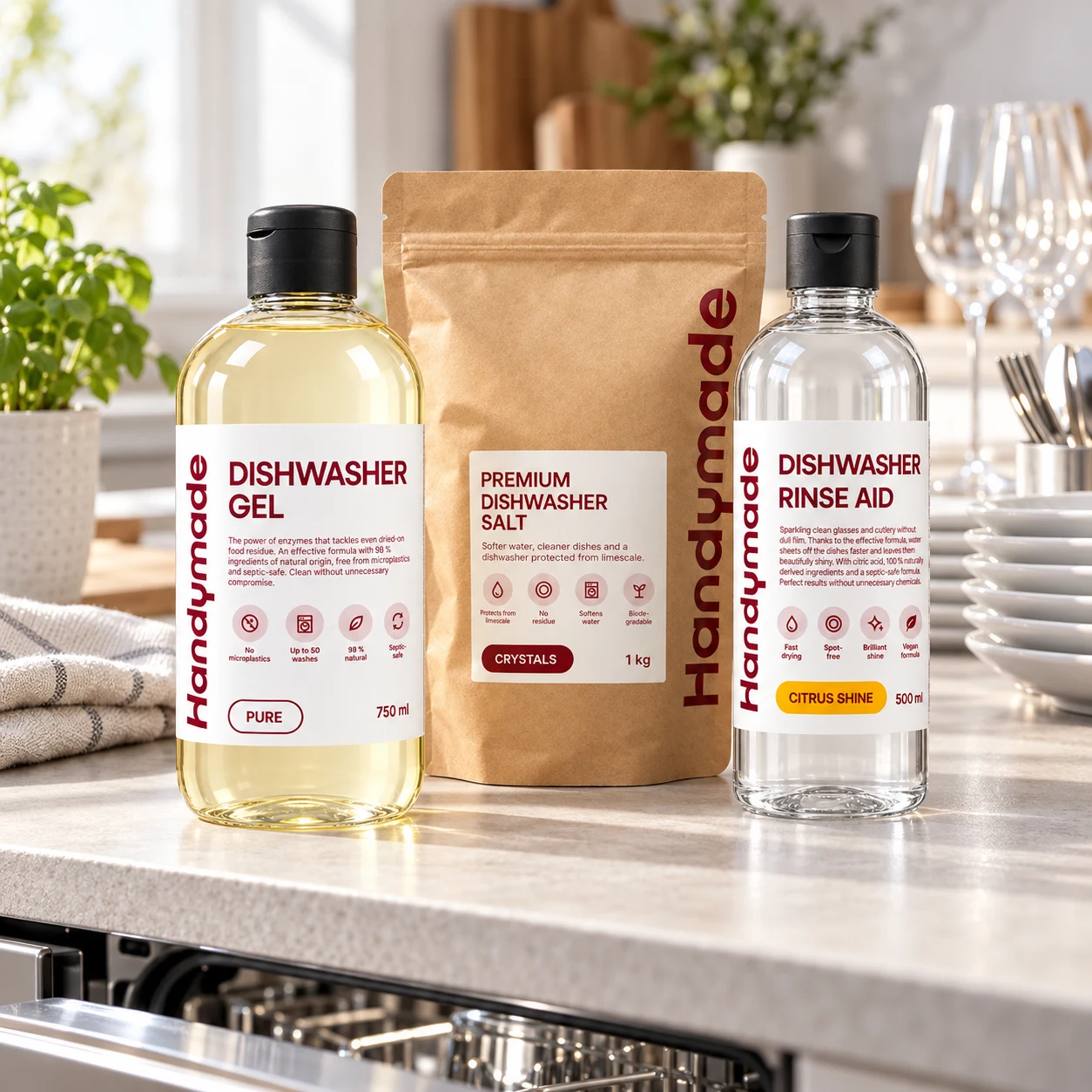
Even the best gel needs partners: salt, which regenerates the dishwasher’s water softener, and rinse aid, which helps water run off the dishes without streaks. We have explained how the whole system works and how to look after your dishwasher in our article on dishwasher care.
Salt is not just salt
The job of regeneration salt is to restore the water softener, the heart of the dishwasher. And regeneration salt is not the same everywhere either; what is commonly sold is tableted salt made from vacuum-evaporated brine.
Important: Table salt does not belong in the salt reservoir: iodine and anti-caking additives have no place there.
Our premium salt is high-purity sea salt, obtained by crystallisation and purification, with no additives and no anti-caking agents. The crystals are an optimal size: they dissolve gradually and do not clump into a hard block in the reservoir. The water softener therefore gets exactly what it needs: pure sodium chloride.
We developed all three products to work together as one system. The easiest way to try them together is the Pure set. If you prefer a delicate citrus scent, choose the Citrus Shine set, which includes a rinse aid with orange and lemon essential oils.
A label you can read from start to finish
A dishwasher gel does not have to be a mysterious bottle with categories on the label. It can be a formulation in which every ingredient has a name, a role and a reason. That is exactly the kind of gel we have made, together with a complete dishwasher system. Turn over the bottle you have at home, try to answer what you actually know about it, and then compare it with our label.
Frequently asked questions
Are the enzymes in dishwasher gel safe?
With normal use, yes. Enzymes are proteins that are rinsed away with the water and break down quickly in nature. In the gel they are dissolved in liquid, so they do not create dust when dispensed, as powder does. Like any protein, they can cause an allergic reaction in sensitive people, which is why they are listed on the label. They have been used in dishwasher products for decades because they enable effective washing at lower temperatures.
How much gel should I use in the dishwasher?
For normally soiled dishes, about 15 ml is enough. For a full dishwasher, dried-on residues or hard water, fill the detergent compartment completely, which is approximately 25 ml. With soft water and a half-empty dishwasher, you can reduce the dose.
Why does dishwasher gel not foam?
Foam is undesirable in a dishwasher: it would obstruct the spray arms and impair rinsing. That is why the gel contains only a small, precisely measured amount of surfactants, and alkalinity and enzymes take care of the rest of the cleaning. At the normal dose, foam does not persist in the dishwasher. The amount of foam never indicates cleaning performance, not even when washing up by hand.
Does the gel work in an eco programme?
Yes. The enzymes in the formulation work even at the lower temperatures at which eco programmes run. For heavily dried-on residues, a hotter programme or a brief soak will help – this applies to any product.
Why is the gel unscented?
Because fragrance has no business being on dishes. Fragrance would be an extra ingredient that does not clean, and traces of it would remain on the surface you eat from. You can tell clean dishes by the fact that they smell of nothing. If you like a fresh scent when you open the dishwasher, choose the Citrus Shine rinse aid with essential oils. The gel is fragrance-free in both sets.
Is the gel phosphate-free?
Yes. The role once played by phosphates is taken over in our gel by sodium citrate and a biodegradable new-generation chelating agent. Phosphates do not belong in the formulation because they over-feed algae and disrupt the balance of waterways.
Which preservative does the dishwasher gel contain?
A combination of phenoxyethanol and ethylhexylglycerin, a pairing proven in cosmetics. A water-based product needs a preservative, otherwise it would spoil. We do not use isothiazolinone preservatives, which are among the common contact allergens.
You will find the gel, regeneration salt and rinse aid in our e-shop in the Pure and Citrus Shine sets.