+421 950 333 113info@handymade.storeBlack Weekend: −13% on everything with code SAT13Shop now

COSMETICS AND HOME CARE

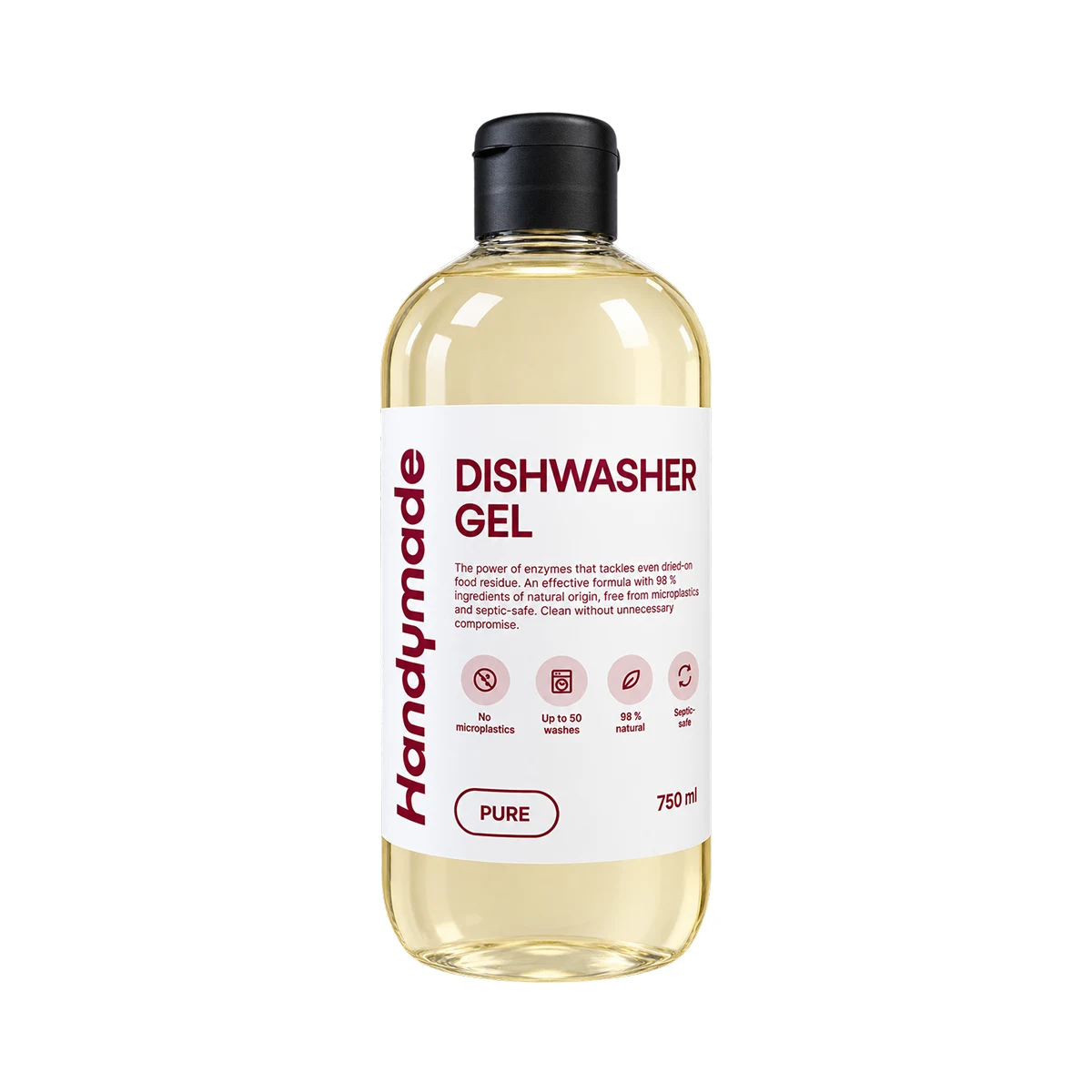
Dishwasher gel, Pure, 750 ml

Pack size750 ml3 l5 l

ManufacturerHandymade

Plates from the morning scrambled eggs, juice glasses and pots from Sunday lunch for the whole family only go into the dishwasher in the evening. full description

AvailabilityIn stock · 91 pcs
Product codeHMP0401_750
Batch106DHM04
Best before10/2028
€7.99incl. VAT€10.65/l

Lowest price in the last 30 days: €7.19

Product description

Plates from the morning scrambled eggs, juice glasses and pots from Sunday lunch for the whole family only go into the dishwasher in the evening. Pure dishwasher gel also washes off food residues that have dried on during the day.

It is free from perfume and dyes. It does not bring any added scent into the kitchen, only the smell of cleanliness.


Why Pure gel

  • Dose according to what you are washing – a tablet always has the same dose, whether the dishwasher is full or half empty and the water is soft or hard. You pour in as much gel as you need.
  • Washes from the moment the compartment opens – a tablet is pressed and in a short or cold programme it may not have time to dissolve completely. The gel dissolves quickly in water, even cold water.
  • No film around the dose – a capsule is held together by a film that dissolves in water but does not wash the dishes. The gel is in an ordinary bottle and only the gel itself goes into the dishwasher.

Every ingredient has its role

The gel contains two enzymes, each for a different type of food residue. Protease breaks down proteins from eggs, milk and meat juices, and amylase breaks down starch from pasta, potatoes, rice and sauces. They also work at the lower temperatures of eco programmes and remain effective in the liquid gel even during storage.

For grease, the gel has two surfactants. The first is a low-foaming plant-derived surfactant, which is what a dishwasher needs. The second is sophorolipids, surfactants produced by fermentation from rapeseed oil and sugars. This is not another name for SLS or SLES; there are no sulfate surfactants in the gel.

The gel also contains ingredients that bind calcium and magnesium from the water, so that they do not settle on the dishes during washing as a white film. In hard water, the salt in the dishwasher’s water softener helps it.

The gel contains a preservative that protects it from the moment you open it to the last drop. We did not include preservatives from the isothiazolinone family, such as MIT, because under EU rules they are among the strongest skin allergens. According to the ISO 16128 standard, 95.9% of the ingredients are of natural origin. You can also use the gel in a household with a septic tank or a reed bed treatment system. It was developed in our own laboratory and we make it in Slovakia.


How to use it

Pour the gel into the detergent compartment; the dishwasher opens it by itself when the main wash starts. For a full dishwasher with normally soiled dishes, 15 ml is enough in soft and medium-hard water and 25 ml in hard water, which is usually a full compartment. Adjust the dose according to the amount of dishes and how soiled they are.

For heavily burnt-on or long-dried residues, soak the dishes before washing or choose a more intensive programme.


From the same range

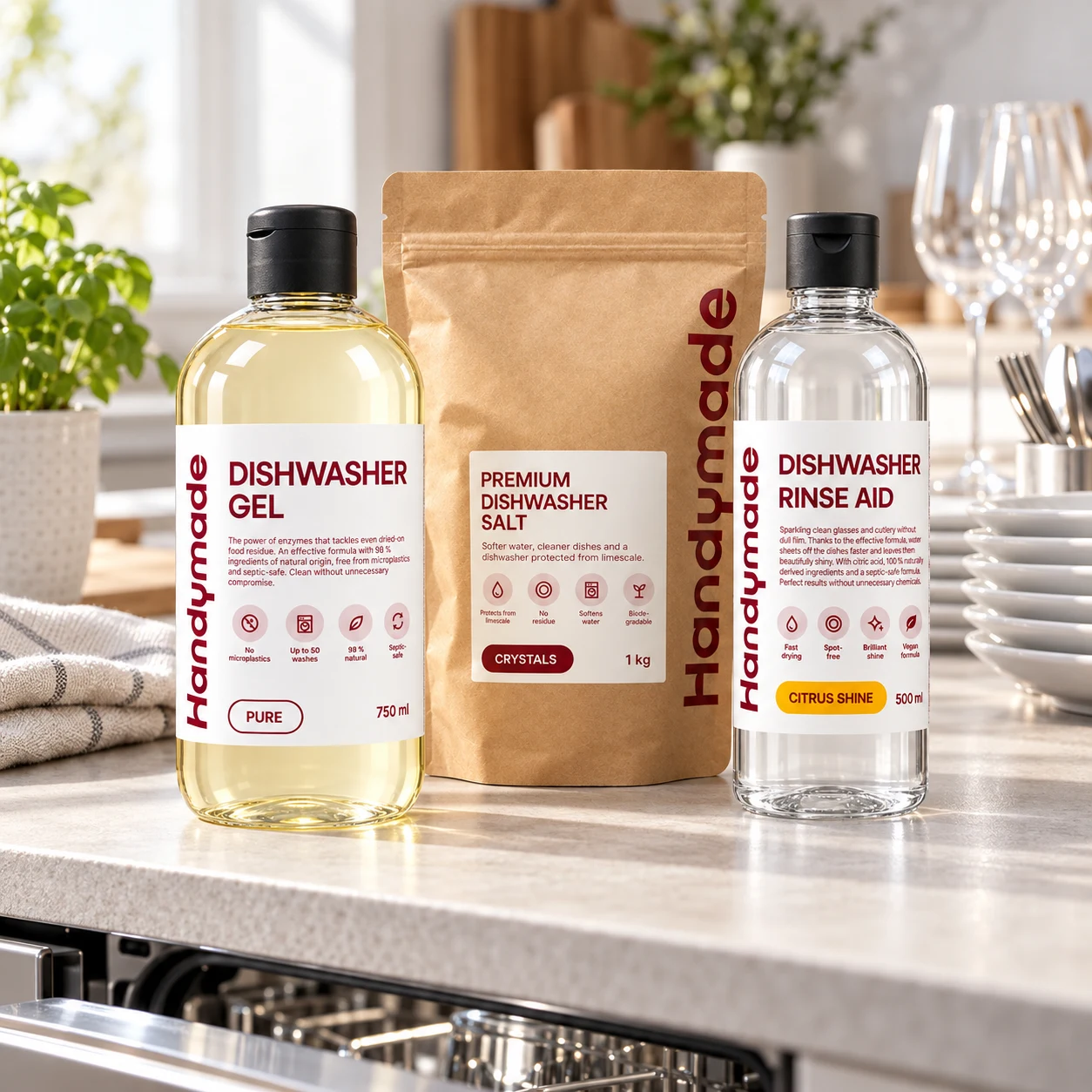
The gel cleans, the premium salt protects the dishwasher from limescale, and the Pure rinse aid helps the dishes dry without spots. You can find all three together in the Pure set.


Frequently asked questions

What exactly are sophorolipids?
They are surfactants whose molecule combines a sugar with a fatty acid and contains no sulfur. In a test, 24 people with sensitive skin had a surfactant solution under a patch for 24 hours. Skin redness (0 means none) was 0.02 for sophorolipids, 0.79 for SLES and 1.73 for SLS. Water loss through the skin increased by 36% with sophorolipids, by 154% with SLES and by 465% with SLS.
Why does the gel not foam in the dishwasher?
Foam would get in the way of the spray arms that spray the dishes and would impair rinsing. The gel therefore contains only a small amount of surfactants. The amount of foam says nothing about how well the gel washes.
Why do glasses have a white film after washing?
A film that can be wiped off is most often caused by minerals in hard water. Check that there is salt in the reservoir and that the softener is set to the hardness of your water. Spots left by droplets are more likely a sign of missing or under-dosed rinse aid, while streaks suggest too much of it.
How many washes does the gel last?
With a dose of 15 ml, the 750 ml bottle lasts for about 50 washes. The 3 l pack lasts for about 200 washes and the 5 l pack for about 330. Keep the 750 ml bottle together with its closure and simply refill it with gel from the larger pack.
Can I use it if I have a septic tank or a reed bed treatment system?
Yes. Septic tanks and domestic wastewater treatment plants are harmed mainly by chlorine-based and disinfecting products, which disrupt their natural function. The gel contains no chlorine and is not a disinfectant. In normal use, it is diluted in the wastewater enough that it does not harm the treatment plant. The same applies to a reed bed treatment system, because the wastewater reaches it through a pre-treatment tank.

Ingredients

Less than 5%: non-ionic and anionic surfactants, polycarboxylates. Enzymes. Preservation agents: phenoxyethanol, ethylhexylglycerin. 95.9% of ingredients are of natural origin according to ISO 16128. List of all ingredients: handymade.store

Product documentation

SDSSafety Data Sheet
Available for purchased products —
Vladimira W.9 Nov 2026SK

Verified purchase

Libuše M.8 Nov 2026CS

Verified purchase