Dishes from the dishwasher are the only surface in the home we eat directly from. That is why the Pure dishwasher gel contains only ingredients that each have a role to play. Enzymes break down dried-on egg, milk and sauces, a sugar surfactant and sophorolipids carry away grease, and hard water is softened by sodium citrate and the modern chelating agent MGDA instead of phosphates. The gel is free of fragrance and dyes, so washed dishes do not smell of cleaner.
Why a gel and not a tablet or capsule
A tablet is convenient, but always the same. A gel gives you back what you handed over to the manufacturer with a tablet: control over the dose.
- You dose according to reality. A half-empty dishwasher does not need a full dose, and for a full dishwasher with dried-on residues you add more. Your measuring cup is right in the dishwasher — it is the detergent compartment.
- It dissolves right away. A tablet is a pressed concentrate and in short and cold programmes it may not have time to dissolve completely. The gel dissolves quickly in water and washes from the moment the compartment opens.
- A tablet does not replace salt. "All in one" tablets promise you need neither salt nor rinse aid. But their ingredients act only during the wash and do not regenerate the softener that protects the dishwasher and dishes from limescale. For that it needs regeneration salt in the reservoir.
- No film. Capsules are held together by a polyvinyl alcohol (PVA) film. It dissolves in water but does not wash the dishes, it only holds the dose together. And dissolving does not mean breaking down: experts still do not agree on how quickly PVA degrades in nature. Our gel comes in an ordinary bottle. You can see it, sort it for recycling, and nothing about it pretends to have disappeared.
You will find all the differences, with sources, in the article Dishwasher gel or tablets? There are more differences than it seems.
Why our gel in particular
- A proper dose of enzymes. The blend of protease and amylase comes from a leading European enzyme manufacturer. The gel contains almost as much as the manufacturer recommends for dishwasher gels at all, and we increased the dose gradually based on test batches. According to the manufacturer it works best at 15 to 60 °C, so it washes even at the lower temperatures of economy programmes. It is supplied with a stabiliser that keeps it effective in the liquid gel even during storage.
- A biosurfactant from fermentation. Alongside the sugar surfactant, sophorolipids also do the washing. They are produced by yeasts through fermentation from European rapeseed oil and sugars, without palm oil, and are readily biodegradable. The same biosurfactant is also in our rinse aids.
- Composition with no secrets. On the label of an ordinary gel you find only categories, for example "less than 5% non-ionic surfactants". With our gel you know every ingredient and the reason it is there. We developed the formula in our laboratory and fine-tuned it over several versions.
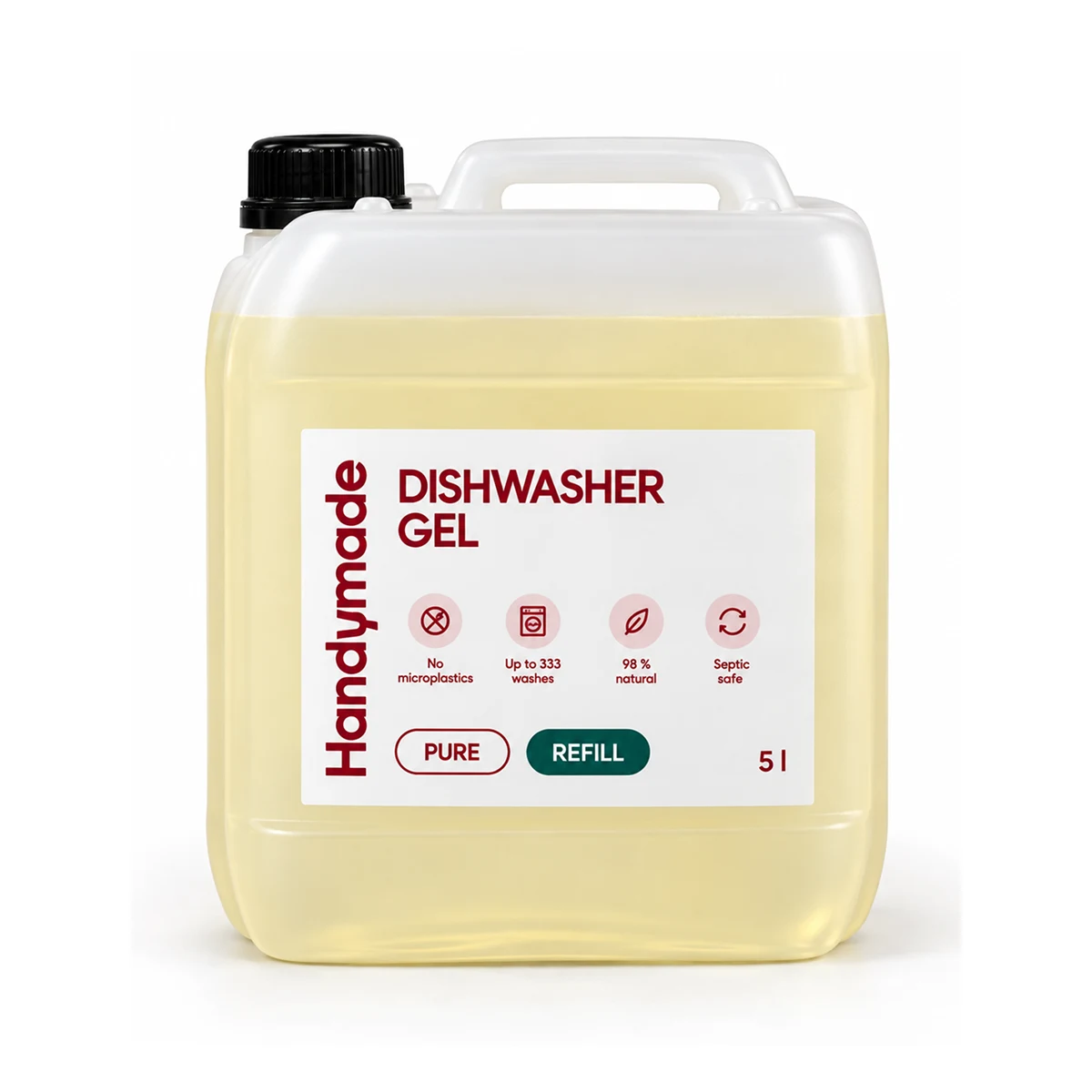
- It lasts a long time. At a dose of 15 ml, a 750 ml bottle lasts for about 50 washes, a 3 l pack for 200 and a 5 l pack for about 330 washes.
Why, after cosmetic ingredients, we also took up cleaning products, we explain in the article Why we started making our own cleaning products.
How the gel washes
In the dishwasher the gel's ingredients work all at once, and each has its role:
- Protease – an enzyme that breaks down proteins: dried-on egg, milk, meat juices.
- Amylase – an enzyme for starches from pasta, potato, rice and sauce residues.
- Sugar surfactant (APG) – an alkyl polyglucoside of natural origin. It helps water get under grease and carry it off the dishes. It foams little and is readily biodegradable.
- Sophorolipids – biosurfactants that yeasts produce by fermentation from rapeseed oil and sugars. Together with the sugar surfactant they help carry grease off the dishes. They are readily biodegradable.
- Sodium citrate and MGDA – they bind calcium and magnesium from hard water so these do not interfere with washing or settle on the dishes. MGDA is a modern chelating agent, readily biodegradable, that replaces phosphates.
- Sodium silicate – it creates a mildly alkaline environment in which grease loosens more easily, and protects glass and glaze from corrosion. This helps glasses keep their clear look longer.
- Hydroxyethyl cellulose and glycerin – they give the gel its thickness so it doses well.
- Phenoxyethanol with ethylhexylglycerin – a preservative that protects the water-based gel from spoiling.
We describe every ingredient, and why we chose it, in the article What dishwasher gel contains and what it does there.
What you will not find in the gel
- Phosphates – water is softened by sodium citrate and MGDA.
- Bleaches – the gel contains neither chlorine nor oxygen bleaches.
- Fragrance and dyes – no scent or colour should remain on the dishes you eat from.
- Isothiazolinone preservatives – the gel is preserved by phenoxyethanol with ethylhexylglycerin.
- Sulfate and ethoxylated surfactants – instead, the gel washes with a sugar surfactant (APG) and sophorolipids from fermentation.
Dosage
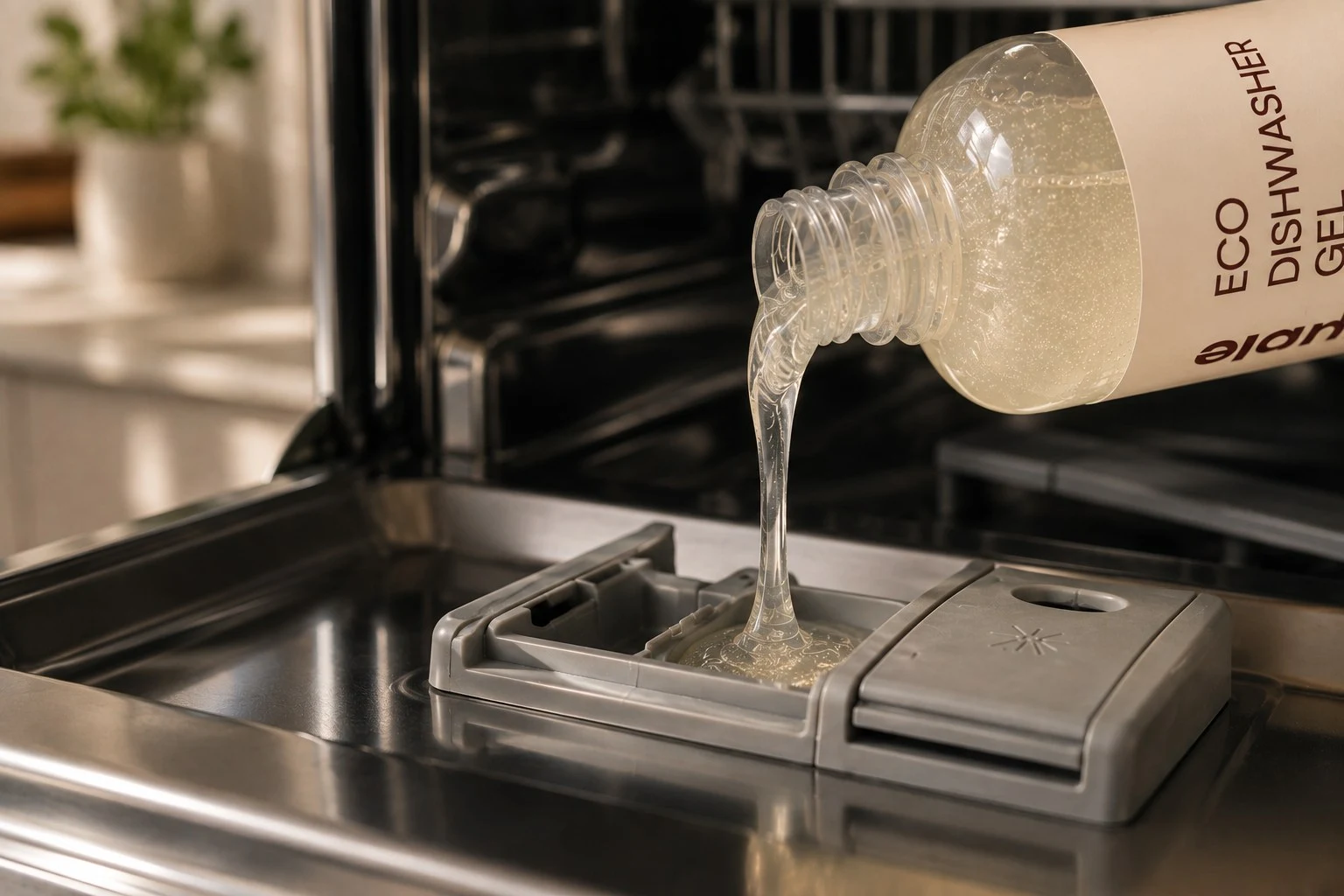
The gel is dosed into the detergent compartment
The detergent compartment is also the measuring cup. The dishwasher opens it by itself when the main wash begins.
For normally soiled dishes, about 15 ml of gel is enough. For a full dishwasher, dried-on residues or hard water, fill the whole detergent compartment, usually about 25 ml. For a half-empty dishwasher and soft water you can reduce the dose.
It is a good idea to soak heavily burnt-on or long dried-on residues before washing, or to choose a more intensive programme. Wash only dishes the manufacturer has marked as dishwasher-safe.
Gel, salt and rinse aid each do a different job in the dishwasher. The gel washes, premium salt keeps the water softener working, and the Pure or Citrus Shine rinse aid helps water run off the dishes so they dry without spots. We tuned all three as a single system and you can find them together in the Pure set. Why the dishwasher needs each of them, we explain in the article Why a dishwasher needs gel, salt and rinse aid.
Frequently asked questions
How much gel to dose into the dishwasher?
For normally soiled dishes, about 15 ml of gel is enough. For a full dishwasher, dried-on residues or hard water, fill the whole detergent compartment, usually about 25 ml. For a half-empty dishwasher and soft water, less is enough.
Is dishwasher gel better than tablets or capsules?
The gel gives you more control. You adjust the dose to how full the dishwasher is, to the soiling and to the water hardness; it dissolves as soon as the compartment opens, even in a short programme, and it has no PVA film.
Does the gel work in short and economy programmes too?
Yes. The gel dissolves as soon as the compartment opens, and according to the manufacturer the enzymes work best at 15 to 60 °C, that is, also at the lower temperatures at which economy programmes run. For heavily dried-on residues, a more intensive programme or a short soak helps.
Why does the dishwasher gel not foam?
Foam would get in the way of the spray arms in the dishwasher and worsen rinsing. That is why the gel contains only a small amount of surfactants, and cleaning is handled mainly by the enzymes and the alkaline environment. The amount of foam says nothing about cleaning power.
Why does the gel have no scent?
The gel is fragrance-free because scent does not wash the dishes and traces of it would remain on the surface you eat from. If you like a fresh scent when you open the dishwasher, choose the Citrus Shine rinse aid with orange and lemon essential oils.
Why do glasses have a white film after washing?
A white film that can be wiped off or dissolved with a weak acid most often comes from the minerals in hard water. Check whether there is salt in the reservoir and whether the softener is set to your water's hardness. Drops and streaks after drying point rather to a lack of rinse aid. You will find more in the article
How to care for your dishwasher so it washes like new.
What preservative does the gel contain?
The gel is preserved by a combination of phenoxyethanol and ethylhexylglycerin. A water-based product needs a preservative, otherwise it would spoil. Isothiazolinone preservatives, for example methylisothiazolinone, are not in the gel.