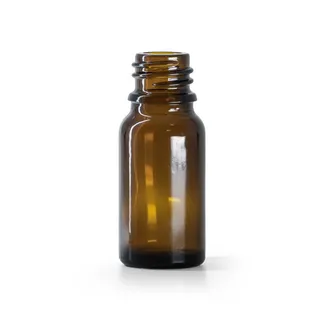
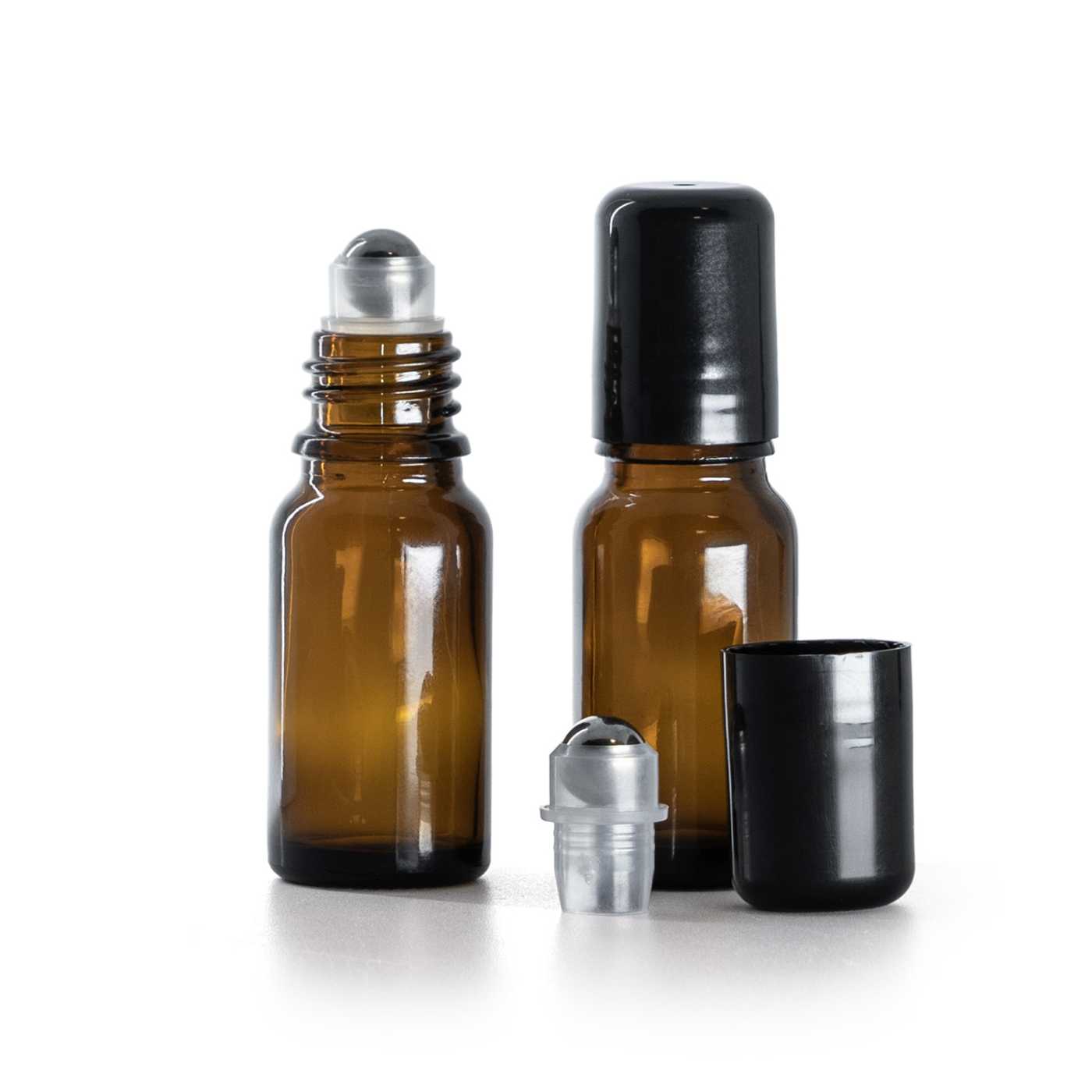
The amber glass medicine bottle with a metal roller ball and a black cap makes a ready-to-use 10 ml roll-on that only needs to be filled and screwed shut. It is suitable for perfume oils, essential oil blends in a carrier oil, oil-based eye serums or lip oil, that is, for liquid preparations applied to the skin in small amounts. The roller ball spreads the contents over the skin without spilling and without you touching them with your fingers.
Amber glass reduces the amount of light that gets in, which matters for essential oils and unsaturated vegetable oils, because light speeds up their oxidation. The whole set – bottle, roller ball and cap – is declared suitable for contact with cosmetics.
What the set consists of
- Glass bottle, medicine bottle – amber glass bottle with an 18/410 neck finish. Medicine bottle refers to the shape of the bottle; it has nothing to do with use for medicines.
- Metal roller ball – steel ball seated in a clear plastic socket. After filling, the socket is pressed onto the neck of the bottle and holds firmly in place. The ball rotates during application and picks up the contents from the bottle in a thin layer.
- Plastic cap – black PP screw cap. It is screwed on over the fitted roller ball and protects it from dirt in a handbag or other bag.
What it is suitable for
A roll-on works best with liquid contents of low viscosity. Oil, perfume oil or an alcohol-based solution is applied smoothly through the roller ball. Thick gels, balms and creams cannot be picked up by the ball, so choose a jar or another type of packaging for them.
- Perfume oils – 10 ml is a common size for perfume applied to the wrists and neck.
- Aromatherapy blends – essential oils diluted in a carrier oil, for example for the temples or wrists.
- Oil serums for the eye area and lips – a small amount, precise application and the cooling touch of the metal ball.
- Cuticle care – the oil is applied with the roller ball directly to the edge of the nail.
For alcohol-based perfumes and more concentrated essential oil blends, we recommend checking how the plastic ball socket and the cap behave with your specific formulation, for example by testing a filled bottle over several weeks.
Filling and volume
The bottle is filled up to the nominal volume of 10 ml, that is, the volume the packaging is designed for under normal filling. The brimful volume given in the parameters is the physical volume up to the neck. The difference between them is a reserve for the ball socket, which is pressed into the neck when fitted and takes up part of the space, and for the expansion of the contents when the temperature changes. If you fill the bottle to the brim, the contents will overflow when you fit the roller ball.
Fit the roller ball onto the dry neck and press it down evenly with your thumb until it sits flush with the rim. Then turn the bottle upside down and check that no contents leak from the socket. Only then screw on the cap.
Good to know
Before the first filling, wash the glass bottle, disinfect it with isopropyl alcohol or ethanol and leave it to dry completely. Residual water in oil-based contents promotes the growth of microorganisms. It is enough to rinse the roller ball with its socket in ethanol and dry it.
Reuse is possible. The ball socket can be carefully prised out of the neck, but after fitting it again, check that it holds firmly and seals.
The food-contact certificate applies to the glass bottle alone. The set as a whole is intended for cosmetics, because the roller ball and the cap have not been assessed in this way.
After use, the glass bottle belongs in glass recycling; the cap with the roller ball should be separated beforehand.
Frequently asked questions
Is the 10 ml glass roll-on suitable for essential oils?
Yes, the amber glass bottle with a roller ball is commonly used for essential oil blends diluted in a carrier oil. Glass does not react with essential oils and the amber colour reduces the amount of light that gets in. If the share of undiluted essential oils is high, we recommend checking in advance how the plastic ball socket and the cap behave, because concentrated essential oils can attack some plastics.
How much fits into a 10 ml roll-on bottle?
The bottle is designed for 10 ml of contents. The physical brimful volume is higher and you can find it in the parameters, but this reserve is taken up by the ball socket, which is pressed into the neck when fitted. If you filled the bottle to the brim, the contents would overflow when you fit the roller ball, so fill only up to the nominal volume.
Can a roll-on bottle be refilled?
Yes, both the bottle and the roller ball are designed for reuse. The ball socket is prised out of the neck, for example with a blunt knife or a spoon, and the bottle is washed, disinfected with ethanol and left to dry. After fitting the roller ball again, check the seal by turning the filled bottle upside down.
Is a glass roll-on suitable for water-based or alcohol-based contents?
Yes, the glass bottle and the roller ball can handle liquids of low viscosity, including water-based and alcohol-based ones. For water-based preparations, remember to use a preservative, because the roller ball touches the skin and the contents come into contact with microorganisms from the skin surface each time they are used. For alcohol-based perfumes, check the long-term behaviour of the plastic parts with your specific alcohol concentration.
Is a roll-on bottle suitable for thick serums or gels?
No, the roller ball picks up only liquid contents that can flow between the ball and the socket. Thick gels, balms and creamy serums either do not pass through the roller ball or are applied unevenly. A jar, a bottle with a dropper or a bottle with a pump is more suitable for these preparations.
Why is the roll-on bottle made of amber glass?
Amber glass reduces the amount of light reaching the contents, and light speeds up the oxidation of vegetable and essential oils. A perfume oil or aromatherapy blend therefore keeps its fragrance and properties longer in an amber bottle than in clear glass. You cannot see the contents through amber glass; you can check the amount by unscrewing the cap or by weighing the bottle.