A macerate, or macerated oil, is a carrier oil that serves as a “solvent” for extracting the medicinal properties of a given plant or fruit. There are many herbs and plants from which you can make your own macerate — you may well have them at home or in your garden without realising how to enjoy their healing or nourishing properties for as long as possible. We will show you how to prepare, store and use a macerate in home-made cosmetics.
About this article
This article was prepared for you by Martina Oboňová. In it you will find a description of what a macerate is, a comparison of dried and fresh plants, two methods of preparation — classic maceration in oil as well as the quicker thermal preparation — and finally how to store and use a macerate in cosmetic products.
Main benefits
- The properties of herbs for longer
The carrier oil extracts the medicinal properties of the plant, so you can enjoy them outside the season of fresh herbs too.
- The ingredients are close at hand
All you need is a carrier oil, herbs and a clean glass container — and many suitable plants can be found at home or in the garden.
- Two methods of preparation
Classic maceration takes 3–6 weeks; for the impatient there is thermal preparation in a water bath in 2–6 hours.
- A wide range of uses
Macerates are suitable for everything from skin care products, through balms, ointments, creams and soaps, to hair products.
- A natural fragrance too
Vanilla pods macerated in jojoba oil will give your products a beautiful, natural vanilla aroma.
Properties of a macerate
What a macerate is and which oil to macerate in
A macerate, or macerated oil, is essentially a carrier oil that serves as a “solvent” for extracting the medicinal properties of a given plant or fruit. The oils most commonly used for maceration are almond, sunflower, olive, coconut and jojoba oil.
The choice of oil also affects how long the result will keep — some oils are more prone to going rancid quickly. Besides ordinary herbal macerates, jojoba oil is also well suited to macerating vanilla pods, which will give your products a natural vanilla aroma.
Which herbs are suitable for maceration
Many herbs are suitable for infusion. You can try, for example, jasmine, lavender, calendula, carrot, sea buckthorn, St John’s wort, rosemary, oregano, peppermint, vanilla or comfrey.
Should I use fresh or dried plants for maceration?
Dried plants are ideal, because they do not contain water and, besides making the maceration process easier for you, they will ensure the longest possible shelf life of the oil. Fresh plants contain water, so they need to be replaced more frequently and the final product needs to be checked more often so that the oil does not go rancid or become cloudy (this also depends on the type of oil, as some are prone to going rancid more quickly). In this case, it is recommended to add 0.5–1.0 % vitamin E (tocopherol), which is a strong antioxidant.
Method: maceration in oil
The most common method is maceration in oil for approximately 3–6 weeks. After 3 weeks the macerate should already be finished and of good quality; you can extend the maceration time, and 6 weeks is considered the maximum.
- Prepare the container and the herbs
You need a clean glass container, into which you add the herbs — ideally finely chopped and filling the container to the top.
- Pour the oil over them
Pour your chosen carrier oil over the herbs so that they are completely covered.
- Remove the air bubbles
Close the container and, by shaking it several times, tapping and mixing it, make sure that the herbs are completely covered and that the air bubbles are removed — bubbles promote oxidation of the oil and significantly shorten its shelf life.
- Put it in a warm place 3–6 weeks
Place the container, sealed airtight in this way, in a warm place — ideally on a windowsill, where the sun’s rays will gently warm it. Such a temperature is ideal for infusion.
- Shake it
Shake the container over the course of a few days to ensure better extraction.
- With fresh plants, replace the material every week
In the case of fresh plants or fruits, the macerated material needs to be replaced approximately every week.
Thermal preparation of a macerate
For the impatient, there is one more quick way to make a macerate.
- Prepare the mass in a water bath water bath
Prepare the same mass of macerated raw materials in a water bath and heat it up.
- Keep the temperature as low as possible lowest temperature2–6 hours
It is quite important that, with this method, you maintain the lowest possible temperature for 2–6 hours and do not boil the oil.
- Check the temperature
Here, however, you really do need to check the temperature carefully. In home conditions it can easily happen that the temperature rises and the oil together with the herbs is spoiled.
Straining and storing a macerate
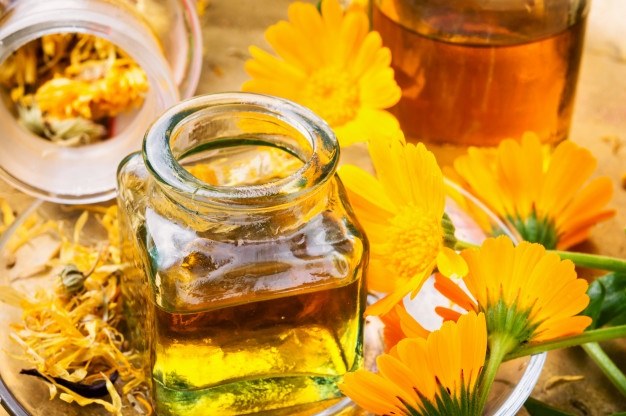
After three to six weeks, strain off the macerate — you can do this through a sieve, but ideally you should filter it through cloth — and store it preferably in smaller sterile containers, so as to prevent excessive contact with air when reusing and opening the container. Depending on the plant that has been macerated, the resulting macerated oil may take on a new colour. It will keep for approximately 6–12 months, provided you store it in a darker, cooler place away from direct sunlight.
If you notice a pronounced change in smell, or cloudiness, the macerate is no longer safe to use.
Using a macerate in cosmetics
Macerates have a wide range of applications in cosmetic products, from skin care products, through balms, ointments, creams and soaps, to hair products. They are used at a ratio of 5–10 %. In cases where the macerate replaces the carrier oil in the product, you can use it in a higher proportion.
In addition to their healing properties, macerates can also serve as natural fragrances — vanilla pods macerated in jojoba oil, for example, will give your products a beautiful, natural vanilla aroma.
A word of caution
In conclusion, we would like to point out that although your macerate may turn out perfectly, you do need to test it on the skin before use. Although all the components of the macerate are natural, some of you may be allergic to certain plants.
Frequently asked questions about macerates
Practical questions about making a macerate — choosing the plants, the maceration time, shelf life and dosage.
How long should maceration take?
Most often 3–6 weeks. After 3 weeks the macerate should already be finished and of good quality; you can extend the time, and 6 weeks is considered the maximum. With thermal preparation in a water bath, 2–6 hours at the lowest possible temperature is enough, but the oil must not be boiled.
Dried or fresh plants?
Dried plants are ideal — they do not contain water, the process is easier and the oil keeps the longest. Fresh plants contain water, need to be replaced more frequently (approximately every week) and the product needs to be watched so that the oil does not go rancid or become cloudy.
When should you add vitamin E, and how much?
When macerating fresh plants, it is recommended to add 0.5–1.0 % vitamin E (tocopherol), which is a strong antioxidant.
How long does a macerate keep, and when should you stop using it?
Approximately 6–12 months, provided you store it in smaller sterile containers in a darker, cooler place away from direct sunlight. If you notice a pronounced change in smell, or cloudiness, the macerate is no longer safe to use.
At what ratio should a macerate be dosed into cosmetics?
Macerates are used at a ratio of 5–10 %. In cases where the macerate replaces the carrier oil in the product, you can use it in a higher proportion.
Why do the air bubbles need to be removed?
Bubbles promote oxidation of the oil and significantly shorten its shelf life. That is why you should shake, tap and mix the container several times after closing it, so that the herbs are completely covered.
Conclusion
Do you make your own macerates at home, or have we just inspired you? Share with us at [email protected].
The article was prepared for you by Martina Oboňová.
You will find dried herbs, carrier oils and ready-made macerates in the Handymade range of raw materials — dried herbs, oils and macerates.