
Natural deodorants are used by many people, especially in summer. Even when it comes to minimising the undesirable manifestations of sweating, there is a natural solution. Deodorants can also be made in the comfort of your home in various forms, whether as sprays or solid sticks and the like. Let’s take a closer look at the reasons for body odour, how to suppress it, and which raw materials should not be missing from your deodorant.
About this article
How do deodorants work and which natural raw materials can you make them from? In this article we go through the reasons for body odour, the difference between a deodorant and an antiperspirant, the three basic components of an effective homemade deodorant, and the specific raw materials — from sweat absorbents through antimicrobial substances to aromatic ingredients.
Key benefits
- A natural solution
Even when minimising the undesirable manifestations of sweating, there is a natural solution made from readily available cosmetic raw materials.
- Various forms
You can make a deodorant in the comfort of your home — as a spray, as a solid stick and the like.
- A feeling of dryness
Absorbents bind the sweat produced well and thus give you a greater feeling of dryness on the skin.
- No clogged pores
A deodorant does not create an impermeable barrier on the skin the way an antiperspirant does, which can lead to clogged pores or the appearance of rashes.
- Consideration for the microflora
Overly aggressive chemicals can lead to skin irritation and also to a disruption of the natural microflora — with natural raw materials you choose with this balance in mind.
Properties of natural deodorants
Deodorants and their importance in suppressing body odour
Have you ever wondered why sweat starts to smell after a while? Many of you may know the answer: microorganisms are responsible, especially bacteria found on the surface of the skin. When these bacteria come into contact with sweat, they begin to break it down. This leads to the production of substances with an unpleasant odour.
Precisely thanks to understanding this phenomenon, deodorants can be actively targeted at suppressing body odour. This is achieved by adding substances that inhibit the multiplication and growth of microorganisms. Many such substances are contained in plants, and therefore many essential oils or hydrosols exhibit antimicrobial properties. There are also cosmetic raw materials directly intended for use in deodorants; you will learn about their properties later in the article.
Do deodorants suppress sweating?
You might want to focus, when making a deodorant, on suppressing sweating. Unfortunately, deodorants do not work in this way. Their role is only to cover and reduce body odour. In contrast, antiperspirants suppress sweating, for example by creating an impermeable barrier on the skin. To achieve this effect, they often use aluminium-derived salts, so that bacteria cannot reach the sweat and no odour is produced.
The disadvantage of such suppression of sweating is the fact that it can lead to clogged pores, or the appearance of rashes and the like, if the skin does not tolerate such substances well.
Beware of aggressive substances: The use of overly aggressive chemicals, whether in deodorants or antiperspirants, to suppress bacterial growth can lead not only to skin irritation but also to a disruption of the natural microflora on the skin. And damage to this balance can also lead to the appearance of other types of microorganisms that are not natural to our skin.
What should a natural deodorant contain?
There are three basic components that an effective homemade deodorant should contain in order to be able to suppress the formation of odour, at the same time cover existing odour and absorb part of the sweat produced.
- Sweat absorbent
These are ingredients that absorb the sweat produced well and thus give you a greater feeling of dryness on the skin.
- Antimicrobial substance
We have already mentioned how the breakdown of sweat by microorganisms contributes to the development of body odour. This is where the antimicrobial substance plays a role, as it suppresses this phenomenon.
- Aromatic substance
You certainly want your deodorant to give you a pleasant fragrance. This function is provided by the essential or fragrance oils present. In the case of liquid deodorants, these can also be various floral hydrosols.
Sweat absorbents for deodorants
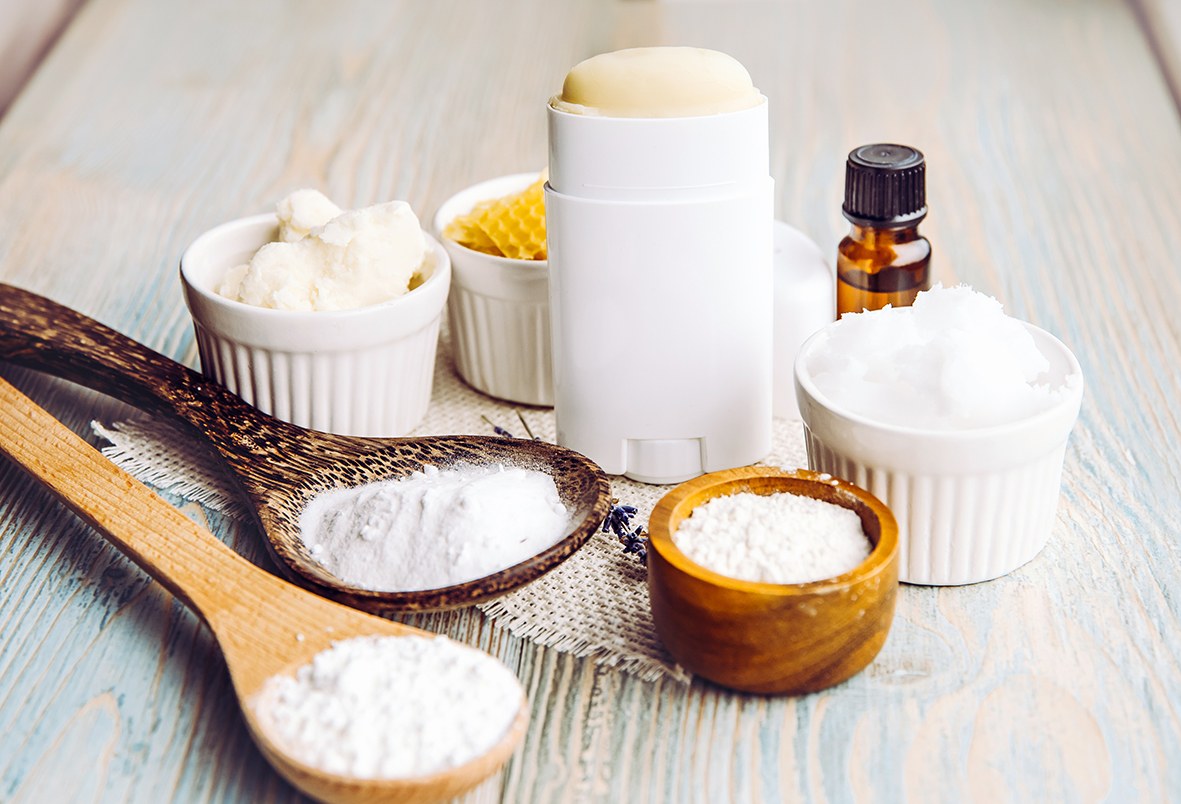
To maintain a feeling of dry skin, raw materials that bind sweat well are most often used. These are primarily various starches. Corn starch is often used because it is readily available, but other types of starch can also be used. The advantage of these substances is that the skin usually tolerates them very well and they at the same time leave the skin smooth and soft. For this reason, starches often form the basis of baby powders.
Another raw material used for its ability to bind sweat is baking soda. Its advantage is that it partially helps to prevent the growth of bacteria due to its high pH. However, this is also its disadvantage. Not all deodorants therefore use baking soda, because it can irritate the skin.
Antimicrobial substances for deodorants
The role of antimicrobial substances is to suppress or slow down the growth of microorganisms, which would otherwise cause the breakdown of sweat and the resulting odour. You can choose from several cosmetic raw materials, from essential oils to special substances formulated for use in deodorants.
Essential oils for deodorants
As mentioned, these are primarily various plant-based products. Essential oils in particular are rich in antimicrobial substances. A good choice is tea tree oil, which is generally used also in treating acne-prone skin.
Another essential oil for deodorants can be sage essential oil, or other types of essential oils that exhibit antibacterial properties and are well tolerated by your skin.
If essential oils are too concentrated for you, you can also reach for hydrosols from these herbs. They then form the base of liquid spray deodorants.
Special cosmetic raw materials for deodorants
Special cosmetic raw materials have been developed for use in deodorants, many of which have antimicrobial effects or another property or properties for use in deodorants.
Deodorant Decalact Deo
Decalact Deo is a substance developed for deodorants that can be used in both the water and oil phases of the product. It is added to the water phase at up to 40 °C and to oils at up to 60 °C. Decalact Deo serves primarily to prevent the formation of microorganisms, and thus allows longer effectiveness of the deodorant. In addition to suppressing the growth of microorganisms, it also has the ability to mask existing odour, for up to 24 hours.
Dermofeel TEC eco
Dermofeel TEC eco (INCI Triethyl Citrate) is a lipophilic substance, and is therefore well soluble in oils. It is an ester of citric acid and is often used in deodorants, where it serves as an active substance. Its advantage is that it can be used in various forms of deodorants, from sticks and balms to various emulsions and sprays. It is a colourless, odourless liquid that reduces odour formation by inhibiting the breakdown of sweat.
Aromatic substances for deodorants
The third category of substances for making deodorants are pleasantly fragrant aromatic substances that cover existing body odour. These are mainly essential oils, which combine well with the antimicrobial essential oils already added. In this respect, fresh tones are most often chosen, especially citrus notes such as grapefruit and the like.
Fresh fragrances are very popular, but not all plants produce enough essential substances. Therefore, it is possible to use fragrance oils as well. Particularly popular are oils with a cucumber scent or other fresh fragrances. For example, it can be a combination with ginger.
If your product already contains enough fragrant hydrosol or antimicrobial essential oil, you do not necessarily have to add more fragrance substances, if you are satisfied with the scent of the product as it is.
Frequently asked questions about natural deodorants
Practical questions about natural deodorants — the origin of odour, the difference from an antiperspirant, composition and the dosage of special raw materials.
Why does sweat start to smell after a while?
Microorganisms are responsible, especially bacteria found on the surface of the skin. When they come into contact with sweat, they begin to break it down, and this leads to the production of substances with an unpleasant odour.
What is the difference between a deodorant and an antiperspirant?
Deodorants do not suppress sweating — their role is only to cover and reduce body odour. Antiperspirants, in contrast, suppress sweating, for example by creating an impermeable barrier on the skin; they often use aluminium-derived salts for this. The disadvantage is that it can lead to clogged pores, or the appearance of rashes, if the skin does not tolerate such substances well.
What should a homemade deodorant contain?
An effective homemade deodorant should have three basic components: a sweat absorbent, an antimicrobial substance that suppresses the growth of microorganisms, and an aromatic substance that covers existing odour.
Is baking soda suitable for every deodorant?
Baking soda binds sweat well and, thanks to its high pH, partially helps to prevent the growth of bacteria as well. However, that same high pH is also its disadvantage — it can irritate the skin, so not all deodorants use it. An alternative is starches, which the skin usually tolerates very well.
At what temperature is Decalact Deo added?
Decalact Deo can be used in both the water and oil phases of the product. It is added to the water phase at up to max. 40 °C and to oils at max. 60 °C. In addition to suppressing the growth of microorganisms, it can mask existing odour for up to 24 hours.
Do I have to add fragrance substances to a deodorant?
No. If your product already contains enough fragrant hydrosol or antimicrobial essential oil, you do not necessarily have to add more fragrance substances, if you are satisfied with the scent of the product as it is.
Natural deodorants and conclusion
Have you ever made your own natural deodorant? How did it go? Did you use any of the raw materials mentioned?
Write to us about how it went and share your opinion or experience. Feel free to contact us at [email protected]. We look forward to all your messages.
Until saponification, friends.
Decalact Deo, Triethyl Citrate, starches, baking soda as well as the essential and fragrance oils from this article can be found in the Handymade range of raw materials.