


AIRLESS BOTTLES
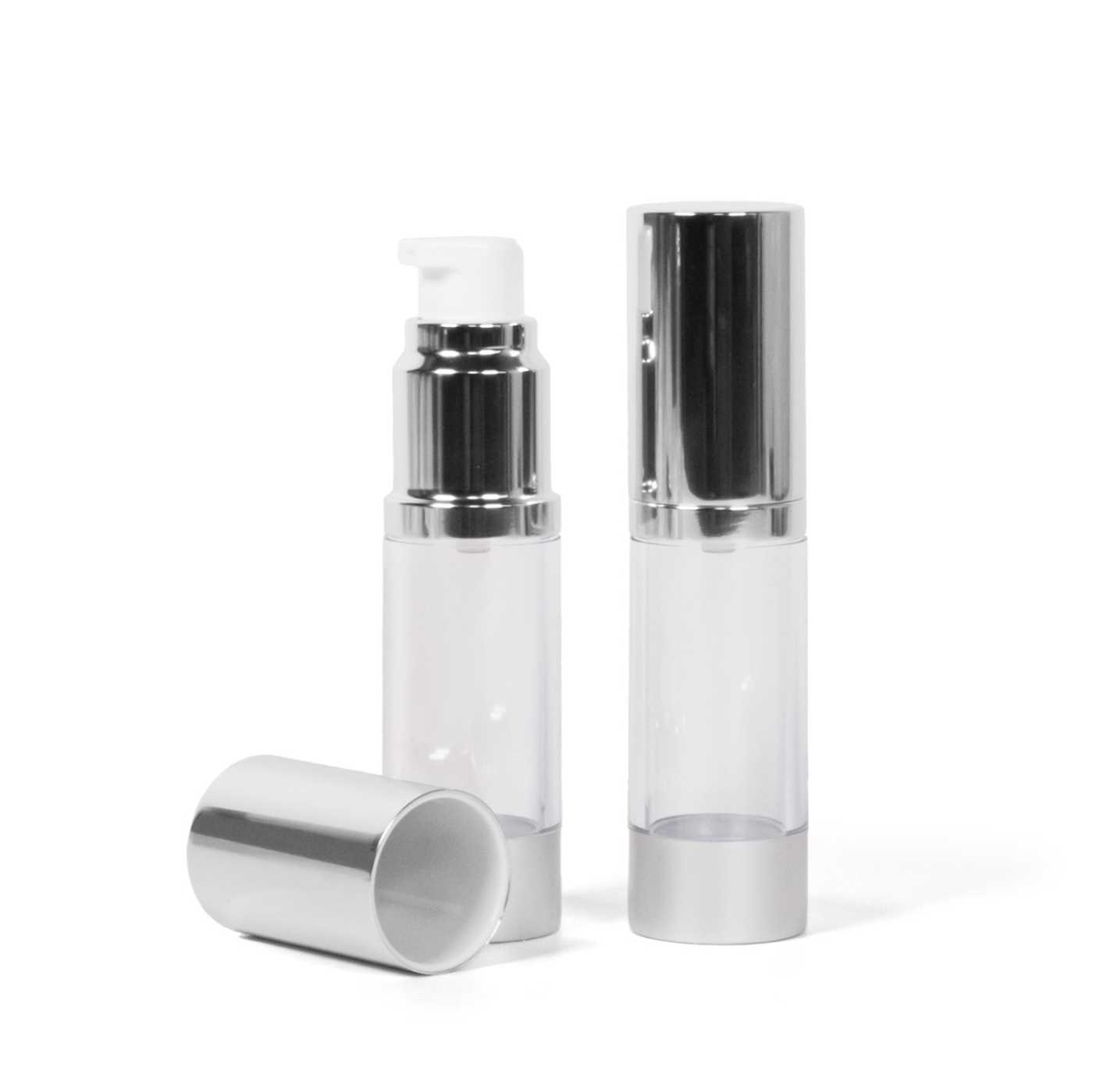
Clear Airless Bottle with Aluminium Top, 15 ml
The 15 ml airless bottle with aluminium cap is a complete bottle and pump cap set that dispenses the contents without air contact. full description
Lowest price in the last 30 days: €3.03
Save €1.95 with this set


Product description
The 15 ml airless bottle with aluminium cap is a complete bottle and pump cap set that dispenses the contents without air contact. It is suitable for serums, eye creams and concentrated active ingredients — formulations with sensitive components that are used in small amounts and would quickly lose efficacy in an open jar. The transparent body shows how much product remains. The silver base and aluminium cap give the packaging an appearance that holds up even in gift wrapping.
The set includes both the bottle and the pump cap — nothing else needs to be purchased. The packaging is declared as suitable for contact with cosmetics; a declaration of conformity and technical documentation are included with the product. The set is intended for cosmetic preparations, not food.
How an airless bottle works
Unlike a standard pump, an airless bottle has no inner dip tube. At the base is a movable piston that moves upward with each press and delivers a precise dose. No air is drawn into the bottle, so the contents remain sealed throughout use. This principle has three practical consequences:
- Protection against oxidation – air-sensitive components, such as vitamin C, retinol, coenzyme Q10 and unsaturated oils, retain stability for longer, because no new air comes into contact with the contents after each opening.
- Lower contamination risk – the product is not removed with a finger and nothing enters the bottle from outside. For leave-on face and eye formulations, this is an advantage especially in formulations with a lower preservative content.
- Near-complete emptying – the piston pushes the contents all the way to the outlet, leaving minimal residue in the bottle.
One press releases approximately 0.2 ml, which corresponds to a standard dose of serum or eye cream. The exact amount depends on the viscosity of the contents and how the pump is primed.
Suitable for products such as
- Facial serums – water-based and oil-based, especially with air-sensitive active ingredients.
- Eye creams and gels – the small volume and precise dosing are well suited to preparations used in small amounts.
- Concentrates and ampoule treatments – highly dosed active ingredients where stability matters.
- Light to medium-density creams – day and night creams, décolleté preparations, targeted treatments.
- Samples and travel sizes – the 15 ml volume is suitable for customer formula testing or travel.
Viscosity of the contents is the deciding factor. An airless pump reliably dispenses serums, gels and creams. With very thin water-based contents (tonics, hydrolats) the dose may flow out uncontrolled. With very thick balms and butters, the piston may not push the contents all the way to the outlet.
The transparent bottle body does not protect the contents from light. We recommend storing formulations with photosensitive components (vitamin C, retinol, certain plant extracts and essential oils) in the dark or choosing an opaque packaging.
Nominal and total volume
Nominal volume is the amount the packaging is designed for under standard filling conditions. Total brim volume is the physical internal capacity up to the neck. The difference between the two provides a reserve for the pump mechanism and for the expansion of the contents with temperature change. The bottle is filled to the nominal volume, not to the brim. If overfilled, the cap cannot be fitted correctly, the contents are forced out through the thread and the piston may not operate properly. Both values are stated in the specifications.
Filling and preparation before use
Before first filling, we recommend washing and disinfecting both the bottle and cap with isopropyl alcohol or ethanol and allowing them to dry completely. Fill from the top with the cap unscrewed. With thicker creams, a filling syringe or a bag with a corner cut off helps prevent air bubbles from remaining in the contents. After filling, tap the bottle against a surface several times so the contents settle against the piston, then tighten the cap. The pump needs to be primed with several empty presses until the first dose appears.
An air bubble between the piston and the contents is the most common reason an airless pump fails to dispense. Fill directly onto the piston, without a gap, and allow thick cream to warm to room temperature before filling so it flows more easily.
Good to know
- Preservation – airless packaging reduces the risk of contamination during use, but does not replace a preservation system. Water-based and emulsion preparations require a preservative even in this packaging.
- Material and essential oils – the bottle is made of SAN plastic, which is clear and dimensionally stable. With a higher proportion of essential oils, solvents or alcohol, we recommend testing compatibility on a single unit before filling the entire batch.
- Temperature – do not fill with hot emulsion; the plastic may deform and the piston may lose its seal. Allow the contents to cool before filling.
- Reuse – the bottle can be used again after thorough cleaning and returning the piston to the base, but the pump mechanism is difficult to clean internally. For a new product or a different formulation, we recommend a new set.
- With a transparent body, bear in mind that the label will cover part of the contents. A narrow band or a clear film will keep the fill level visible.
- Recycling – the bottle is plastic; the cap combines aluminium and plastic. We recommend separating the components before disposal.
Closures with the same neck type and further ready-made combinations are available in the Handymade range. This set is assembled as a functional unit; if the cap is replaced with a different type, we recommend verifying the seal and dosing.
Frequently asked questions
Parameters
Clear Airless Bottle with Silver Bottom, 15 ml
- Product color
- SilverTransparent
- Country of origin
- China
- Nominal capacity
- 15
- Brimful capacity
- 18 ml
- Diameter
- 27,5 mm
- Thread diameter
- 26 mm
- Height
- 79,7 mm
- Dose
- 0.2 ml
Silver Pump for Airless Bottle, 15 ml
Product documentation
- PDSProduct Data Sheet
- PDF ↓
Learn how to work with it
From our blog
Verified by customers.
No reviews yet.
Only customers with a delivered order can write reviews.