Cosmetic labelling protects the consumer, provides the manufacturer with legal certainty and builds brand credibility. Let’s take a look at what must be included on the label, which rules apply in the EU and which mistakes occur most often in practice.
When manufacturing cosmetics, it is not enough to have a good formulation, nice packaging and a pleasant fragrance. If you want to place a cosmetic product on the market, it must be correctly labelled in accordance with the applicable European legislation.
The label is not just a design element. It is an important part of the product’s legislative responsibility, safety and credibility.
On it, the consumer looks for the composition, the expiry date and the name of the person responsible for the product. Control authorities, on the other hand, verify whether the product complies with all EU rules — and here the brand has the first moment where a legal obligation meets the visual first impression.
For the manufacturer, the label is a small but very important space. It must clearly tell the customer what the product is, how it is used, who is responsible for it, what its composition is, until when it is safe to use and what to watch out for.
In the European Union, the labelling of cosmetic products is governed in particular by Regulation (EC) No 1223/2009 of the European Parliament and of the Council on cosmetic products. Article 19 lays down which information must appear on the container and packaging of a cosmetic product, and this information must be indelible, easily legible and visible. The list of ingredients must be expressed using common ingredient names according to the glossary under Article 33; if no common name exists, a term from a generally accepted nomenclature is used.
Why the label is not just design
The label has to look good, but first and foremost it must function correctly. It must comply with the formulation, the safety assessment, the product documentation and the requirements of the market on which the product is sold.
It is therefore not enough to design nice graphics and add a few attractive sentences. For a cosmetic product, the manufacturer must also deal with mandatory information, correct ingredient names, allergens, shelf life, batch, warnings, label language and physical legibility on the specific packaging.
“A good label must be truthful, legible, indelible, visible, comprehensible and in line with the composition of the product as well as with cosmetic legislation.”
What a cosmetic product label must contain
A correctly labelled cosmetic product must contain several mandatory items of information. Some of the data help the consumer when using the product, others are important for traceability, safety and control of the product.
| Mandatory information | What the manufacturer must ensure | Practical note | Example on the label |
|---|---|---|---|
| Name or function of the product | It must be clear what kind of product it is. | If this does not follow from the presentation of the product, the function must be stated. | Moisturising face cream, Gentle shampoo, Body scrub, Face serum |
| Name or trade name and address of the responsible person | The entity responsible for the product must be stated. | For products on the EU market, the responsible person must be established in the EU. | Manufacturer / responsible person: Company name, street, postcode, country |
| Nominal content | The quantity of the product at the time of packaging is indicated. | Most often in ml or g. | 50 ml, 100 ml, 30 g, 250 g |
| Date of minimum durability or PAO | The manufacturer must determine the correct information according to the durability of the product. | Date for a durability of 30 months or less, PAO for longer durability if relevant. | Best before: 05/2027, 6M, 12M, 24M |
| Particular precautions for use | They must be stated if they are necessary or mandatory. | Depends on the type of product, the composition and the method of use. | For external use only. Avoid contact with eyes. Keep out of reach of children. Do not use on irritated skin. |
| Batch number or reference for identification | It must enable the product to be traced back. | Important in case of a complaint, an inspection or a safety issue. | Batch: 240501, Batch No.: HM0524, Lot: A125 |
| Ingredients | List of ingredients according to INCI or the common nomenclature of ingredients. | It is stated in the format Ingredients: | Ingredients: Aqua, Glycerin, Cetearyl Alcohol, Prunus Amygdalus Dulcis Oil, Parfum, Tocopherol. |
| Allergens | They must be stated if they exceed the specified limits. | Allergens may also originate from essential oils, fragrance compositions or extracts. | Linalool, Limonene, Citral, Geraniol, Citronellol, Coumarin, Eugenol |
Did you know that?
The date of minimum durability is used when a cosmetic product has a minimum durability of 30 months or less.
For products with a longer durability, a PAO symbol is generally used, i.e. the period after opening during which the product is usable, for example 6M, 12M or 24M, if this information is relevant for the given type of product.
Nominal content: how much product is in the pack
Nominal content is the amount of product at the time of packaging. For cosmetics it is most often stated in millilitres or grams.
Examples:
- 30 ml
- 50 g
- 100 ml
- 250 ml
For very small packs, single-use products or free samples, the nominal content does not always have to be stated. However, the manufacturer should distinguish between practical filling and legislative labelling.
Note for the manufacturer
When dosing products, check the technical tolerances and the rules for quantity control. For pre-packaged products in the EU, these are governed in particular by Council Directive 76/211/EEC, which lays down the tolerable negative deviations according to the nominal quantity of the product.
For the manufacturer, a simple rule follows from this: the nominal content must not be an estimated quantity or a case of “filling to the top”. It is an exact declared value which must be based on the actual filling process and must correspond to the quantity of product stated on the label.
Ingredients: how to correctly state the composition
The list of ingredients of a cosmetic product is stated in the following format:
Ingredients: Aqua, Glycerin, Prunus Amygdalus Dulcis Oil, Cetearyl Alcohol, Parfum, Tocopherol, Linalool, Limonene.
The word Ingredients: is important and is not translated; it has the same form in all languages. It is followed by a list of ingredients according to the INCI system, i.e. the International Nomenclature of Cosmetic Ingredients, or the common ingredient names used for the labelling of cosmetic products.
Ingredients are stated according to their total proportion in the product at the time of being added to the formulation. Ingredients with a higher content are listed at the beginning. Ingredients with a concentration lower than 1 % may be listed in any order after the ingredients with a concentration above 1 %.
Tip for formulators
When calculating the composition, it is not always enough to look only at the trade name of the raw material as a whole. Many cosmetic raw materials are mixtures of several substances and, when compiling the Ingredients list, it is necessary to work with their individual INCI components.
Typical examples are preservative systems, solubilisers, emulsifiers, plant extracts in a carrier, active complexes or commercial blends which contain several INCI ingredients. If such a raw material is used in the formulation, its trade name is not included in the final Ingredients list, but rather its individual INCI components according to the labelling rules.
For the correct ordering of ingredients, it is therefore necessary to know not only the dosage of the raw material in the formulation, but also its internal composition. The manufacturer should base this on the supplier’s technical documentation, in particular on the specification, the technical data sheet, the INCI breakdown and the available information on the content of the individual ingredients in the raw material.
In practice this means that if, for example, you use 3 % of a commercial blend consisting of several INCI ingredients, each of these ingredients may have a different actual proportion in the final product. This proportion is then important for the correct compilation and ordering of the Ingredients list.
At the same time, not all substances present in the technical documentation of a raw material have to be stated on the label automatically. Impurities in raw materials and auxiliary technical substances which are not present in the final product are not considered ingredients according to Article 19 of Regulation 1223/2009. In borderline cases it is therefore appropriate to base the decision on the supplier’s documentation and on the assessment of the person responsible for placing the product on the market.

INCI is not a translation of the raw material
The INCI name is not a marketing name, a name in the national language or an English translation. It is a standardised nomenclature which makes it possible to identify the same ingredient across different countries and languages.
For plant-based raw materials, the INCI name often derives from the botanical, i.e. Latin, name of the plant. Therefore, for example, almond oil is not listed in the Ingredients list as Almond Oil, but as Prunus Amygdalus Dulcis Oil. The particular plant part used and the form of the raw material are also important.
Oil Oil from the plant without further specification of the part. Seed Oil Oil obtained from the seeds of the plant. Leaf Juice Juice obtained from the leaves of the plant. Flower Water Flower water, often a hydrolate from the distillation of flowers. Extract Extract from the plant obtained by various methods. Butter Plant butter with a solid consistency at room temperature.
Correct names should preferably be checked in the CosIng database or in the current glossary of common ingredient names of the European Commission. CosIng makes it possible to search for substance names according to cosmetic legislation, ingredient names used for labelling purposes, and also CAS and EC numbers. The database also distinguishes current entries marked as active and historical entries marked as not active.
We deal with this topic in more detail in a separate article INCI, CAS and EC number: how to navigate cosmetic ingredients.
Colourants are stated as CI numbers
Colourants are not listed in the ingredients list as “pink colourant”, “blue colour” or “red pigment”. At the same time, their INCI name in terms of composition is not used for them either. For cosmetic colourants, the designation using a CI number, that is, a Colour Index number, is used. It is the CI number that serves as the standardised designation of a colourant in the Ingredients list.
Examples:
| Common name of the colourant / pigment | Designation in Ingredients |
|---|---|
| Mica | CI 77019 |
| Titanium dioxide | CI 77891 |
| Red iron oxide | CI 77491 |
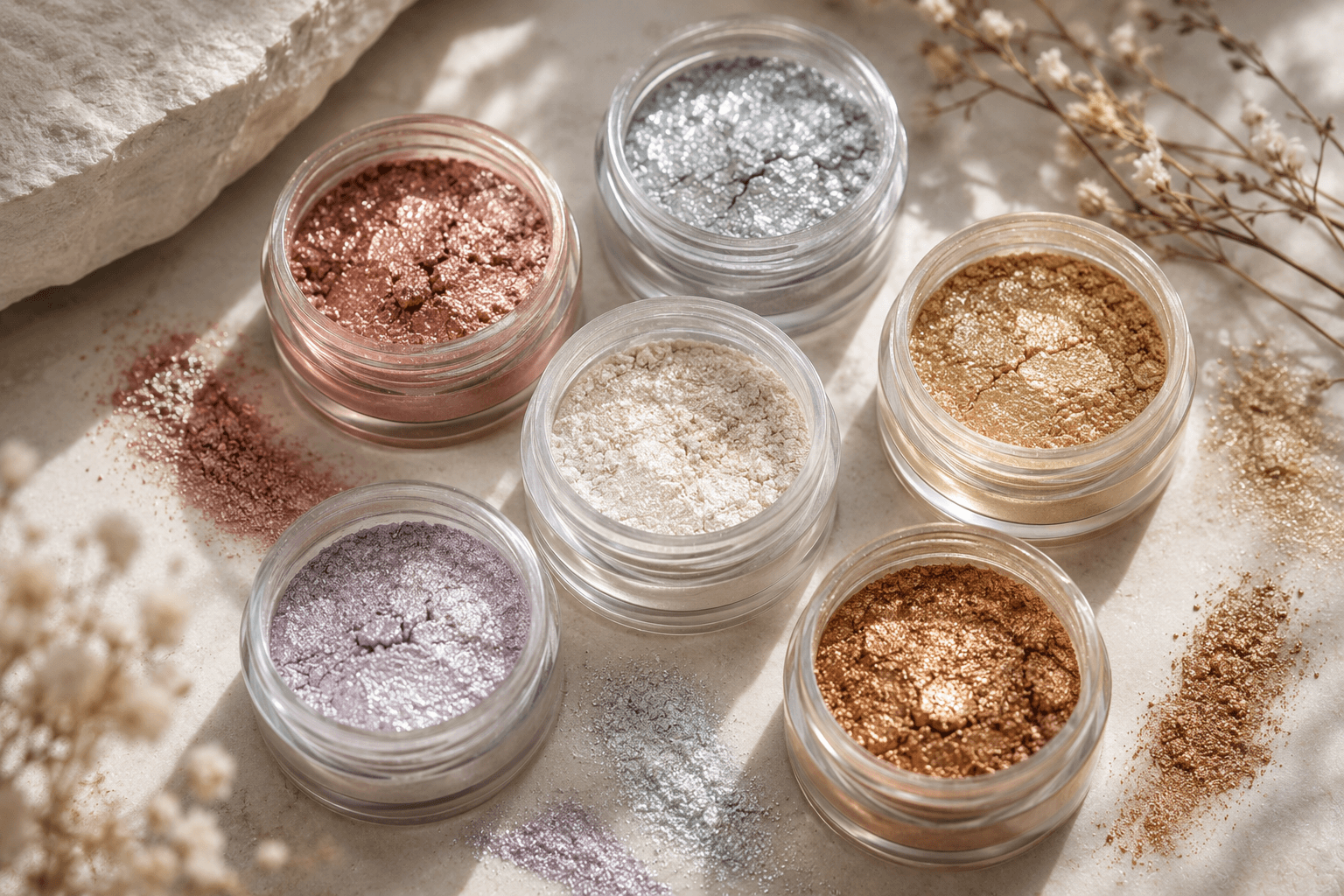
Colourants may be listed at the end of the ingredients list. For decorative cosmetics that come in several shades, the designation may contain or +/- can also be used, if this corresponds to the specific product and its composition.
Parfum, Aroma and allergens
The fragrance can be listed in the ingredients list as:
- Parfum
- Aroma
The manufacturer can decide whether to indicate the perfume or aromatic composition using the general designation Parfum or Aroma, or whether to break down some fragrance components in more detail. However, it is important that mandatory allergens cannot be hidden under the word Parfum.
If the product contains regulated fragrance allergens above the specified limits, they must be stated separately in the ingredients list. This applies to allergens regardless of their source, i.e. not only to fragrance compositions, but also to essential oils or plant extracts.
% NOI: what the share of natural origin means
In cosmetics we increasingly encounter the designation % NOI, i.e. the percentage of ingredients of natural origin. This is information intended to show the customer what part of the product comes from natural or naturally derived raw materials according to the calculation methodology used.
NOI can be a useful piece of information, but the manufacturer should handle it carefully. It is not enough to put a high percentage of natural origin on the label without it being clear which methodology was used for the calculation and whether this information can be substantiated.
When calculating % NOI, it is necessary to start from the exact composition of the formulation, the documentation of the individual raw materials and the data from suppliers. For compound raw materials, it is necessary to take into account which substances they consist of and what proportion of them can be considered natural or naturally derived according to a specific standard or calculation methodology.
It is important to distinguish between a claim of natural origin and certified natural or organic cosmetics. A high % NOI alone does not mean that the product is certified as BIO, organic, COSMOS Organic or to another certified standard.
Practical note
If the manufacturer states the percentage of ingredients of natural origin on the label or in marketing communication, they should be able to substantiate this information. The calculation should be consistent, verifiable and based on the documentation for the raw materials used. Standard ISO 16128-2 provides a framework for determining the natural, naturally derived, organic and organically derived content of cosmetic products, but at the same time it does not address product communication, label claims or regulatory requirements for cosmetics.
Icons and logos on the label: Leaping Bunny, Ecocert, COSMOS and others
Various symbols, logos and marks often appear on cosmetic labels. Some are just graphic icons, others represent independent certifications or verified standards. For the manufacturer, it is important to know that a certification logo cannot be added to the label just because it fits the design or looks trustworthy.
Certification marks such as COSMOS, Ecocert, EU Ecolabel, Leaping Bunny and others are bound to specific rules, an approval process and control by the certification body. Certification is governed by the rules of the specific standard and cannot be replaced by your own marketing statement.
When cosmetics may be labelled as BIO
For cosmetics, it is necessary to distinguish between a general marketing impression and certified labelling. The word BIO or organic should not be used freely by the manufacturer just because the product contains a plant oil, an extract or ingredients that appear natural.
In order for a product to bear the logo of a certification body, it must meet the rules of the specific standard and undergo the certification process.
In the certification of organic and natural cosmetic products, the following are usually assessed, for example:
- The origin and quality of the ingredients.
- The proportion of ingredients of natural origin.
- The proportion of organic ingredients.
- Permitted and prohibited substances.
- The manufacturing process.
- The packaging.
- The labelling of the product.
- Documentation and traceability.
In practice this means: the manufacturer cannot use a certification logo without holding a valid certification. Likewise, they should not create the impression of certified BIO cosmetics if the product only meets the brand’s internal or marketing criteria.
Certification is not the same as your own icon
The label may also contain the brand’s own graphic icon, for example “vegan”, “natural”, “handmade” or “eco packaging”. However, such designations must be truthful and comprehensible, and must not be misleading.
| Type of designation | What it means |
|---|---|
| Independent certification | The product or brand has undergone inspection according to the rules of a specific organisation. |
| The brand’s own icon | This is the manufacturer’s marketing or informational designation, which must be truthful and verifiable. |
| Graphic symbol without certification | It can help orientation, but must not create a false impression of a certificate. |
If the label contains symbols that resemble a certification, the manufacturer should have clearly documented what they mean and on what basis they are used.
Can a QR code replace mandatory information?
A QR code can be a very good supplement to the label. It can lead to extended information about the product, explanations of ingredients, instructions, videos, recommendations for recycling or other educational materials.
However, it should not be understood as a simple replacement for mandatory information.
Mandatory information must be accessible in the way required by cosmetic legislation. If, for practical reasons, it is not possible to state some information directly, it may be given, for example, on an enclosed or attached leaflet, label, tape, tag or card.
| Question | Answer |
|---|---|
| Can a QR code supplement the label? | Yes. |
| Can a QR code replace all mandatory information? | Generally no. |
| Can a QR code be useful for the customer? | Yes, especially for extended information. |
| Must the basic information be physically available? | Yes, according to the labelling rules. |
The most common mistakes in cosmetic labelling
Manufacturers most frequently go wrong on details which, however, can be very important during an inspection or when selling.
- Using national-language or marketing names instead of INCI.
- A missing Ingredients: designation
- Incorrect order of ingredients.
- Incorrect calculation of the composition for raw materials consisting of several INCI components.
- Including the trade name of a compound raw material instead of its individual INCI components.
- Unlisted allergens.
- Using the word Parfum without checking allergens.
- A missing batch number.
- An unclear responsible person.
- Type that is too small or illegible.
- Using a certification logo without a valid certification.
- Free use of the words BIO, organic, natural or eco without a clear basis.
- Stating % NOI without a clear calculation methodology or without documentation from the raw material suppliers.
- Confusing a high proportion of natural origin with certified BIO or organic cosmetics.
- Mandatory information available only via a QR code.
- Claims that sound medicinal or misleading.
Checklist before printing the label
Formulation and composition
- Is the final formulation already closed?
- Have all the INCI names been verified?
- Is the list given in the format Ingredients:?
- Are the ingredients correctly ordered according to their actual proportion in the final product?
- For compound raw materials, have the individual INCI components been calculated according to the supplier’s documentation?
- Has the trade name of a raw material been included in the Ingredients list by mistake instead of its INCI composition?
- Have the technical substances from the raw materials also been correctly assessed?
Allergens, colourants and NOI
- Have the mandatory allergens been calculated and stated?
- Are the colourants stated as CI numbers?
- If the product communicates % NOI, has this figure been calculated according to a clear methodology?
- Does the manufacturer have documentation from the raw material suppliers to support the % NOI?
- Is the information about natural origin clearly distinguished from certified BIO or organic labelling?
Mandatory information on the packaging
- Has the date of minimum durability or the PAO been chosen correctly?
- Is the nominal content stated?
- Is the batch stated?
- Are the responsible person and the address stated?
- Are the necessary warnings stated?
Claims and certifications
- Are the claims on the packaging truthful and verifiable?
- Have any certification logos been used without authorisation?
Physical properties of the label
- Is the label legible on the specific packaging?
- Does the mandatory information physically fit on the packaging?
- Is a multi-layer label, a tag or a card needed?
Conclusion
A correct label is not a formality to be added just before printing. It is the result of the formulation, the safety assessment, the legislative requirements, the packaging solution and responsible communication.
For the manufacturer, a well-prepared label is both a protection and a mark of professionalism. For the customer, it is proof that the product has a clear origin, composition, method of use and responsible person.
A good label does not look cluttered, does not hide important information and does not try to replace facts with pretty icons. A good label helps the product to appear trustworthy and gives the customer exactly the information they need.