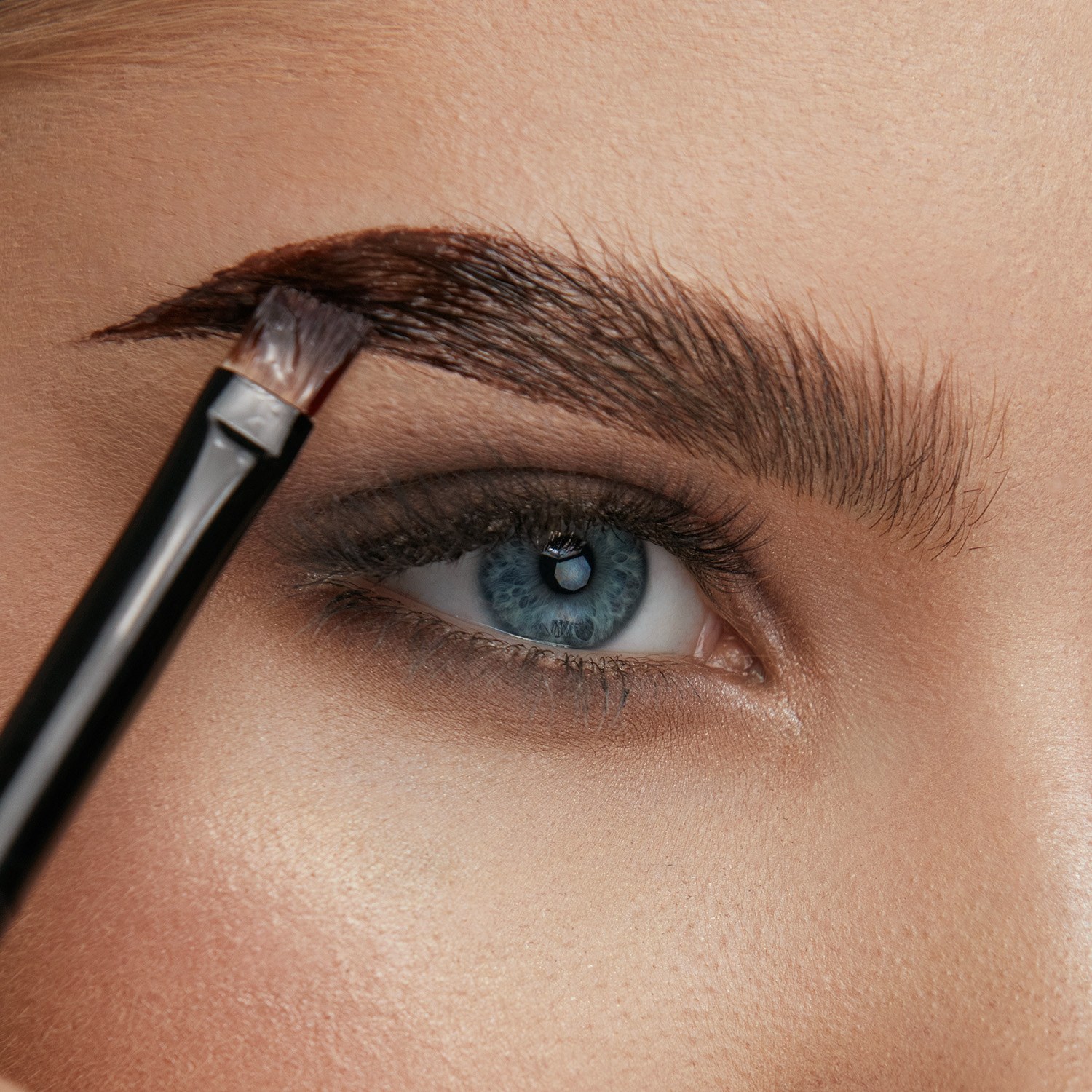
Eyebrow wax is an excellent addition to your make-up. You will use it not only to fix the shape of your eyebrows, but thanks to the pigments you can also use it to fill in sparse areas and to enhance and contour the overall appearance of the eyebrows — this is not a wax intended for depilation. Groomed eyebrows gently frame your face.
About this recipe
The recipe was prepared by the Handymade team. We have prepared two types of eyebrow wax for you — a light and a dark shade. However, if you have specific requirements for your shade, nothing prevents you from blending it exactly to measure!
As the name suggests, the base of the eyebrow wax will be wax. We chose white beeswax for its good availability and compatibility with other ingredients. The product is then supplemented with pigments and oil so that the resulting wax has a pleasant consistency and sufficient coverage.
Main benefits
- Fixes the shape of the eyebrows
You will use the wax to fix the shape of your eyebrows — groomed eyebrows gently frame your face.
- Filling in and contouring
Thanks to the pigments, you can fill in sparse areas and enhance and contour the overall appearance of the eyebrows.
- A shade tailored exactly to you
Besides the light and dark shade, you can also blend your own shade by combining yellow, brown and black pigment.
- Simple, water-free production
The wax does not contain water-based ingredients — there is no need to create an emulsion or to use a preservative.
Product properties
Key ingredients in the recipe
Below, we will introduce the individual ingredients for making eyebrow wax. You will learn more about their possible substitutions and their importance for the recipe so that you can prepare a product tailored to your needs.
MCT Caprylis — neutral oil
To soften the resulting eyebrow wax and ensure easy application, the neutral oil MCT Caprylis was chosen. The advantage of this oil lies in its high stability, and therefore it is very little prone to oxidation. Thanks to this, products containing it remain fresh longer even without the use of an antioxidant. In addition, MCT Caprylis is odourless and colourless and thus does not affect the final appearance of the product. Its alternative is other oils that are minimally coloured, such as fractionated coconut oil. However, you can choose any liquid vegetable oil.
White beeswax
To give the final product hardness and the correct consistency, beeswax was chosen. White beeswax is refined and deprived of colour and odour, and is therefore suitable for pigmented products because it does not affect their colour. However, you can replace it with a natural unrefined version of beeswax.
For vegan cosmetics, almond wax is suitable. Overall, you can also replace beeswax with other waxes intended for cosmetics, but you should count on a slight change in the firmness and consistency of the final product. Waxes differ in their hardness and melting point.
By reducing the proportion of wax in the recipe, you can create an eyebrow wax that is softer and easier to apply. On the other hand, if it seems to you that the eyebrow wax melts too much and does not hold well on the skin, increase the wax content in the recipe at the expense of the oil.
Modified rice starch
Rice starch is an ingredient specially created for use in cosmetics, which in this guide has two roles. It is a matte white powder whose task is to create a uniform colour base for the addition of coloured oxides and to achieve the colouring of the resulting eyebrow wax. Its second role is to improve the durability of make-up (it improves the adhesion of the product to the skin) and to slightly thicken the consistency of the mixture. We recommend that you do not omit this ingredient, as this would lead to a change in both the consistency and the colour of the final product on the skin.
Titanium dioxide, oil
Titanium dioxide is a strongly white pigment. Thanks to its presence, it is sufficient to use a much smaller amount of coloured pigments to achieve an intense colour of the eyebrow wax. Without titanium dioxide, the eyebrow wax would only weakly contour and fill in the missing parts of the eyebrows. That is why it is good to add this substance to the product.
Always choose titanium dioxide that is oil-dispersible, otherwise it will take too long to fully combine with the other ingredients. Likewise, when mixing the final product, make sure that you do not see any white spots of undispersed titanium dioxide in the product before pouring it into the container.
Iron oxides
The main colouring pigments in the eyebrow wax are various coloured versions of iron oxide — specifically its yellow and black versions and the dark brown version. It is precisely by combining these pigments that you can blend a shade exactly tailored to you.
Do not substitute the oxides with mica powder — mica powders contain shimmer, and such an eyebrow wax may not give the most natural look on the skin. However, if you want a slightly shiny and sparkling eyebrow wax, feel free to add mica powders.
The recipe (100 g)
The recipe is given in percentages by weight — with the basic 100 g batch, the percentages correspond directly to grams. The ingredients are divided into phase A (oil and wax, melted in a water bath) and phase B (starch and pigments). Choose either the light or the dark shade.
Eyebrow wax — light shade
| Phase / ingredient | Content |
|---|---|
| Phase A | |
| MCT Caprylis neutral oil | 50,00 % |
| Beeswax, white | 35,20 % |
| Phase B | |
| Modified rice starch | 9,10 % |
| Titanium dioxide, oil | 2,70 % |
| Iron oxide, yellow | 1,00 % |
| Iron oxide, dark brown | 2,00 % |
| Packaging | |
| Plastic jar | 1 pc |
Eyebrow wax — dark shade
| Phase / ingredient | Content |
|---|---|
| Phase A | |
| MCT Caprylis neutral oil | 50,00 % |
| Beeswax, white | 35,20 % |
| Phase B | |
| Modified rice starch | 9,10 % |
| Titanium dioxide, oil | 1,80 % |
| Iron oxide, black | 1,00 % |
| Iron oxide, dark brown | 2,90 % |
| Packaging | |
| Plastic jar | 1 pc |
It is therefore missing from the shopping lists — we list it in the recipe rows for completeness. You will find the available shades in the oxides category.
Method
- Disinfection
Disinfect all tools, containers and packaging, for example with ethanol.
- Melting phase A
Into a heat-resistant container, weigh out the ingredients of phase A. Cover with aluminium foil, place in a water bath and heat.
Phase Awater bath - Adding phase B
Meanwhile, weigh the ingredients of phase B into another container. Add phase B, still in the water bath, to the melted phase A and stir thoroughly.
Phase B - Mixing the pigments thoroughly
Stir the eyebrow wax for several minutes in the water bath until all the pigments are thoroughly combined and the lumps have disappeared. It is suitable to use a silicone spatula (e.g. a confectionery spatula). If, after running along the bottom of the container, you no longer see any remnants of white, unmixed titanium dioxide or other pigments, the product has been mixed sufficiently.
several minutes - Filling and setting
Pour the still hot eyebrow wax into the prepared jars and leave it to solidify, ideally overnight, in order to achieve the final consistency. The product is then ready for use.
overnight
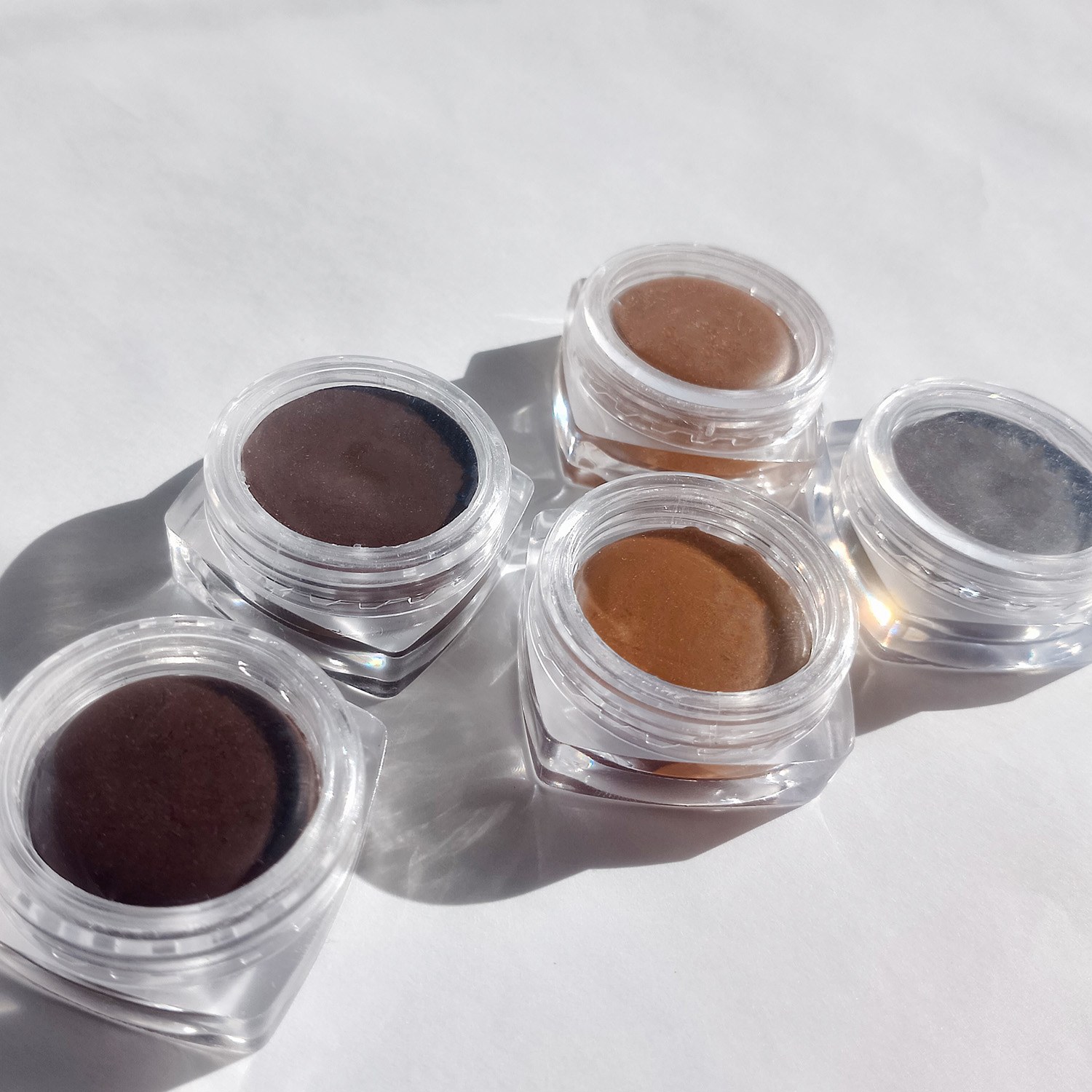
Tips and tricks
We bring you a few tips and tricks on how to make the production of eyebrow wax easier, or how to solve problems during its manufacture.
Since eyebrow wax does not contain any water-based ingredients, it is not necessary to create an emulsion and the production is all the simpler. On the other hand, the key step in production is thorough dispersing of the pigments in the melted oil phase.
If the pigments are not thoroughly dispersed, it may happen that clumps of pigment sink to the bottom of the container and, during application, streaks of darker or lighter spots of undispersed pigment can appear on the skin. You prevent this by thoroughly mixing the mixture, for example with a silicone spatula. When making smaller batches, you can also opt for small silicone spatulas for face masks.
One way to improve the binding of pigments and oils is to thoroughly grind and mix the pigments (the entire phase B) in a mortar or a small mixer before adding them to phase A. This is particularly useful if you are making larger batches. On the other hand, if you are making only small amounts, you may lose a relatively large portion of the powder ingredient due to the use of the mortar or mixer, which will be more difficult to remove, especially from the mixer.
If you want to blend your own shade, start with small additions of the individual pigments (yellow, black or brown pigment). Write down the quantities so that you can reproduce the given shade again later.
The resulting eyebrow wax does not contain water, and therefore it is not necessary to use a preservative. However, if the oils and waxes in the product undergo significant oxidation (the product will smell bad, the consistency will change to sticky, or the colour will change), do not continue to use the product and make a new one. It is ideal to make small batches so that you always have a fresh product at hand.
How to use it
When applying eyebrow wax, it is suitable to use a firmer angled brush, but you can choose any applicator that suits you. For make-up removal, oil-based make-up removers (cleansing oil or balm) are suitable.
Warning
As mentioned, you can experiment with homemade recipes to achieve the desired properties. However, the final result can be influenced by many factors, such as humidity, temperature, quality of the ingredients or their storage.
Before using any ingredient to make a cosmetic product, familiarise yourself with its properties, recommended dosage, storage conditions and safe handling. Each ingredient may have the potential to cause an allergic reaction in sensitive individuals, so before using the product we recommend determining whether you suffer from an allergy to any of the ingredients or to the overall product, for example by means of a skin test.
If you have very sensitive or very acne-prone skin, or if you have other skin and health problems, we recommend that you consult a medical professional before applying a new product to your skin, whether it is a homemade cosmetic product, a pure ingredient or a commercially available product.
Frequently asked questions about the recipe
Practical questions about eyebrow wax — blending your own shade, preservation, dispersing the pigments, application and ingredient substitutions.
Is the eyebrow wax also intended for depilation?
No — this is not a wax intended for depilation. It serves to fix the shape of the eyebrows, to fill in sparse areas and to enhance and contour the overall appearance of the eyebrows.
How do I blend my own shade?
Start with small additions of the individual pigments (yellow, black or brown). Write down the quantities so that you can reproduce the given shade again later. Rice starch with titanium dioxide serves as the colour base, while the iron oxides provide the colouring.
Why does the recipe not need a preservative?
Eyebrow wax does not contain water or any other water-based ingredients, so it is not necessary to use a preservative. However, if the oils and waxes in the product undergo significant oxidation (the product will smell bad, the consistency will change to sticky, or the colour will change), do not continue to use it and make a new one. It is ideal to make small batches.
How do I prevent lumps of pigment and streaks?
The key step is thorough dispersing of the pigments in the melted oil phase, for example with a silicone spatula. It also helps to mix the entire phase B in a mortar or a small mixer before adding it to phase A — this is particularly useful with larger batches.
What should I use to apply and remove the eyebrow wax?
A firmer angled brush is suitable for application, but you can choose any applicator that suits you. For make-up removal, oil-based make-up removers are suitable — cleansing oil or balm.
Can I replace the beeswax with another wax?
Yes — you can replace white beeswax with the natural unrefined version, and for vegan cosmetics almond wax is suitable. However, count on a slight change in the firmness and consistency. By reducing the proportion of wax the product will be softer, and by increasing it the product will hold better on the skin.
You will find all the ingredients from this recipe in the Handymade.sk range — oxide pigments, waxes and oils.