
Preservative 1388 eco plus is a modern antimicrobial ingredient designed for the preservation of cosmetic products. It uses new and sustainable technologies that enable safe preservation without the need to use traditional preservatives, which are often associated with skin irritation or negative consumer perception.
About this article
Why is choosing a high-quality preservative, such as Preservative 1388 eco plus, crucial for safe and effective cosmetics? In this article we go through the basic characteristics of this antimicrobial blend, its origin and composition, its mechanism of action and efficacy against microorganisms, the recommended dosage according to the pH of the final product and, finally, practical formulation tips.
Main benefits
- Broad-spectrum protection
This is a broad-spectrum antimicrobial blend — it provides protection against bacteria, yeasts and moulds.
- 100 % natural
The blend is 100 % natural and vegan, and its index of natural origin (NOI according to ISO 16128) has a value of 1.0.
- Easy solubility
It is liquid and easily soluble in water, so it is used directly and simply in formulations.
- Economical and versatile
It is cost-effective and easy to use, and suitable for all types of formulations.
- Without traditional preservatives
It enables safe preservation without the need for traditional preservatives, which tend to be associated with skin irritation.
Properties of the raw material
Characteristics and origin
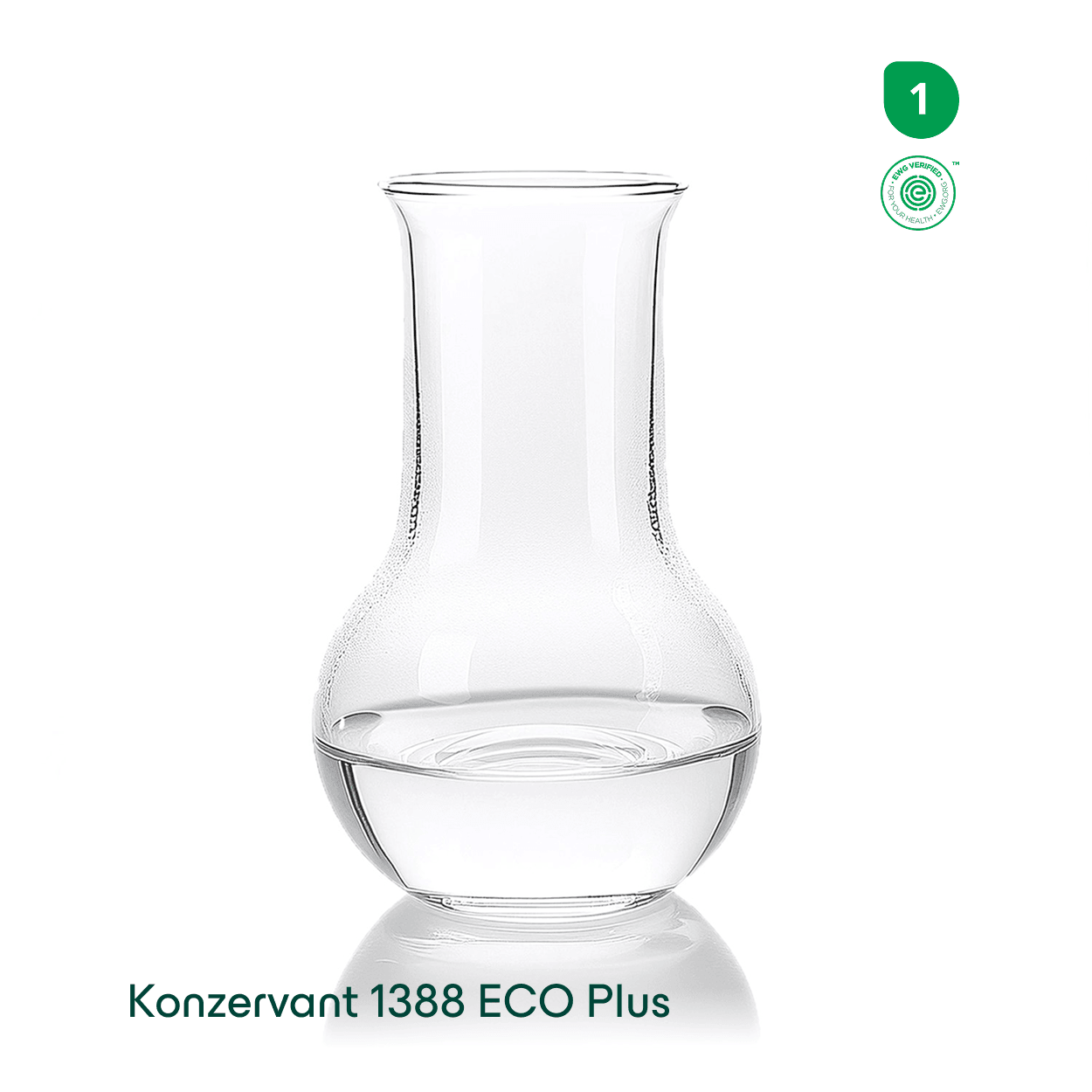
The main principle is the combination of natural organic acids, which provide effective protection against bacteria, yeasts and moulds. In the case of Preservative 1388 eco plus, this is a blend of salts of levulinic acid and anisic acid, supplemented with glycerin for better solubility.
Preservative 1388 eco plus is an aqueous solution containing the sodium salt of levulinic acid and the sodium salt of anisic acid in an optimal ratio. Glycerin acts as an auxiliary substance increasing solubility. Thanks to this, it avoids problems with the low solubility of anisic acid and allows direct and simple use in formulations.
The raw materials are of plant origin: levulinic acid from sugar cane or corn, anisic acid from star anise and glycerin from rapeseed oil. The product is 100 % natural, vegan and meets the criteria of the COSMOS and Natrue certifications. The index of natural origin (NOI according to ISO 16128) has a value of 1.0.
Mechanism of action and antimicrobial efficacy
The effective organic acids act on microorganisms by penetrating the cell and changing its internal pH, which leads to the demise of the microorganism. Therefore, the efficacy of Preservative 1388 eco plus is pH-dependent. It achieves the best results in the range of pH 3.5 – 6.0, which is suitable for most cosmetic products.
Efficacy against microorganisms:
| Microorganism | Efficacy |
|---|---|
| Gram+ bacteria | Very good |
| Gram- bacteria | Very good |
| Yeasts | Very good |
| Moulds | Very good |
Recommended dosage according to pH
Since Preservative 1388 eco plus is pH-dependent, the higher the final pH of the product, the higher the dosage of the preservative should be. In the table below we present the recommended dosage at different pH values of the final product.
| pH | Dosage |
|---|---|
| 3.5 | 2.5 % |
| 4.5 | 3.5 % |
| 5.5 | 4.0 % |
| 6.0 | 5.0 % |
Formulation tips
- Adding to the aqueous phase Aqueous phase
The preservative is added to the aqueous phase under continuous stirring.
- Heating the aqueous phase up to 80 °C
The aqueous phase can be heated up to 80 °C.
- Before homogenisation
It is recommended to add it before homogenisation.
Frequently asked questions about Preservative 1388 eco plus
Practical questions about this raw material — dosage according to pH, efficacy range, origin of the raw materials, certifications and incorporation into a formulation.
What is the recommended dosage of Preservative 1388 eco plus?
The recommended dosage is 2.5 – 5.0 % and is governed by the final pH of the product: at pH 3.5 it is 2.5 %, at pH 4.5 3.5 %, at pH 5.5 4.0 % and at pH 6.0 5.0 %. The higher the final pH of the product, the higher the dosage of the preservative should be.
In what pH range does the preservative work?
Its efficacy is pH-dependent — it achieves the best results in the range of pH 3.5 – 6.0, which is suitable for most cosmetic products.
Which microorganisms does the preservative act against?
Its efficacy is very good against Gram+ bacteria, Gram- bacteria, yeasts and moulds. The organic acids penetrate the cell and change its internal pH, which leads to the demise of the microorganism.
What is Preservative 1388 eco plus made from?
The raw materials are of plant origin: levulinic acid from sugar cane or corn, anisic acid from star anise and glycerin from rapeseed oil. The INCI composition is Sodium Levulinate, Sodium Anisate, Glycerin, Aqua.
Is it suitable for certified natural cosmetics?
Yes — the product is 100 % natural, vegan and meets the criteria of the COSMOS and Natrue certifications. The index of natural origin (NOI according to ISO 16128) has a value of 1.0.
When and how should the preservative be added to a formulation?
It is added to the aqueous phase under continuous stirring, and the aqueous phase can be heated up to 80 °C. It is recommended to add it before homogenisation.
Conclusion
Preservative 1388 eco plus represents a modern and sustainable approach to the preservation of cosmetics — it combines natural origin, high efficacy and simple use in formulations. Thanks to the combination of levulinic acid and anisic acid, it provides reliable antimicrobial protection that is gentle on the skin and on the environment, making it an ideal choice for both natural and conventional cosmetics.
You will find Preservative 1388 eco plus in 10, 50 and 100 ml packs, along with other preservatives, in the Handymade range of raw materials.