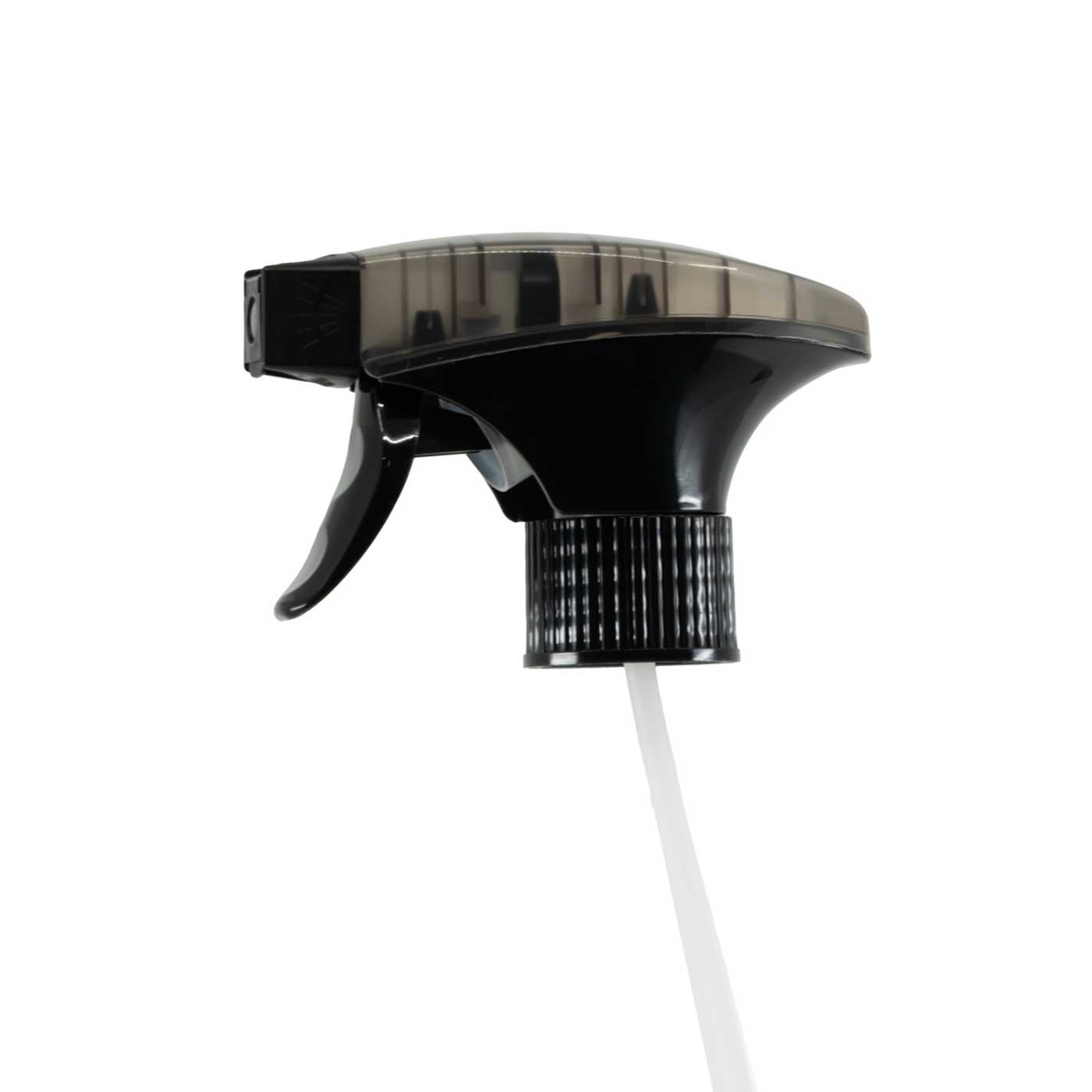
Foam pump sprayer turns a liquid formulation into dense foam without propellant gas. When the lever is pressed, it does not atomise the liquid into a mist but mixes it with air and dispenses it as foam that spreads easily. Suitable for products applied over larger areas: bathroom and kitchen foam cleaners, foaming hand soaps, pet shampoos, upholstery cleaning agents, and foam shoe care products.
Foam stays on a surface longer than liquid, runs less on vertical surfaces, and can be dispensed more economically than pouring. For a cosmetics or household-product manufacturer, it is a straightforward way to turn an aqueous surfactant solution into a product with a more pleasant application experience. The sprayer has a 28/410 neck finish and is suitable for both cosmetic and technical formulations.
How foam is formed and what this means for the formulation
When the lever is pressed, the formulation is drawn up through the dip tube and forced through the foamer mesh, where the liquid stream is mixed with air. The sprayer does not create foam on its own — the formulation composition is decisive. Key points:
- Surfactants are essential – foam is only produced by a solution with a sufficient content of foaming surface-active agents, for example Cocamidopropyl Betaine, Sodium Coco-Sulfate, or Decyl Glucoside. Pure water, a hydrolat, or a surfactant-free solution will come out as a thin stream, not foam.
- Low viscosity – the formulation must be as fluid as water or only slightly thicker. The mechanism struggles to draw up gel cleansers and thickened shampoos, the foam is thin or does not form, and the mesh clogs.
- No oils or undissolved particles – oils, exfoliating particles, or undissolved powder will block the mesh. Oil-based formulations also destabilise foam.
- Surfactant concentration determines foam quality – too much surfactant produces dense foam but makes rinsing harder and can leave a film on surfaces in the case of cleansers. Test several concentrations and choose the one at which the foam is stable and rinses off easily.
Test the formulation directly in this sprayer, not in a standard mist sprayer. The same solution behaves differently in a foamer, and only a practical test will confirm the right viscosity and surfactant level.
Use with a bottle
The sprayer is designed for bottles with a 28/410 neck finish. Compatible bottles and ready-made bottle-and-sprayer combinations are available in the Handymade range. The transparent dip tube is long enough to reach the bottom of taller bottles. For a shorter bottle, cut it to length with a sharp knife or scissors so that the end touches the bottom without bending. A bent dip tube draws in air, producing uneven foam.
Do not fill the bottle to the brim. The nominal volume is the amount the bottle is designed for. The total capacity up to the brim is greater, but part of it is taken up by the sprayer head and dip tube, so the formulation would overflow when closing. Fill only to the nominal volume, not to the neck. With your own bottle-and-sprayer combination, verify the seal integrity, consistency of the dose, and the behaviour of the formulation after the filled package has been standing for several days.
Good to know
- Suitability for cosmetics – the sprayer is made of polypropylene (PP) and is suitable for use with cosmetic products. The declaration of conformity and technical documentation are available with the product.
- Before first use – rinse the sprayer with clean water, or pump a small amount of ethanol or isopropyl alcohol through it and allow it to dry. This removes any residues from manufacturing and transport.
- Cleaning and reuse – when changing the formulation or before storing, pump clean water through the mechanism. Dried surfactant in the mesh is the most common reason a sprayer stops foaming. A clean mechanism with a smoothly operating lever can be reused.
- Essential oils and solvents – polypropylene tolerates standard aqueous surfactant solutions and most cleaning formulations. For formulations with a higher proportion of essential oils, limonene, or organic solvents, verify in advance that the material does not soften and that the seal does not begin to leak.
- Chemically aggressive formulations – strong acids, alkalis, or chlorine-based cleaners can damage the spring and seals of the mechanism. For such formulations, carry out a storage test in the filled package and monitor dosing over several weeks.
The foam pump sprayer is not intended for fine mist atomisation. For that purpose, use a standard trigger sprayer. For alcohol-based and flammable formulations, verify material compatibility in advance.
Frequently asked questions
Why does the foam pump sprayer not produce foam?
The most common cause is a formulation with insufficient surfactant content or a recipe that is too thick. Foam is created by mixing a surfactant solution with air in the foamer mesh. Water, a hydrolat, and oil-based formulations will not produce foam. If the formulation foamed previously and has stopped, the mesh is most likely blocked with dried residue. Rinsing it with water or pumping a small amount of ethanol through it is usually sufficient.
Which bottles are compatible with the 28/410 foam pump sprayer?
The sprayer fits any bottle with a 28/410 neck finish, meaning a neck diameter of 28 mm. Trim the dip tube to the height of the bottle so that the end reaches the bottom without bending. With your own bottle-and-sprayer combination, verify the seal integrity and consistency of the dose; ready-made combinations have already passed this check.
Can the foam pump sprayer be used for shampoo or hand soap?
Yes, provided the formulation is sufficiently fluid. The foamer works with aqueous surfactant solutions. A standard thickened shampoo is too viscous and needs to be diluted with water and then preserved accordingly. For foaming hand soaps and pet shampoos, this is a practical dispensing format, as the foam spreads easily and the formulation is not wasted.
Is the plastic foam pump sprayer suitable for formulations containing essential oils?
For standard cleansing and cosmetic formulations with a low proportion of essential oils, yes. Polypropylene is resistant to aqueous surfactant solutions, but at higher concentrations of essential oils, limonene, or organic solvents, it may soften or lose its seal. In that case, carry out a storage test in the filled package for several weeks before releasing the product.
How do I clean the foam pump sprayer for reuse?
Pump clean water through the mechanism until it comes out without foam, then allow it to dry. When switching to a different type of formulation or before extended storage, pump a small amount of ethanol or isopropyl alcohol through to remove any surfactant residue from the mesh. A well-maintained sprayer can be reused as long as the lever operates smoothly and the dose is consistent.