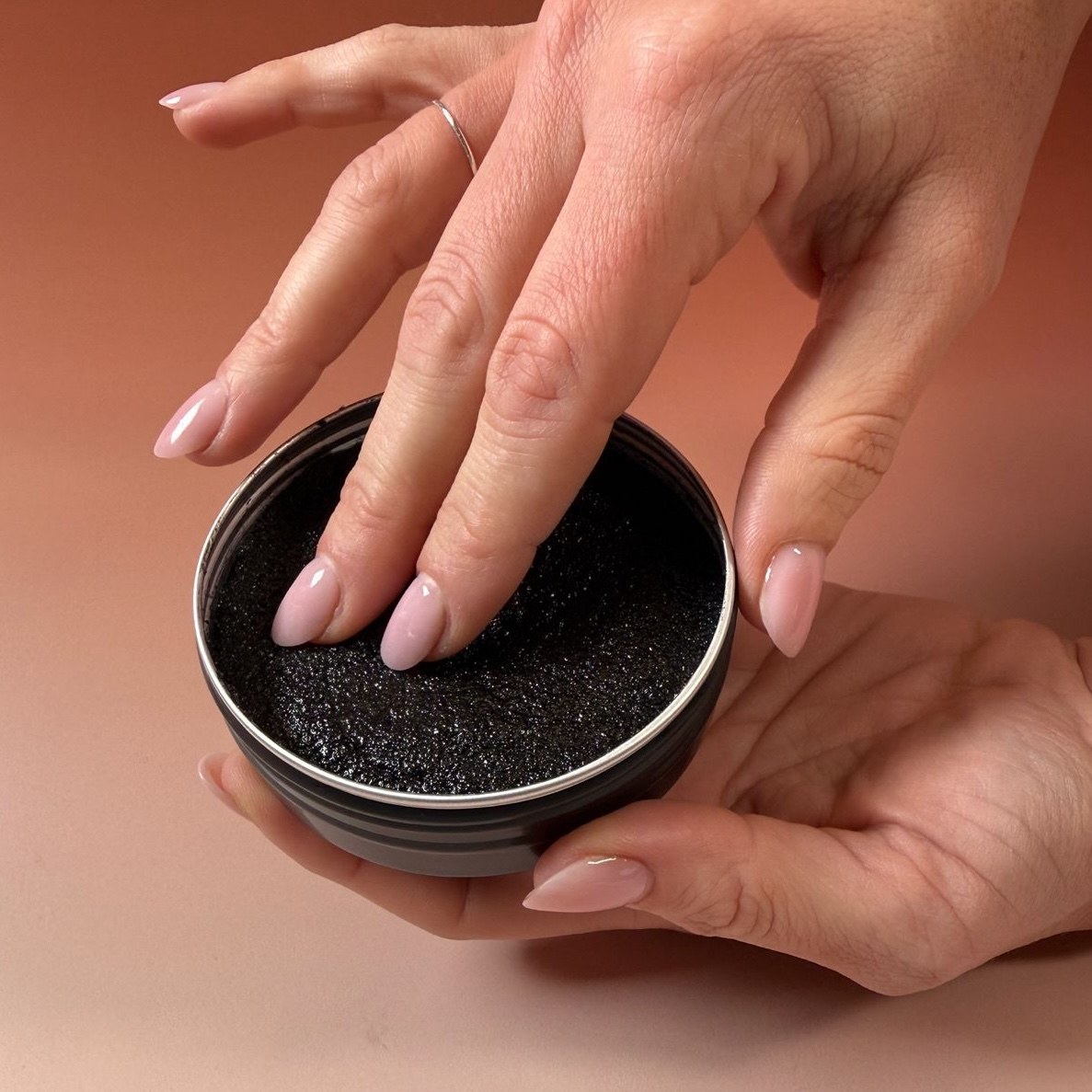
A gel body scrub can easily be created at home by any beginner in cosmetic formulation. We bring you instructions for a simple gel body scrub that you can adapt to your liking using mica powders and fragrance or essential oils. Making it is not complicated, so it is a suitable product even for beginners!
About this recipe
The excellent method for making this scrub was prepared by Ivana Jačalová. The gel body scrub is a water-based product that, however, contains a thickener – guar gum, which also helps to disperse the small amount of fragrance oil in the product. As exfoliating particles, jojoba beads were chosen because they do not dissolve in water, therefore sugar or salt are not suitable as exfoliating materials for this formula.
Key benefits
- Even a beginner can manage it
Making it is not complicated, so the gel body scrub is a suitable product even for beginners in cosmetic formulation.
- You can adapt it
Using mica powders and fragrance or essential oils, you can tailor the scrub exactly to your liking.
- Particles that will not dissolve
The exfoliating particles were chosen so that they do not dissolve in water — therefore sugar or salt are not suitable as exfoliating materials for this formula.
- The physiological pH of the skin
The scrub is adjusted to a range of pH 4.5 to 5.5, which is the physiological pH of the skin — the product is therefore better tolerated by the skin.
- Freshness and softness
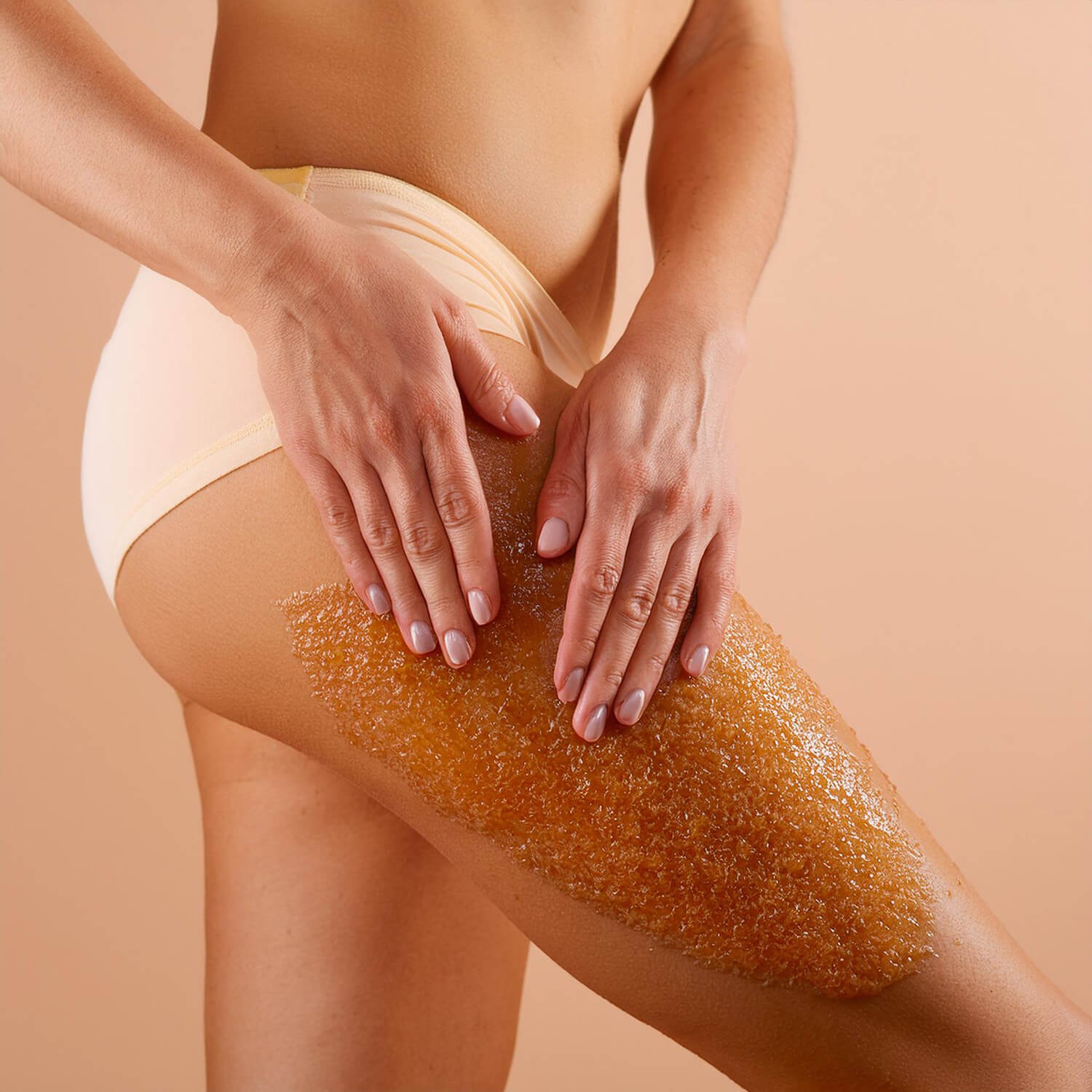
A homemade body scrub restores freshness and softness to the skin, and you also treat yourself to a little relaxation while using it.
Product properties
Key ingredients in the formula
In the following lines, we bring you the function of the individual ingredients in the formula. At the same time, you will learn more about their possible substitutions and the options for tailoring the product exactly to your needs.
Guar gum
To create a gel-like consistency in the product, it is necessary to use a thickener, in this case guar gum. By changing the content of guar gum, you can create thicker or thinner gels. An alternative to this gum is xanthan gum, which, however, thickens somewhat more strongly, so it is usually sufficient to add only 1 %.
Strawberry seeds
The exfoliating component of the product is the strawberry seeds. They have a strawberry scent that perfumes the product. An alternative to them is any other exfoliating particles that are insoluble in water, such as ground strawberry seeds or finely ground pumice powder. You can also play with the content of exfoliating particles in the gel scrub and adapt it to your needs.
Aloe vera juice
Aloe vera juice is an excellent ingredient for the care of irritated skin. It is already a diluted and preserved aloe vera juice, similar in its properties to hydrolats. For this reason, this ingredient can be replaced by a hydrolat or demineralised water, but each such substitution will result in a change in the required amount of lactic acid for pH adjustment.
Lactic acid
Lactic acid was chosen for pH adjustment, as it is already sold in the form of an aqueous solution and can therefore be added directly to the product. Its alternative is citric acid, which must first be dissolved in a 1:1 ratio in demineralised water, and the resulting solution used for pH adjustment. pH adjustment must always be carried out to ensure the function of the preservative and good skin tolerance of the product. Information on how to do this can be found in the Tips and tricks section.
Euxyl K903
The preservative in the gel body scrub is Euxyl K903. This preservative is active at an acidic pH, therefore it must be adjusted, for example with lactic acid. Do not omit the preservative from the product, as the scrub would spoil very quickly due to its water content. You can replace Euxyl K903 with another broad-spectrum preservative. However, always check in which pH range the preservative is active and adjust the product pH accordingly.
Other ingredients
Demineralised water is the base of most types of cosmetics. Do not use tap water or filtered water; minerals will still be present in it that can disrupt the stability of the product. An alternative may be floral hydrolats, which can replace the entire water portion of the formula.
Pigments — for colouring the final product, a mixture of pigments was used, from mica powders to two-tone pigments. The choice of pigment is truly up to you; you can also reach for cosmetic glitter. However, jojoba beads are brown and will therefore be more visible when lighter pigments are used.
Glycerin is a water-soluble alcohol used to moisturise the skin. It also helps to speed up the hydration of guar gum, so smaller lumps of this gum will form and you will obtain a homogeneous gel without lumps more quickly. It is therefore possible to omit glycerin from the product, but then it will take longer for the guar gum to become fully hydrated.
Fragrance oil — for all lovers of fragranced cosmetics, we have added a wonderfully woody-scented fragrance oil, Moroccan Amber, to the product. However, choose your own fragrance oil, the one that suits you best. An alternative to fragrance oils is represented by essential oils; with them, always follow the dosage, for example according to IFRA standards, to avoid an allergic reaction. Or you can prepare an unperfumed product by omitting the fragrance oil and topping up with water.
Formula (100 g)
The ingredient content is given in percentages by weight, so it corresponds to a batch of 100 g of finished scrub. The formula is divided into three phases: the aqueous phase A, the mixture of pigments and guar gum with glycerin in phase B, and the ingredients added at the end in phase C.
| Phase / ingredient | Content in % |
|---|---|
| Phase A | |
| Demineralised water | 78.03 % |
| Aloe vera juice | 5.00 % |
| Phase B | |
| Glycerin | 8.00 % |
| Pigment, two-tone, gold | 0.05 % |
| Mica powder Brushed Bronze | 0.10 % |
| Mica powder Coppery Blush | 0.05 % |
| Guar gum | 1.30 % |
| Phase C | |
| Strawberry seeds | 6.00 % |
| Fragrance oil, Moroccan Amber | 0.25 % |
| Lactic acid | 0.22 % |
| Euxyl K903 | 1.00 % |
| Packaging | |
| Glass jar | — |
Method
- Disinfection
Disinfect all utensils, containers and packaging, for example with ethanol.
- Aqueous phase Phase A
Weigh the ingredients of phase A, mix well.
- Paste of pigments and gum Phase B
In a second container, mix the ingredients of phase B, stirring until a thick paste without lumps is formed.
- Combining the phases Phase A + B
Pour the aqueous ingredients (phase A) into the mixture of pigments and guar gum (phase B), mix well, the mixture will slowly start to thicken.
- pH adjustment pH 4.5 – 5.5
Subsequently, check the pH of the mixture, for example using indicator strips, and adjust it with lactic acid to a range of 4.5 to 5.5. Add the acid dropwise and always check the pH after each addition. The stated amount of lactic acid is only indicative, see Tips and tricks.
- Finishing and standing Phase Covernight
After adjusting the pH, stir the remaining ingredients of phase C into the mixture. Ideally, leave the product to stand in a covered container overnight so that it reaches its final viscosity, and then fill it into packaging. The scrub is then ready to use.
Tips and tricks
When making the gel body scrub, you may, for example, encounter problems when adjusting the pH. Therefore, we bring you a few tips on how to handle this part of the body scrub preparation as easily as possible.
It is necessary to adjust the pH of the product not only for the correct efficacy of the preservative, but the final scrub will also be better tolerated by the skin, since a pH in the range of 4.5 to 5.5 is the physiological pH of the skin. When adjusting the pH, proceed slowly and add lactic acid dropwise. Always mix the mixture thoroughly and check the pH before the next addition. The stated amount of lactic acid is only indicative and your actual consumption depends on many factors, such as the quality of the ingredients, weighing accuracy, substitutions in the formula and others.
Do not use sugar or salt as exfoliating particles, because these substances will dissolve in the water present in the product. At the same time, the scrub is a rinse-off product, so after massaging it into the skin, rinse off the residue from the skin with clean water.
Warning
As mentioned, you can experiment with homemade recipes to achieve the desired properties. However, the final result can be influenced by many factors, such as humidity, temperature, quality of the ingredients or their storage.
Before you use any ingredient to make a cosmetic product, familiarise yourself with its properties, recommended dosage, storage conditions and safe handling. Each ingredient may have the potential to trigger an allergic reaction in sensitive individuals, so before using the product, we recommend determining whether you are allergic to any of the ingredients or the overall product, for example by a skin test.
If you have very sensitive or very acne-prone skin, or if you have other skin and health problems, we recommend consulting a medical professional before applying a new product to the skin, whether it is a homemade cosmetic product, a pure ingredient or a commercially available product.
Frequently asked questions about the recipe
Practical questions about the gel body scrub — pH adjustment, preservation, ingredient substitutions and use.
Why are sugar and salt unsuitable for a gel scrub?
The scrub is a water-based product and both sugar and salt will dissolve in the water present in the product. That is why exfoliating particles that do not dissolve in water were chosen.
How do I adjust the pH of the scrub correctly?
Adjust the pH with lactic acid to a range of 4.5 to 5.5. Add the acid dropwise, always mix the mixture thoroughly and check the pH after each addition, for example with indicator strips. The stated amount of lactic acid is only indicative — the actual consumption depends on the quality of the ingredients, weighing accuracy or substitutions in the formula.
Can I omit the preservative from the recipe?
Do not omit the preservative from the product — due to its water content, the scrub would spoil very quickly. You can replace Euxyl K903 with another broad-spectrum preservative, but always check in which pH range the preservative is active and adjust the product pH accordingly.
What can I use instead of guar gum?
An alternative is xanthan gum, which, however, thickens somewhat more strongly, so it is usually sufficient to add only 1 %. By changing the content of the thickener, you can create thicker or thinner gels.
Do I have to use demineralised water?
Do not use tap water or filtered water — minerals will still be present in it that can disrupt the stability of the product. An alternative is floral hydrolats, which can replace the entire water portion of the formula.
How is the finished scrub used?
The scrub is a rinse-off product — after massaging it into the skin, rinse the residue off the skin with clean water. Before filling it into packaging, it is ideal to leave the product to stand overnight in a covered container so that it reaches its final viscosity.
Conclusion
A homemade body scrub restores freshness and softness to the skin thanks to the jojoba beads. Treat yourself to relaxation and use natural homemade cosmetic products that you make yourself. We thank Ivana Jačalová for the excellent method for creating this scrub.
You can feel free to contact us with your questions. Write to us at [email protected].
Do not stop creating and making. We look forward to your creations.
You will find the guar gum, strawberry seeds, aloe vera juice, mica powders and preservative from this recipe in the Handymade ingredient range.