
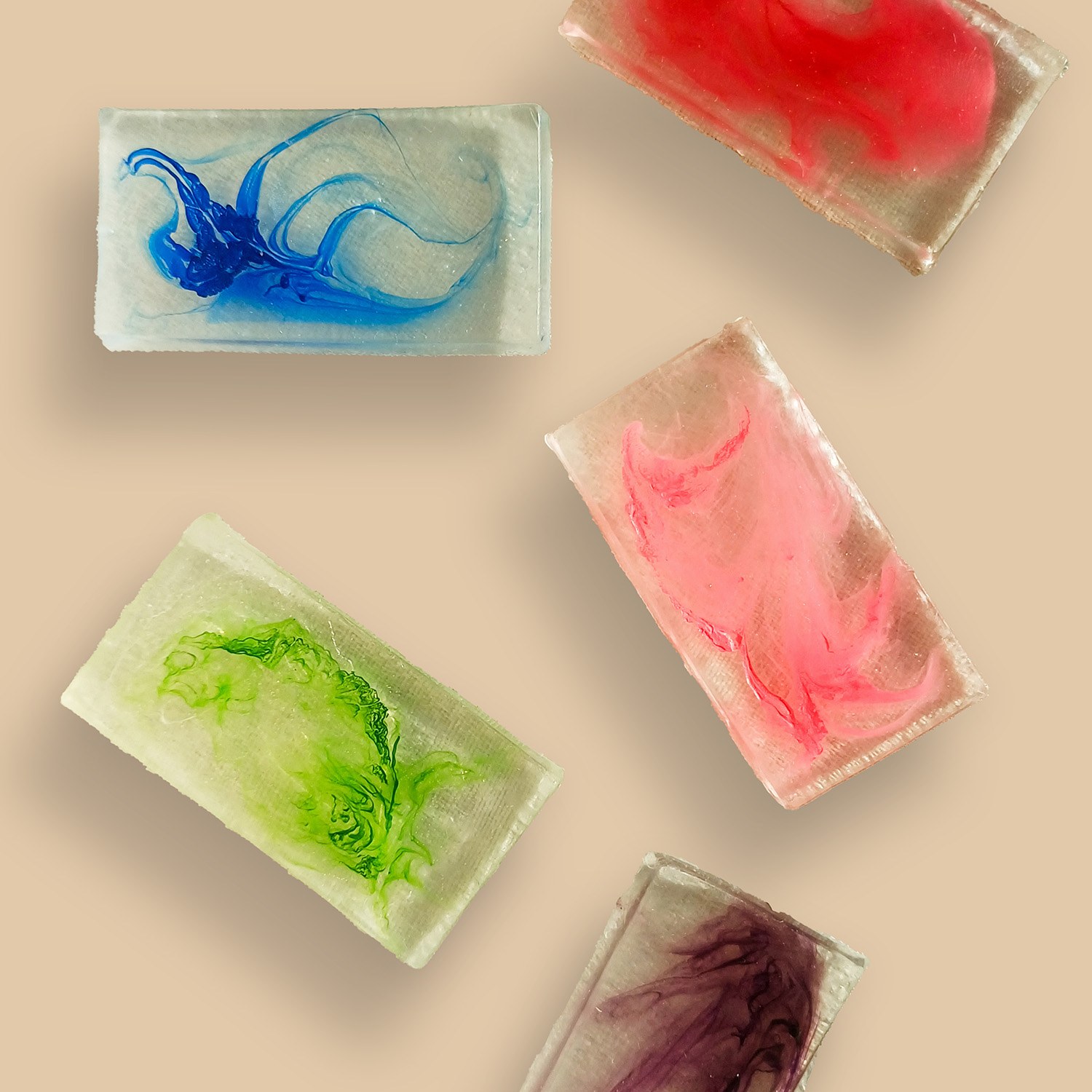
Swirl effect soap is a colourful soap that will also delight as a gift. The swirl effect is an interesting colour effect that can be applied when making any soap from soap base, so do not be afraid to experiment with it and incorporate it into your designs. Today we will show you how to make such a soap.
About this guide
The swirl effect is achieved thanks to the use of liquid colourants and soap base — the colour is dropped onto the freshly poured surface of the soap and spread with a wooden toothpick into the desired pattern. A similar effect can also be achieved in soaps made cold from oils and hydroxide; however, the procedure is somewhat different, since you do not work directly with colourants, but it is necessary to colour part of the soap in advance.
Main benefits
- A striking gift
Colourful soap with a swirl effect will also delight as a gift.
- A versatile technique
The swirl effect can be applied when making any soap from soap base — incorporate it into your designs.
- A pattern to your own liking
You spread the colour with a wooden toothpick or stick towards the edges of the mould, according to the pattern you wish to create.
- Bold colours in a transparent base
In a transparent soap base the colour effect will be more pronounced than in a white or other opaque base.
- Quick preparation
You melt the soap base in the microwave — or in a water bath, where it will take a little longer.
Product properties
Swirl effect soap — what do we need?
The swirl effect can be achieved thanks to the use of liquid colourants and, of course, a soap base. Choose the soap base that suits you best. However, we recommend reaching for a transparent soap base, as the colour effect will be more pronounced.
Soap bases
For the swirl effect, the best choice is non-sweating soap base Zenisoap Pro-clear — in a transparent base the colour stands out most. In a white or other opaque base the swirl effect will completely disappear as soon as the colourant sinks deeper into the interior of the soap.
In the list of ingredients you will also find non-sweating soap base Zenisoap Pro-W white — in a white or other opaque base, however, the swirl effect will completely disappear as soon as the colourant sinks deeper into the interior of the soap. So choose the soap base that suits you best.
Liquid glycerine colourants
For colouring the soap choose liquid colourants — otherwise achieving the swirl effect will not be possible, or will be very difficult. From the range of liquid colourants you can choose glycerine colourant, classic, yellow, glycerine colourant, extra, red, glycerine colourant, classic, blue, glycerine colourant, classic, green, glycerine colourant, classic, magenta or glycerine colourant, extra, soft pink.
If you want to use mica powders, there is the option of first mixing them with IPA and then applying them into the soap, but the colour effect will be different, as the viscosity of such a mixture is different and the IPA present will cause a different dispersion of the pigment.
IPA — isopropyl alcohol
Isopropyl alcohol, IPA serves as a bubble remover. You spray the mould with it before pouring in the base, then the surface of the soap immediately after pouring, and finally once more before it sets.
Fragrances and the mould
To scent the soap, choose from the range of fragrance oils — for example fragrance oil Summer night or fragrance oil Bali Body Spa. You can also reach for essential oils.
You pour the soap into a silicone mould rectangle; you will find further shapes among the silicone moulds. In addition, prepare a heat-resistant container and wooden toothpicks or sticks for spreading the colour.
Swirl effect soap — how to do it?
- Weigh out the base
Place the required amount of soap base into a heat-resistant container (according to the amount of soap you wish to make).
- Melting in the microwave every 10 s
Melt the soap in the microwave, stopping the microwave roughly every 10 seconds and checking whether the soap has already melted. The soap must not boil or foam over.
- Alternative — water bath
Alternatively, you can melt the soap base in a water bath. In this case, it will take a little longer until the soap becomes liquid.
- Preparation and fragrance below 50 °C
Prepare the mould, colourants, wooden toothpicks/sticks and IPA (bubble remover). Wait until the temperature of the soap drops below 50 °C and add fragrance or essential oils as desired. You can stir the soap a few times, but be careful not to introduce too many air bubbles into it.
- Pouring and the swirl
Spray the soap mould with IPA and pour in the base in a thin layer. Immediately spray the surface of the soap with IPA and add one to two drops of liquid colourant. Then, using a wooden toothpick or stick, spread the colour towards the edges of the mould according to the pattern you wish to create.
- Work quickly
Work quickly, as the soap base cools and hardens quickly, especially in a thin layer.
- Finishing and setting
Finally, spray the surface of the soap with IPA again and let the soap harden thoroughly.
Swirl effect soap — tips for making it
To apply the swirl technique in the easiest and most effective way, we bring you a few tips and hints on how to do it.
It is important to work with a thin layer of soap. Since the liquid colourant easily sinks to the bottom, if you apply it in a thicker layer, it may happen that the swirl effect will not be as pronounced, because all the colour will settle at the bottom.
If you are working on a more complex and larger soap, first create a thin layer with a swirl effect and then, after it has hardened, add the rest of the soap base. This will ensure that the soap will have a swirl effect, but all the colour will not sink to the bottom.
For colouring the soap, choose liquid colourants, otherwise it will not be possible, or will be very difficult, to achieve the swirl effect. If you want to use mica powders, there is the option of first mixing them with IPA and then applying them into the soap, but the colour effect will be different, as the viscosity of such a mixture is different and the IPA present will cause a different dispersion of the pigment.
If possible, choose a transparent soap base. In a white or other opaque base, the swirl effect will completely disappear as soon as the colourant sinks deeper into the interior of the soap.
Before adding the colour, it is good if the temperature of the soap has slightly dropped. The soap will thus be less fluid and the colourant will sink more slowly and create a nicer pattern.
Warning
Before any use of raw materials for the production of cosmetic products, it is essential to thoroughly familiarise yourself with their properties, the recommended dosage, the storage conditions and safe handling. It is important to realise that each raw material can cause an allergic reaction in sensitive individuals. Therefore, we recommend performing a skin test before using any new product on the skin.
If you have very sensitive or acne-prone skin, or suffer from other skin and health problems, it is advisable to consult a medical professional before applying new products. This applies not only to homemade cosmetic products, but also to pure raw materials or commercially available products.
When experimenting with homemade recipes, many factors must be taken into account, such as humidity, temperature, quality of raw materials and their storage. These factors can affect the final result and the effectiveness of the product. Therefore, be careful and experiment wisely!
Frequently asked questions about the swirl effect
Practical questions about swirl effect soap — choosing the base, the thickness of the layer, colourants and the temperature of the soap.
Which soap base should I choose for a swirl?
Choose the base that suits you best, but we recommend a transparent soap base — the colour effect will be more pronounced. In a white or other opaque base the swirl effect will completely disappear as soon as the colourant sinks deeper into the interior of the soap.
Why is it necessary to work with a thin layer of soap?
The liquid colourant easily sinks to the bottom. If you apply it in a thicker layer, it may happen that the swirl effect will not be as pronounced, because all the colour will settle at the bottom.
How do I make a swirl on a larger soap?
With a more complex and larger soap, first create a thin layer with a swirl effect and then, after it has hardened, add the rest of the soap base. The soap will then have a swirl effect and all the colour will not sink to the bottom.
Can mica powders be used instead of liquid colourants?
For a swirl, choose liquid colourants — otherwise achieving the effect will not be possible, or will be very difficult. You can first mix mica powders with IPA and then apply them into the soap, but the colour effect will be different — the viscosity of such a mixture is different and the IPA present causes a different dispersion of the pigment.
At what temperature should I work with the soap?
Add fragrances only once the temperature of the soap drops below 50 °C. Before adding the colour it is also good if the temperature of the soap has slightly dropped — the soap will be less fluid, the colourant will sink more slowly and create a nicer pattern.
Can a swirl also be made in cold process soap?
A similar effect can also be achieved in soaps made cold from oils and hydroxide, the procedure is somewhat different, however — you do not work directly with colourants, but it is necessary to colour part of the soap in advance.
You will find the soap bases, liquid glycerine colourants, fragrances, IPA and silicone moulds from this guide in the Handymade range.