


CO2 Extracts
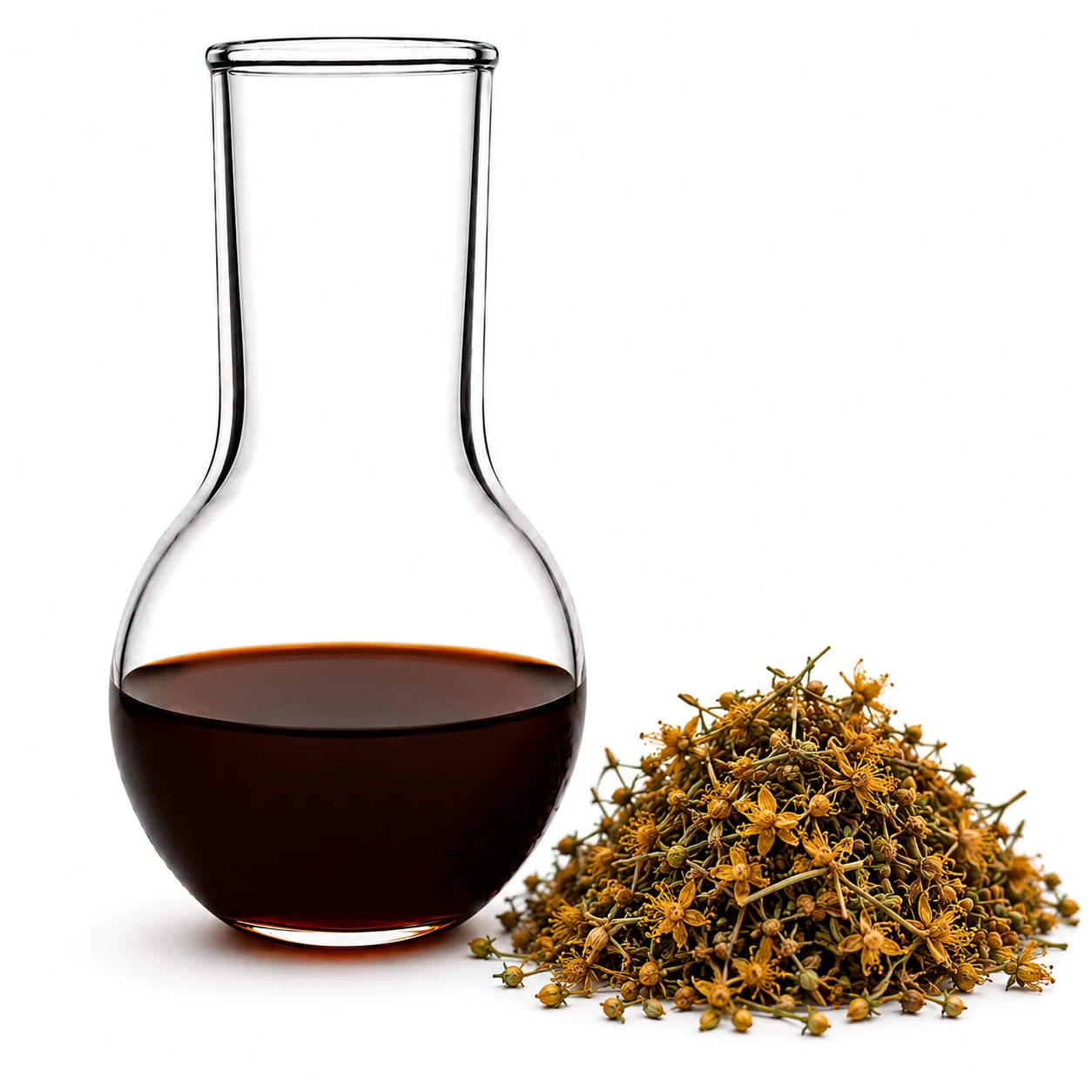
St John’s wort CO2-to extract, 10 ml
St John’s wort CO2-to extract is a concentrated plant extract from the flowers and twigs of St John’s wort (Hypericum perforatum L.), obtained by gentle CO2 extraction . full description
Lowest price in the last 30 days: €15.49
Product description
St John’s wort CO2-to extract is a concentrated plant extract from the flowers and twigs of St John’s wort (Hypericum perforatum L.), obtained by gentle CO2 extraction. It is an oil-soluble active ingredient, the one to choose when a formulation is meant to soothe irritated, dry or sensitive skin and support the restoration of its protective barrier.
St John’s wort has long been used traditionally in skin care. This extract of European origin retains the lipophilic components of the plant without the use of organic solvents, which makes it suitable also for certified natural cosmetics under COSMOS, NATRUE and ECOCERT.
What the extract brings to a formulation
- Soothing sensitive skin – the lipophilic components of St John’s wort help to ease the feeling of irritation and redness. The effect is most noticeable in leave-on products, where the extract stays on the skin for longer.
- Supporting skin barrier restoration – the extract binds well into the oil phase and, together with carrier oils, helps the skin retain its own moisture better. It is particularly useful for dry and flaky skin.
- Antimicrobial action – the components of St John’s wort support the cleanliness of skin prone to imperfections. This is a cosmetic effect, not a therapeutic one. The strength of the effect depends on the usage rate and the overall formulation.
- Anti-inflammatory character – in the cosmetic sense, this means the ability to ease signs of irritation after shaving or when the skin is under mechanical stress.
A CO2 extract is not a St John’s wort macerated oil
Customers often confuse the extract with the traditional red St John’s wort oil, which is made by macerating the flowers in a vegetable oil. A macerated oil is a finished carrier oil and can also be used on its own. CO2-to extract, on the other hand, is a concentrate that is added to the oil phase as an active ingredient. It carries considerably more active substances in a smaller volume, so it is used as an active ingredient, not as a base oil.
Use in a formulation
The extract is oil-soluble and insoluble in water. It is added to the oil phase or only in the cooling phase, and the processing temperature should not exceed 40 °C. In anhydrous products, it is enough to stir the extract into the warmed oil component and homogenise thoroughly. In emulsions, we recommend adding it after the emulsion has formed, once the temperature drops below the stated limit, so that the sensitive components of the plant are not stressed unnecessarily.
The recommended usage rate is approximately 14–25% of the total formulation. The suitable amount depends on the type of product: body oils and balms are formulated towards the upper limit, light facial emulsions rather towards the lower one.
The extract is brown and, at the recommended usage rate, gives the finished product a warm brownish shade. Take this into account when designing the appearance of the product and when choosing the packaging.
Compatibility with common cosmetic raw materials is unrestricted. The extract combines well with vegetable oils, butters, waxes and common O/W and W/O emulsifiers.
Suitable for products such as
- Regenerating facial oils and serums – an anhydrous system dissolves the extract completely and the active substances stay on the skin for longer.
- Balms and ointments for dry and stressed skin – suitable for elbows, heels, hands or areas prone to flaking.
- Creams for sensitive skin – in emulsions, the extract is added to the oil phase or during cooling.
- Body oils and massage products – a higher usage rate makes use of the soothing character of the extract on larger areas of the body.
- Aftershave products – products intended to ease the feeling of irritation.
The extract is intended for leave-on products for the face and body. In rinse-off products, such as shower oils or soaps, it stays on the skin for too short a time and its use is not worthwhile.
Good to know
The product contains fragrance allergens under Annex III to the Cosmetics Regulation. When preparing the label, it is necessary to check which allergens exceed the declaration limit after taking the usage rate into account, and to list them in the ingredients.
The lipophilic components of St John’s wort are sensitive to light. We therefore recommend filling finished products containing the extract into dark or opaque packaging. The extract is readily biodegradable and has not been tested on animals.
Frequently asked questions
Parameters
- INCI
- Hypericum Perforatum Flower/twig Extract
- CAS No.
- 84082-80-4
- EC number
- 282-026-4
- Product colour
- Brown
- Processing method
- CO2 extraction
- Odour
- Characteristic
- Appearance
- Paste
- Free from
- preservativesallergenic food ingredientsEDTAethylene oxide (EO)formaldehyde and formaldehyde donorsphthalatesparabensPEGsiliconessulfatesGMO-derived ingredientspalm oil-derived ingredients
- Formulation phase
- Oil phaseCool-down phase
- Function in formulation
- Active ingredient
- Recommended processing temperature
- < 40 °C
- Recommended usage rate
- 14 - 25 %
- Solubility
- Water-insolubleOil-soluble
- Application type
- Leave-on
- Biodegradability
- Readily biodegradable (OECD 301)
- Suitable for
- Sensitive skinDry skinProblematic skin
- Manufacturer's certificate
- KosherNATRUE ApprovedECOCERT GREENLIFEHalalCOSMOS Approved
- Natural Index (NI ISO 16128)
- 1,00
- Natural Origin Index (NOI ISO 16128)
- 1,00
- Renewable Carbon Content (RCC)
- 100 %
- Volume
- 10 ml
Product documentation
Verified by customers.
No reviews yet.
Only customers with a delivered order can write reviews.