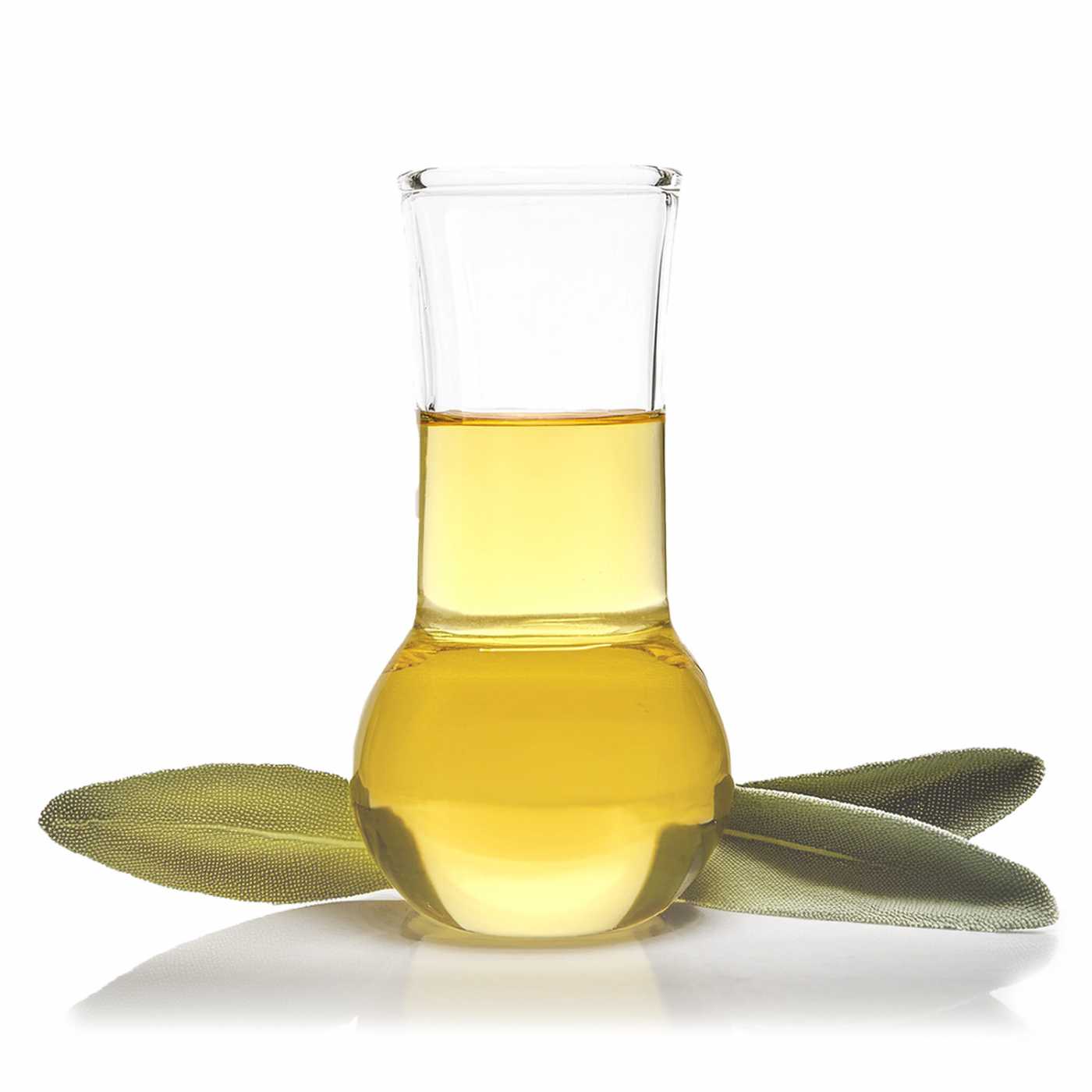
White sage essential oil (Salvia apiana) is a fragrance ingredient with a herbal scent, used in formulations mainly for products with a cleansing and refreshing focus. It is obtained by steam distillation of a plant native to North America. In terms of skin type, it belongs in recipes for oily, problem and acne-prone skin and for hair that tends to become greasy quickly.
The manufacturer states that it has a cleansing and clarifying effect on the skin, supports sebum balance and has a soothing effect. The product is vegan.
What the oil brings to a formulation
- Scent and aromatherapy profile – the herbal scent of white sage works on its own and as a component of fragrance compositions. It is added to diffusers and aromatherapy blends for its clean, fresh character.
- Skin prone to oiliness – according to the manufacturer, it helps balance sebum production and supports a clearer-looking complexion. In a formulation it remains a fragrance ingredient that complements the other active ingredients.
- Antimicrobial and anti-inflammatory effect – the manufacturer lists these as properties of the oil. In the finished product they depend on the usage rate and the whole recipe, and in cosmetics they translate into support for clean, calm skin.
- Warming sensation – it leaves a mildly warming feeling on the skin, which the manufacturer links to use in massage oils and relaxing creams.
- Hair and scalp care – according to the manufacturer, it supports a healthy scalp and a clean environment for hair follicles. It is suitable for shampoos, hair oils and hair tonics for hair that becomes greasy quickly.
Use in formulations
It is added in the cool-down phase, at a temperature below 40 °C, that is, only after heating and emulsification. At higher temperatures the volatile components are lost and the scent weakens. In anhydrous products such as massage oils, balms and hair oils, the oil is simply stirred into the cooled oil phase.
The oil is soluble in oil and in alcohol, and it does not dissolve in water. It therefore cannot be added directly to toners or to face and hair sprays. It needs a solubiliser, otherwise it separates and floats on the surface. The ratio of solubiliser to oil is checked in a small test so that the finished mixture stays clear.
It is suitable for both rinse-off and leave-on products. The manufacturer does not state a specific usage rate. The usage rate is governed by the IFRA limits for the given product category and is verified in the finished recipe.
When making creams and lotions, stir the oil into the emulsion only after it has cooled below 40 °C. This preserves both the scent and the volatile components.
Suitable for products such as
- Face serums and creams for oily and acne-prone skin, where it complements active ingredients for sebum regulation.
- Cleansing gels, face toners and hydrosol sprays with a solubiliser.
- Shampoos, hair tonics and oils for a scalp prone to oiliness.
- Massage oils and balms with a warming effect.
- Solid and liquid soaps, bath salts and bath bombs.
- Candles and diffusers.
- Household cleaning products and craft products with a herbal scent.
Good to know when formulating
White sage (Salvia apiana) is a different botanical species from common sage (Salvia officinalis) or clary sage (Salvia sclarea). The scent and composition differ, so recipes and usage rates for one species do not automatically apply to another.
The oil is subject to CLP classification and contains one or more fragrance allergens under Annex III of Regulation (EC) No 1223/2009. The product as a whole is not classified as CMR, but it contains the components gamma-terpinene and p-cymene, which have a CMR classification. Details are in the safety data sheet (SDS).
Do not apply the oil to the skin undiluted. When setting the usage rate, respect the IFRA limits for the specific product category, for example face creams, body oils, deodorants or candles, and carry out a patch test before introducing the recipe.
Frequently asked questions
Is white sage essential oil water-soluble?
No, white sage essential oil is not water-soluble. It dissolves in oils and in alcohol. For this reason it is added to toners, sprays and other water-based products together with a solubiliser, or worked into the oil phase of an emulsion, otherwise it separates from the water.
At what temperature is white sage essential oil added to a cream?
It is added below 40 °C, in the cool-down phase of the emulsion. A higher temperature evaporates the volatile components and weakens the scent. After emulsification the cream is left to cool and the oil is stirred into the cooled cream, shortly before the recipe is finished.
What skin type is white sage essential oil suitable for?
It is most useful in products for oily, problematic and acne-prone skin and for hair prone to oiliness. The manufacturer states that it supports sebum balance and has a cleansing effect. Caution is needed with sensitive skin because the oil contains fragrance allergens, and a patch test is recommended before use.
What is the difference between white sage and common sage?
White sage (Salvia apiana) and common sage (Salvia officinalis) are two different botanical species with a different scent and composition. White sage essential oil has a herbal, fresh scent and acts as a fragrance ingredient in a formulation. Usage rates and recipes for one species are not automatically transferred to the other.
Can white sage essential oil be used in candles and soaps?
Yes, the manufacturer states use in candles, solid and liquid soaps and bath bombs. We have not verified with our own test how the scent behaves in a specific wax or in cold process soap. We therefore recommend starting with a small test batch, observing any change in the shade of the wax or soap and the intensity of the scent after hardening, and keeping the usage rate within the IFRA limits for the given category.
Does a finished product with white sage essential oil need to be preserved?
Yes, an essential oil does not replace a preservative. Anhydrous products such as massage oils and balms usually do not need a preservative, but for products with a water phase, such as creams, toners and sprays, preservation is necessary. The antimicrobial effect that the manufacturer states for the oil is not a proven substitute for a preservative system.