Soap with sodium lactate is soap for the impatient. In cold process soap making, one of the optional additives is precisely sodium lactate — a compound that helps to speed up the hardening of the soap. We bring you a recipe for a soap that contains this ingredient: if you are too impatient and want to cut your soap as soon as possible, sodium lactate is the right ingredient for you.
About this recipe
This is a recipe for a solid soap made by the cold process. The production of solid soap by the cold process cannot be done without sodium hydroxide, water and of course oils and fats, which are subsequently saponified. To create the colour effect, mica powders were used in combination with titanium dioxide to achieve a more intense white colour.
The soap described was prepared from 400 g of oils and butters and the recipe already includes a superfat of 5 %. The recipe will be appreciated by soap makers who want to cut their soap sooner — sodium lactate is, however, optional and can be left out without changing the proportion of the other ingredients.

Main benefits
- Faster hardening
Sodium lactate accelerates the setting and hardening of soap — you obtain firm soap bars in a shorter time.
- Earlier cutting
It is advisable to cut the soap after about a week, or later if the soap still seems too soft to you.
- Superfat of 5 %
The oils are present in a 5 % excess relative to the sodium hydroxide; this amount remains unsaponified and provides conditioning and emollient properties for the skin.
- Layered colour effect
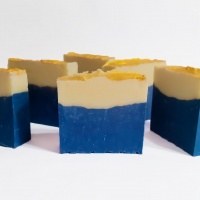
Mica powders in combination with titanium dioxide create a blue and a white layer separated by a gold sprinkle.
- Optional ingredient
Sodium lactate can be left out of the recipe without changing the proportion of the other ingredients; it can also be replaced with lactic acid.
Product properties
Key ingredients in the recipe
Find out more about the ingredients used to make the soap with sodium lactate and about their possible substitutions or variations.
Sodium lactate
As mentioned, sodium lactate accelerates the setting and hardening of soap. You obtain firm soap bars in a shorter time. It can, however, be omitted from the recipe without changing the proportion of the other ingredients. It is usually used at a concentration of around 1 – 2 % of the oil weight. Add sodium lactate to the demineralised water.
Coconut oil
When making solid soap it is appropriate to combine solid fats and butters with liquid oils, ideally in a 1:1 ratio. As coconut oil is solid at room temperature, it is an excellent complement to plant butters. You will appreciate coconut oil in particular if you want hard and bubbly soaps. Conversely, soaps made solely from coconut oil are somewhat less caring for the skin, so it is advisable to combine this oil with other liquid plant oils to prepare a milder soap with a creamier lather.
Cocoa butter
To complement coconut oil, cocoa butter is especially suitable. This butter is popular in the production of solid soaps because it is easy to work with and gives firm yet nourishing soaps. You can replace it with another plant butter, but in this case it is necessary to recalculate the recipe in a soap calculator (the amount of sodium hydroxide required will change).
Olive oil
The basic liquid oil for soap making is olive oil. This oil is very popular in soap making and forms the base of, for example, Castile soap. Its slightly greenish colour can cause the soap to yellow, so if you want the added mica powders to stand out better, combine olive oil with other, less coloured oils.
Titanium dioxide
Titanium dioxide is an intensely white substance used as a pigment or carrier in various types of cosmetics, including decorative cosmetics. It gives the soap a white colour and allows other colours to stand out better. Titanium dioxide can also be omitted entirely from the product; however, when using it, take care to disperse it thoroughly, as it tends to form clumps. You can also prevent clumping by choosing titanium dioxide intended for use in oil rather than in water.
Other ingredients
Sodium hydroxide and demineralised water make up the lye, without which solid soap cannot be made by the cold process — together with the oils and fats, which are subsequently saponified. Sodium lactate is added precisely to the demineralised water.
Shea butter is a softer butter suitable for softening the soap and caring for the skin. This butter is cost-effective and has universal use in many types of cosmetics, so if you have any leftovers, you will certainly use them in other cosmetic projects.
Cottonseed oil — oil from cotton seeds provides the skin with valuable vitamins and minerals. It softens and conditions the soap (a soap with 100 % cottonseed oil would be too soft and would not provide sufficient lather).
Apricot oil is very well tolerated by the skin, it is quickly absorbed and provides hydration. In soaps, due to its minimal colour, it allows the colourants used to stand out. Do not hesitate to add your favourite oil to the soap, but always verify the amount of sodium hydroxide and demineralised water using a soap calculator.
Fragrance oils are an excellent way to enliven your soaps. They are more suitable than essential oils, as they are only minimally coloured and therefore do not affect the final colour result. Try different scents or combinations of them. Their amount is usually 30 – 31 g per 1 kg of soap (the sum of all other ingredients).
Mica powders are the number-one choice for colouring soap. Not only do they shine beautifully, they are also stable in the presence of soap, hold their colour and can be combined freely. In addition to mica powders, you can also reach for cosmetic glitters or omit them altogether.
IPA — isopropyl alcohol: to reduce the risk of soda ash formation, the finished soap was sprayed with IPA. When cutting, it is also good to have IPA at hand and to spray each bar of soap (cut surface) with IPA — not only to reduce the formation of soda ash, but such soap will also be slightly smoothed and will harden better.
The formula
The quantities of the required ingredients are given in grams, since with any change to the recipe relating to the fats and oils used, it is necessary to recalculate the entire recipe using a soap calculator (many are freely available on the internet). This is because the amount of sodium hydroxide required to saponify the particular fat will change.
The soap described was prepared from 400 g of oils and butters.
| Phase / ingredient | Amount in (g) |
|---|---|
| Water phase | |
| Demineralised water | 113,00 |
| Sodium lactate | 3,90 |
| Sodium hydroxide | 56,50 |
| Oils and butters (400 g in total) | |
| Olive oil | 60,00 |
| Refined apricot oil | 40,00 |
| Refined cottonseed oil | 100,00 |
| Refined coconut oil | 100,00 |
| Cocoa butter | 80,00 |
| Refined shea butter | 20,00 |
| Colourants | |
| Mica powder Blueberry | 1,00 |
| Mica powder Gold sparks | as needed |
| Titanium dioxide – oil | 2,50 |
| Extras | |
| Isopropyl alcohol – IPA | as needed |
Method
- Protective equipment
Put on protective equipment (gloves, goggles, older long-sleeved clothing), work in a well-ventilated room, use only plastic or stainless steel containers, or heat-resistant/laboratory glassware.
- Lye with sodium lactate Water phase36 – 38 °C
Into one container weigh the demineralised water and add sodium lactate to it, into another container weigh the sodium hydroxide separately. In a well-ventilated area, add the sodium hydroxide to the water in small portions while stirring continuously. The mixture will heat up intensely, proceed slowly and do not inhale the fumes. Allow the mixture to cool to about 36 – 38 °C.
- Oils and butters Oil phase36 – 38 °C
Into a heat-resistant container weigh all the oils and butters, heat until the butters have melted. Allow to cool to 36 – 38 °C, remove one tablespoon of oil and add it to the container with the titanium dioxide, repeat the same with the blue mica powder.
- Combining the phases 36 – 38 °C
When the lye solution and the mixture of fats and oils have approximately the same temperature (36 – 38 °C), pour the lye solution into the oils and stir well.
- Fragrance oil and titanium dioxide
Stir a few times with an immersion stick blender, add the fragrance oil and the titanium dioxide (through a sieve, to prevent clumping).
- Blending to trace
Blend with the stick blender until you obtain a consistency similar to pudding, to trace stage (after blending you will see the place where you inserted the spoon).
- Blue layer
Remove 2/3 of the batter and add to this portion the blue mica powder dispersed in oil (ideally through a sieve), mix thoroughly and pour into the mould.
- Gold sprinkle and white layer
Sprinkle the surface of the blue soap through a sieve with the gold mica powder, then carefully add the remaining soap batter so as to disturb the gold layer as little as possible.
- IPA and wrapping
Sprinkle the surface of the white layer again with gold mica powder through a sieve, spray with IPA, cover with cellophane and ideally wrap the soap in a blanket and place it in a warm place (under a radiator).
- Cutting approx. 1 week
It is advisable to cut the soap after about a week, or later if the soap still seems too soft to you.
- Curing and pH check min. 6 weekspH 9 – 10
Allow the soap to cure for at least 6 weeks, then check the pH (apply a little water to the surface of the soap and place a pH strip on it); the pH should be in the range of 9 – 10.
Tips and tricks
Below you will find important advice and tips that can make soap making easier for you, or help you avoid mistakes.
When working with sodium hydroxide, always use protective equipment, especially goggles and gloves. Work in a well-ventilated room; sodium hydroxide fumes are harmful. Since sodium hydroxide produces a large amount of heat as it dissolves, you can replace part of the demineralised water with ice made from demineralised water as well — thereby speeding up the cooling of the solution.
To neutralise sodium hydroxide on surfaces and utensils, use a diluted vinegar solution, into which you soak the utensils for a few minutes before washing them. Likewise, you can use diluted vinegar for cleaning work surfaces. If soap gets on your skin during production, wash it off immediately with cold water for several minutes and then you can also rinse it with a diluted vinegar solution to remove any remaining sodium hydroxide.
Mica powders or other powdered colourants dissolve more easily if you premix them with oil. It is ideal to add them through a sieve so that no colourant clumps form in the finished soap.
Add sodium lactate to the demineralised water. Lactic acid can be used as a substitute, but in this case you must add slightly more sodium hydroxide so that it can react with it and form sodium lactate. In this case, however, an exact calculation according to the equation of this reaction is necessary.
The recipe already includes a superfat of 5 %, which means that the oils are present in a 5 % excess relative to the sodium hydroxide, so this amount of oils remains unsaponified and will provide you with conditioning and emollient properties for the skin. You can increase this proportion to 8 % or 10 %. However, it is then advisable to recalculate the entire recipe in a soap calculator so that you use the correct amounts of all ingredients.
When blending, use a stick blender with a stainless steel or plastic attachment, as ordinary metal will corrode under the influence of sodium hydroxide. Silicone spatulas for confectionery are also ideal tools to help you get the soap into the mould with minimal leftovers.
It is good to wrap the soap in a blanket so that the increased temperature supports the chemical reaction and the soap passes through the gel phase. Spraying with IPA can be omitted, but there is a risk of the formation of soda ash (a white coating on the surface of the soap), an aesthetic defect that spoils the appearance of your soap.
If, when checking the pH, you see that the soap has an uneven pH, it is likely that there was poor mixing of the lye solution (some granules remained undissolved). Such a soap is not safe to use.
To check the pH you can also use a phenolphthalein solution or test strips containing phenolphthalein. When using phenolphthalein strips, proceed in the same way as with litmus strips — the strips SHOULD NOT turn pink. If you are using a solution, drip it onto different parts of the soap; it should likewise not turn pink. A pink colour indicates high pH values and therefore unreacted sodium hydroxide; such a homemade soap is not safe to use.

Warning
As mentioned, you can experiment with homemade recipes to achieve the desired properties. However, the final result can be influenced by many factors, such as humidity, temperature, quality of the ingredients and their storage.
Before you use any ingredient to produce a cosmetic product, become familiar with its properties, recommended dosage, storage conditions and safe handling. Every ingredient may have the potential to cause an allergic reaction in sensitive individuals, therefore before using the product we recommend finding out whether you are allergic to any of the ingredients or to the finished product, for example by means of a patch test.
If you have very sensitive or very acne-prone skin, or you have other skin or health problems, we recommend that you consult a medical professional before applying a new product to your skin, whether it is a homemade cosmetic product, a pure ingredient or a commercially available product.
Frequently asked questions about the recipe
Practical questions about soap with sodium lactate — dosage, substitutions, curing and the pH check.
What is sodium lactate for in soap?
Sodium lactate accelerates the setting and hardening of soap — you obtain firm soap bars in a shorter time. It is usually used at a concentration of around 1 – 2 % of the oil weight and is added to the demineralised water. It can be omitted from the recipe without changing the proportion of the other ingredients.
Can sodium lactate be replaced with lactic acid?
Yes, lactic acid can be used as a substitute, but in this case you must add slightly more sodium hydroxide so that it can react with it and form sodium lactate. An exact calculation according to the equation of this reaction is, however, necessary.
When can I cut the soap and when can I use it?
It is advisable to cut the soap after about a week, or later if it still seems too soft to you. The soap is then left to cure for at least 6 weeks, after which the pH is checked.
How do I check the pH of the finished soap?
Apply a little water to the surface of the soap and place a pH strip on it — the pH should be in the range of 9 – 10. You can also use a phenolphthalein solution or test strips containing it; they should not turn pink. A pink colour indicates a high pH and therefore unreacted sodium hydroxide — such a soap is not safe to use. An uneven pH is usually the result of poor mixing of the lye solution.
What does a superfat of 5 % mean and can it be changed?
A superfat of 5 % means that the oils are present in a 5 % excess relative to the sodium hydroxide — this amount of oils remains unsaponified and provides conditioning and emollient properties for the skin. You can increase this proportion to 8 % or 10 %, but it is then advisable to recalculate the entire recipe in a soap calculator.
Do I have to spray the soap with IPA?
Spraying with IPA can be omitted, but there is then a risk of the formation of soda ash — a white coating on the surface of the soap, an aesthetic defect that spoils its appearance. When cutting, it is good to spray each cut surface with IPA as well: the soap is slightly smoothed and hardens better.
Conclusion
Do you make classic soaps using the cold process and sometimes feel tired of waiting? Try using sodium lactate and you can shorten the process.
If you give it a try, do let us know how it went. You can send us your observations, questions and experiences to [email protected] and we will gladly reply to you.
Until we meet again in another blog tutorial, stay creative.
Until saponification, friends.
Sodium hydroxide, sodium lactate, oils, butters and mica powders from this recipe can all be found in the Handymade ingredient range.