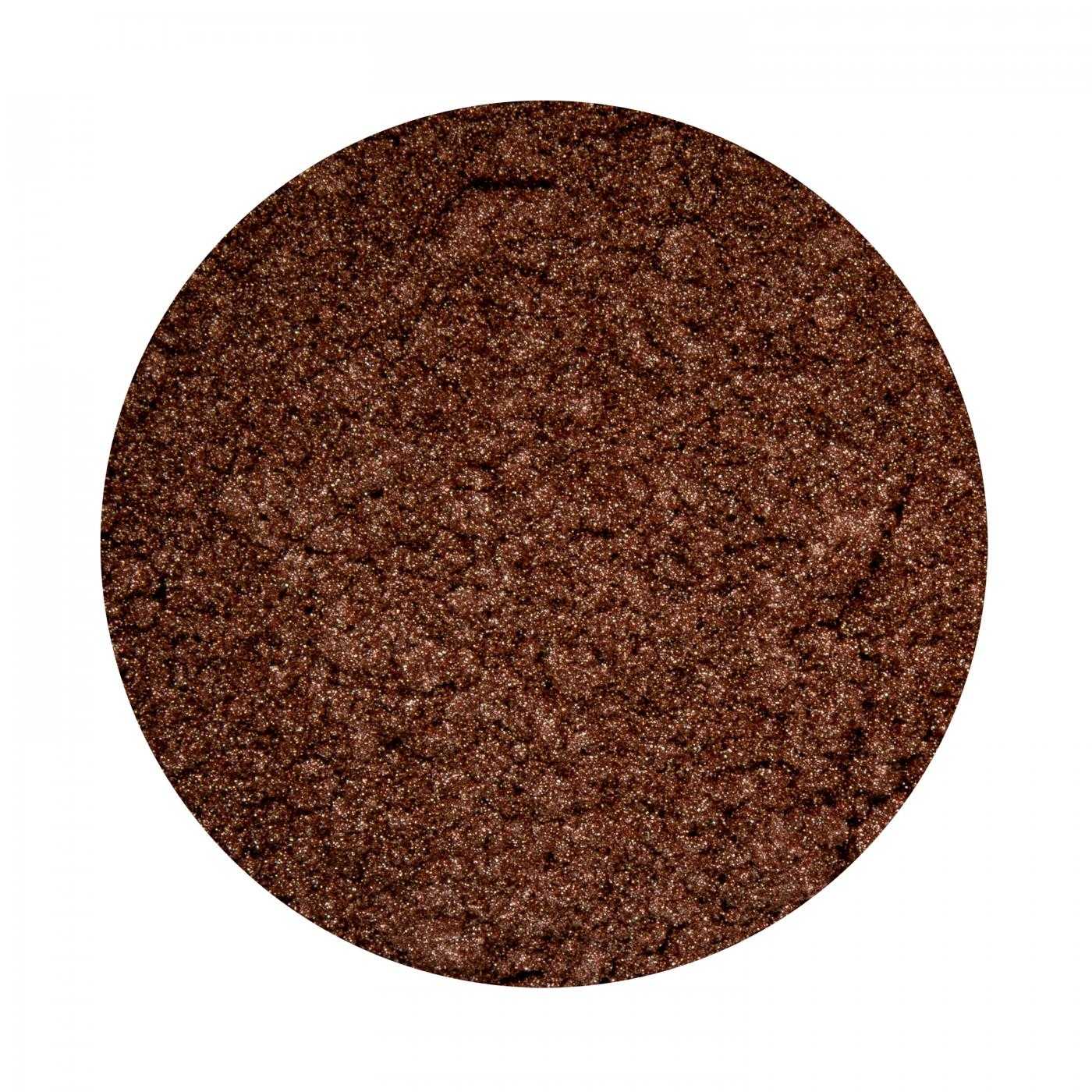
Powder pigment Mica Toffelicious colours cosmetics and soap in a warm brown shade with a satin sheen. The base is natural mica, whose platelets reflect light, and the colour is carried by red iron oxide. The pigment does not dissolve; it remains dispersed in the mass as fine particles, delivering a stable mineral shade in decorative cosmetics, soap, bath products, and colour balms.
Both components are listed among the colorants permitted in Annex IV of Regulation (EC) No 1223/2009.
What the pigment offers
- Satin brown shade – the sheen is silky, without sparkle. In a thin layer it acts as a delicate veil; with higher dosage the colour deepens.
- Heat stability – thermal stability extends to 800 °C, so the colour withstands melting of the soap mass and heating of the oil phase.
- Fine particles – a size of 5 – 25 µm provides a smooth feel on the skin and even dispersion without visible grains.
- Controlled purity – the pigment is supplied with verified microbiological purity and monitored heavy metal limits.
Use in formulation
The pigment does not dissolve in water or oil; fine particles are dispersed into the formulation. The easiest approach is to mix the powder with a small amount of oil, glycerin, or melted base into a smooth paste, which is then blended into the full volume. Pouring directly into a larger volume leads to lumps that are difficult to disperse.
The pigment absorbs a relatively large amount of oil; oil absorption is 50 – 65 g of oil per 100 g of powder. At higher dosage in anhydrous products, such as balms or pressed eyeshadows, expect a slight thickening of the mass and adjust the oil fraction if needed.
In aqueous systems, particles settle over time. It is therefore not suitable for clear toners or sprays; in gels and emulsions with sufficient viscosity it remains dispersed. The pigment's own pH in suspension ranges from 6.0 – 9.0, so it introduces no significant acidity or alkalinity into common cosmetic systems.
In cold-process soap it gives a brown shade, but the satin effect stands out only in a clear melt-and-pour soap mass or a transparent layer. In opaque soap, a more matte brown remains. Before using a larger dose, check the shade on a small sample — the final colour depends on the lightness of the base and the dosage.
The shade is adjusted gradually, starting from small amounts. Colour intensity increases quickly with each addition.
Suitable for products such as
- Decorative cosmetics – eye shadows, bronzers, blushers, and mineral powders, where the smooth feel of fine particles is valued.
- Cold-process and melt-and-pour soap – as the main brown shade or for layers and patterns.
- Bath products – bath bombs, bath salts, and bath tablets.
- Colour balms and solid products – tinted balms, solid perfumes, and sticks, where the pigment is worked into the melted base.
- Shimmer body oils and butters – in liquid oils it is shaken before use; in solid butters it remains distributed.
Good to know
- In bath bombs and bath salts, some pigment remains on the walls of the tub after bathing — bear this in mind when dosing.
- The shade in the finished product is influenced by the colour of the base. In a light soap or balm it comes through fully; in a darker base the colour shifts to a deeper brown.
- By combining with other mineral colorants, such as black oxide or gold mica, further shades of brown can be created.
When working with the powder, avoid stirring fine particles into the air. Weigh and mix calmly, without draughts.
Frequently asked questions
Is Mica Toffelicious soluble in water?
No, Mica Toffelicious does not dissolve in water or oil. Fine particles are dispersed into the formulation and remain suspended throughout the mass. In thin aqueous products they settle to the bottom over time, so the pigment is better suited to gels, emulsions, soap, or anhydrous products where it stays in place.
How is Mica Toffelicious added to cold-process soap?
The powder is first mixed with a small amount of oil from the recipe into a smooth paste, which is then blended into the soap batter at a light trace. In opaque soap a more matte brown shade remains; the satin sheen stands out in a clear melt-and-pour mass. Check the intensity on a small dose — colour builds quickly with dosage.
Can Mica Toffelicious withstand heating during production?
Yes, the pigment has thermal stability up to 800 °C, so production temperatures in cosmetics and soap making will not affect the colour. It can be added directly to the heated oil phase, melted soap mass, or balm base without any concern about shade change.
What is the difference between mica and iron oxide?
Mica is a natural mineral that provides sheen but almost no colour. Iron oxide is a matte pigment with a strong colour. Mica Toffelicious combines both components: the mica forms a shiny platelet carrier and the red iron oxide delivers the brown shade. The result is a coloured pigment with a satin effect.
Is Mica Toffelicious permitted in cosmetics?
Yes, both colorant components are listed in Annex IV of Regulation (EC) No 1223/2009 as permitted cosmetic colorants. The pigment is also not classified as hazardous under the CLP Regulation and does not require a safety data sheet. The finished cosmetic product must, however, undergo its own safety assessment.