Mica pigment powder, Toffelicious
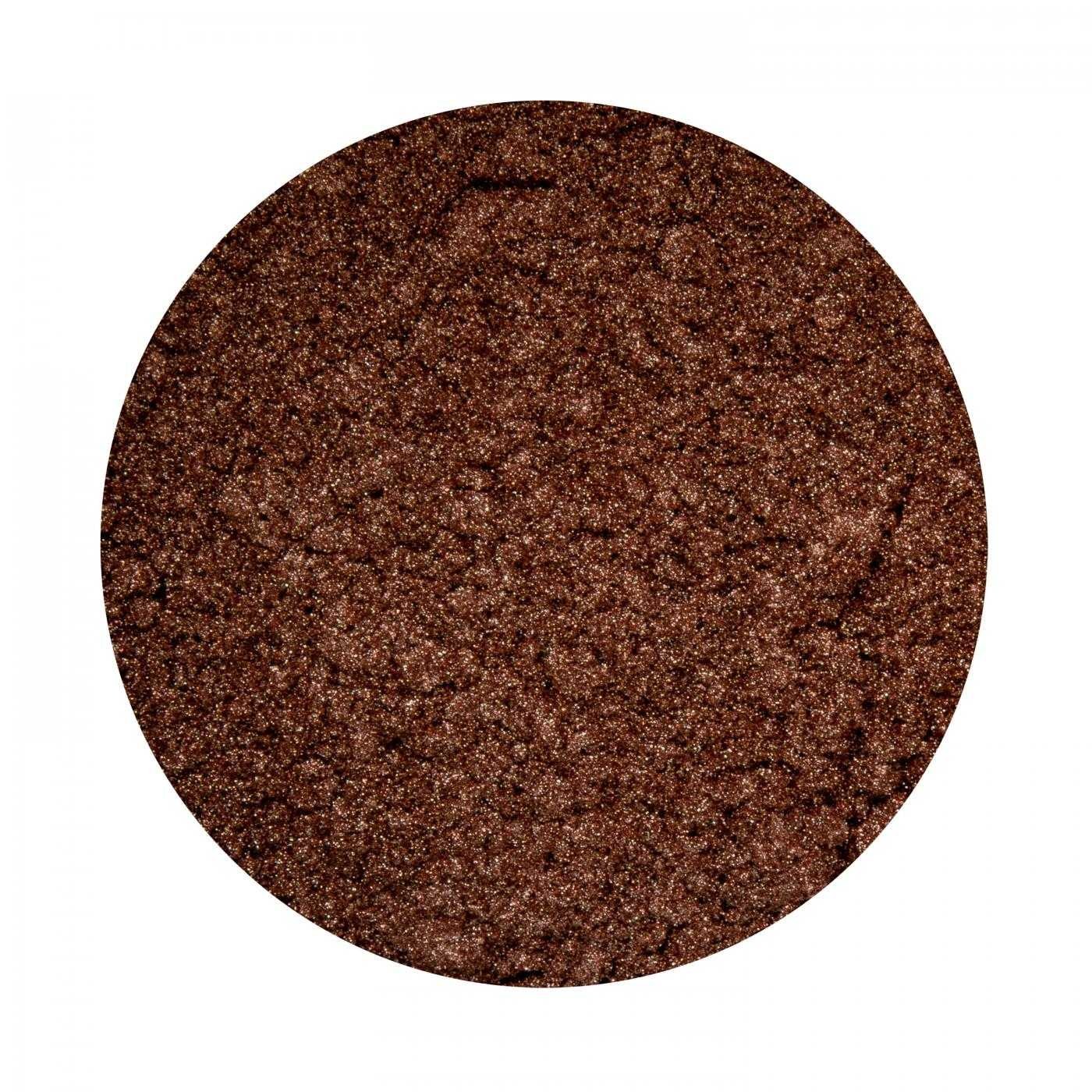
This brown pearlescent pigment made from mica and red iron oxide gives decorative cosmetics a satin brown in a caramel tone. It suits any product where you need a warm brown with a soft sheen and without pronounced sparkle: eyeshadows, bronzers, lipsticks, balms and coloured body oils. This mineral-origin pigment from European production is incorporated into the oil phase or added afterwards to the finished base, and it is intended for both rinse-off and leave-on products.
The pearlescent reflection is created on mica particles with an iron oxide surface treatment. The result is a rich brown with a subdued satin sheen that behaves like a pigment: it does not dissolve, it disperses.
Key properties
- Satin brown shade – mica (58–64%) with red iron oxide (38–52%) gives a warm brown with a soft pearlescent sheen and without coarse glitter.
- Fine particles – the average particle size is 5–25 µm, and the powder is odourless and free of nanomaterials.
- Insoluble, dispersible – the pigment dissolves neither in water nor in oil. It is incorporated into the product as evenly dispersed pigment particles.
- Heat-stable – it withstands temperatures of up to 800 °C, so it can be added to a hot oil phase or melted wax without loss of colour.
- Usage rate 1–30% – the range covers both subtle tinting and rich pressed powders and eyeshadows.
- For rinse-off and leave-on products – intended for the face, body, hands, feet, hair, scalp and nails.
Use in a formulation
The pigment is added to the oil phase or afterwards to the finished base. It gives the best results when you first mix the powder into a small amount of oil or melted butter to form a smooth paste and only then incorporate it into the rest of the recipe. Sprinkling the dry powder directly into a finished emulsion leaves lumps and uneven colour.
In anhydrous products (lipsticks, balms, solid bronzers, pressed eyeshadows) it is enough to mix the pigment thoroughly into the melted oil phase. The oil absorption is 50–65 g per 100 g of pigment. At higher usage rates, therefore, expect part of the oil to be “lost” into the powder and the product to be firmer.
In water-based and emulsion systems the pigment can be dispersed, but it cannot stay in suspension on its own. In thin products without a thickener or sufficient viscosity, the particles gradually sediment.
Before first use in a larger batch, pour off a small test portion and judge the colour only after it has cooled completely and set. The shade of pearlescent pigments looks different in a solid product than in the liquid mixture.
Suitable for products such as
- Eyeshadows and bronzers – loose and pressed, where the satin brown serves as a base or shading shade.
- Lipsticks and lip balms – the powder disperses in a melted oil and wax base.
- Nail cosmetics – the pigment is also intended for use on nails.
- Coloured body and hair products – oils, gels and masks with a soft pearlescent effect.
Good to know
The pigment meets the requirements for cosmetic colorants under Annex IV of Regulation (EC) No 1223/2009, including the heavy metal limits. It is not classified as hazardous under the CLP Regulation, so a safety data sheet is not required for it.
Keep to the recommended pH range of 6.0–9.0. In more acidic products, for example in peels with fruit acids, check the colour stability on a small sample beforehand.
Frequently asked questions
Is Toffelicious mica soluble in water?
No, the pigment dissolves neither in water nor in oil. It can only be dispersed in them, that is, evenly distributed as particles. In water-based and thin products without a thickener it therefore sediments over time, and only sufficient viscosity keeps it in suspension. In anhydrous products such as lipsticks or pressed eyeshadows, this problem does not arise.
How do I add Toffelicious mica to a cream or balm?
First mix the powder with a small amount of oil or melted butter to form a smooth paste, and only then incorporate it into the rest of the recipe. Sprinkling it directly into a finished emulsion creates lumps. The pigment belongs in the oil phase or is added afterwards to the finished base, so in creams it can also be added after emulsification and cooling.
What percentage of Toffelicious pigment should I use?
The recommended usage rate is 1–30%, depending on the required intensity. The lower limit is enough for a subtle tint in a body oil or balm, while the upper limit is used in pressed eyeshadows, bronzers and loose powders. At high usage rates the product thickens, because the powder binds part of the oil in the recipe.
Does Toffelicious mica withstand high temperatures?
Yes, the pigment is heat-stable up to 800 °C and the processing temperature is not restricted. You can add it directly to a hot oil phase, melted wax or butter without worrying that the shade will darken or fade. It is therefore also suitable for lipsticks and solid balms that are poured hot.
Does Toffelicious mica contain nanoparticles?
No, the pigment does not contain nanomaterials. The average particle size is 5–25 µm, which is a common size for satin pearlescent pigments. It meets the requirements of Annex IV of Regulation (EC) No 1223/2009, including the heavy metal limits, and is intended for rinse-off and leave-on products for the face, body, hair and nails.