
Shimmering body oil leaves the skin with a healthy glow and creates a tanning effect — feel like a goddess. It is a regular oil to which selected pigments or cosmetic glitter have been added in order to transform an ordinary oil into a shimmering product. In addition, we have added an emulsifier to our shimmering oils to ensure that the shimmer particles settle to the bottom more slowly and at the same time rub off less from the skin onto clothing and similar. Make it with us — and read our comparison of the three most commonly used emulsifiers for making shimmering body oil.
About this recipe
To enhance the tanning effect, or for a party, a shimmering body oil is just the thing. The comparison and the tutorial for shimmering body oil were prepared by Ivana Jačalová. We have prepared a comparison of three different emulsifiers — Olivem 1000, Beautyderm K10 and Polyaquol-2W. These emulsifiers are commonly used for the production of creams, but they can also be used in purely oil-based products.
Below you will therefore find three recipes, since Olivem 1000 and Polyaquol-2W require a lower dosage than Beautyderm K10. The preparation procedure was the same for all products.
Key benefits
- A healthy glow and a tanning effect
With a shimmering body oil you will highlight and prolong your summer tan even during the Indian summer.
- Pigment stays in suspension for longer
The added emulsifier ensures that the shimmer particles settle to the bottom of the container more slowly.
- Less rubbing off onto clothing
The emulsifier helps keep the pigment on the skin and reduces its rubbing off onto clothing.
- Three tested variants
You can choose according to the availability of the raw materials and according to whether you prefer quick dissolving or the best possible suspension of the pigment.
- Longer shelf life
Neutral oil MCT caprylis shows very good stability and resistance to oxidation, and tocopheryl acetate additionally slows down the oxidation of oils.
Product properties
Key raw materials in the recipe
Below you will find a description of the individual raw materials used for the production of the shimmering body oil, as well as their properties and possible substitutions that can be made.
MCT caprylis — neutral oil
The base for the production of shimmering body oil is of course the oil. MCT caprylis was used because it is a colourless transparent oil that shows very good stability and resistance to oxidation, and therefore a product using this oil will last you relatively long.
If you have your favourite plant oil, you can use it to replace MCT caprylis in full. It is good to use oils that are colourless or have minimal colour, such as fractionated coconut oil. Do not use oils with too many pigments, such as rosehip, raspberry or carrot macerate, as they can affect the final colouration of the product.
You can also use a mixture of your favourite oils. In addition, other oil-based active ingredients can be added to this product; a common one is for example coenzyme Q10 — prefer the liquid form of coenzyme Q10 so that the colouration of the product does not change. Or you can make your product special with your favourite fragrance and, after cooling, add to this oil mixture for example essential or fragrance oils.
Another sought-after group of active ingredients for oils are CO2 extracts, which are likewise soluble in oils. Here again it applies to active ingredients, as well as to fragrance and essential oils, that we add them only after the mixture has cooled, so that they are not destroyed by heat.
Beautyderm K10
Beautyderm K10 is considered a substitute for Olivem 1000 and although in creams it shows similar properties, this was not the case when producing the shimmering body oil. When preparing a 6% mixture of emulsifier in oil, the mixture with Beautyderm K10 remained liquid even after cooling, whereas the mixture with Olivem 1000 solidified. Therefore, it was necessary to reduce the amount of emulsifier to 3% for Olivem 1000.
At the same time, Beautyderm K10 provided a slightly milky-cloudy oil, similar to the other emulsifiers, however, Beautyderm melted well and easily in the oil and the mixture was homogeneous. The cloudiness is not a problem when pigments are used, as the colourants will cover it.
Olivem 1000
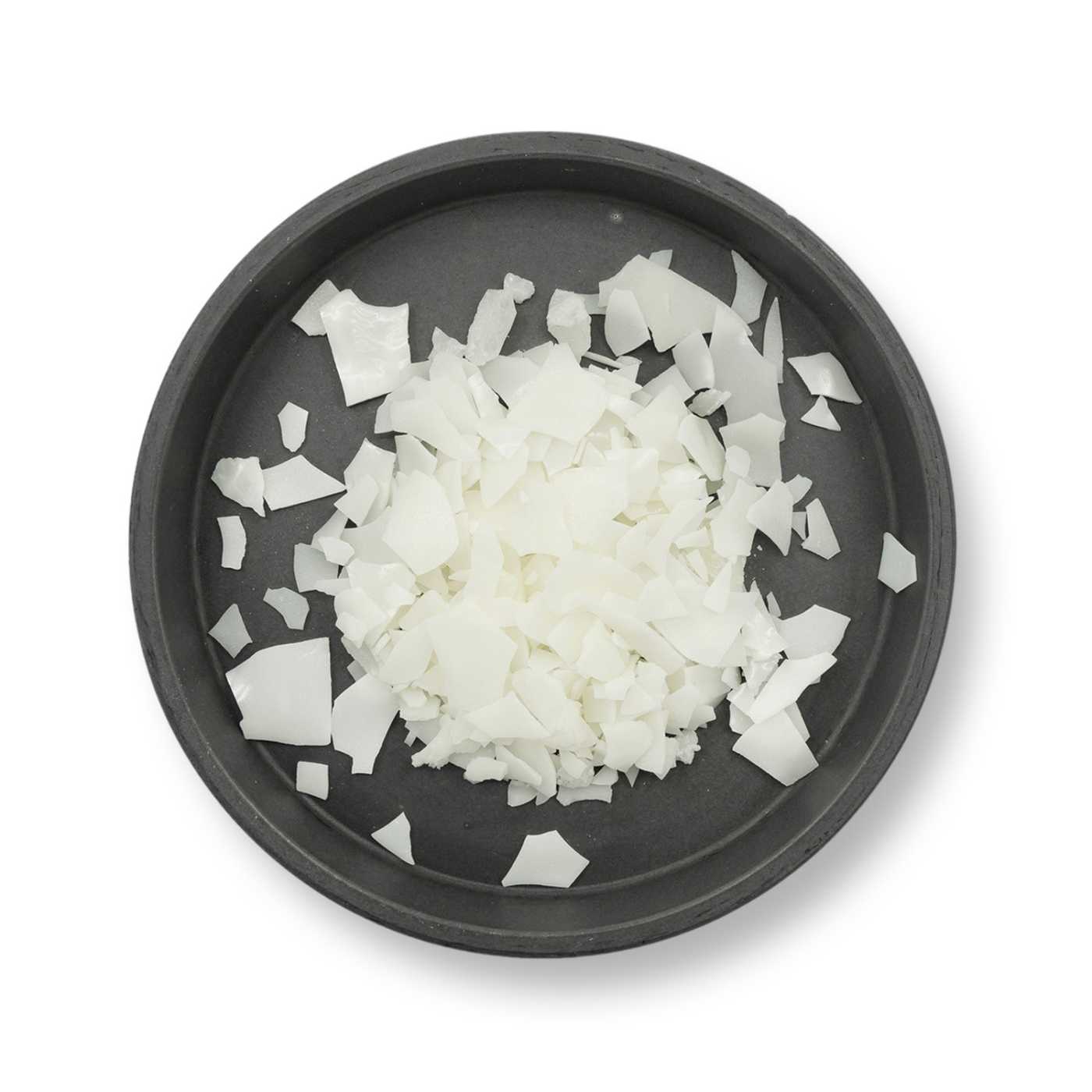
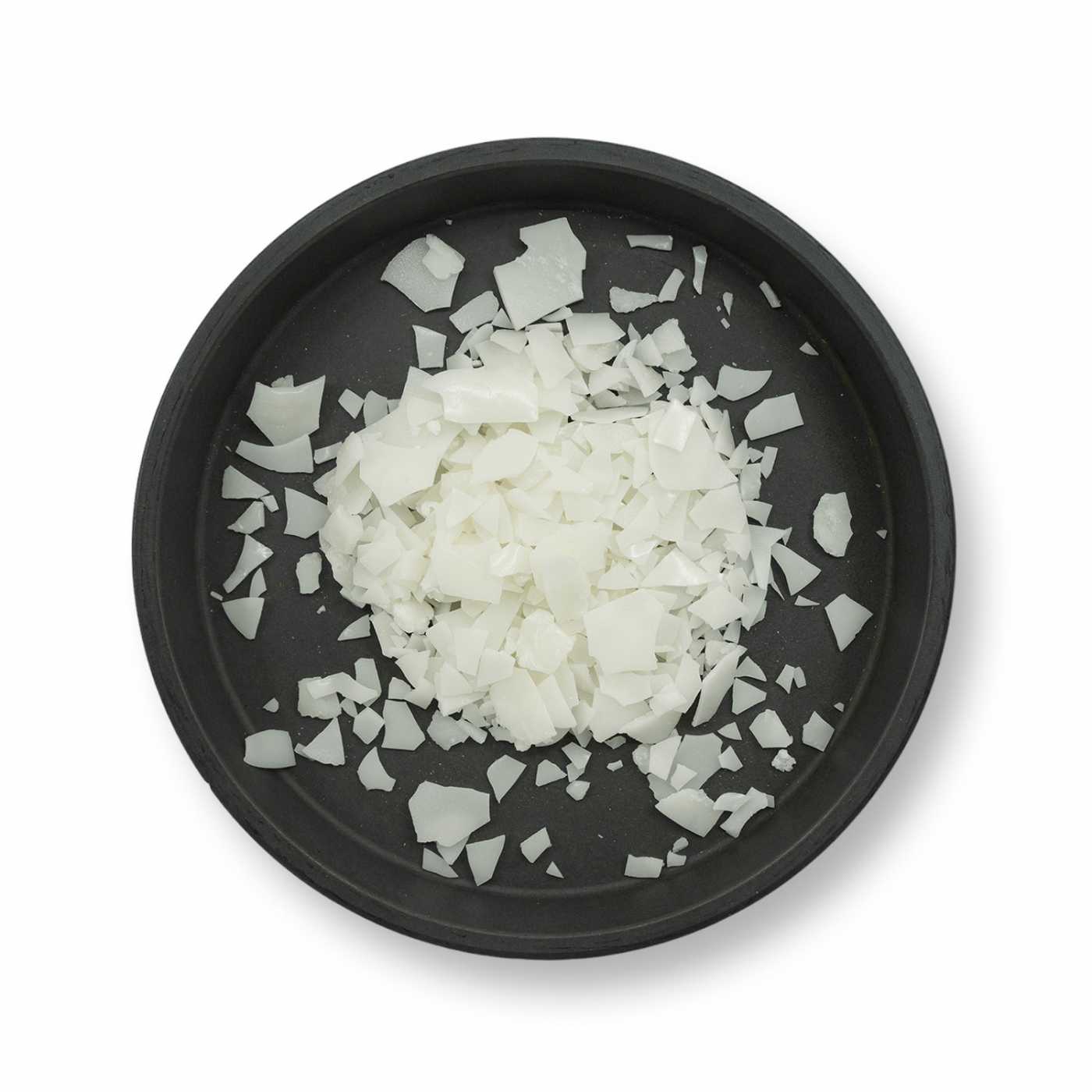
As mentioned with Beautyderm K10, at a concentration of 6% Olivem 1000 forms a solid mixture unsuitable for application, therefore its content was reduced to 3%. For Olivem 1000, however, melting this emulsifier took a very long time and still a completely homogeneous mixture of emulsifier and oil was not achieved — so if you do not want to wait a long time at the water bath for it to dissolve, try one of the other emulsifiers.
Pigment
The most beautiful part of making shimmering body oil is adding the pigment and the gradual transformation of an ordinary oil into a shimmering miracle. You can reach for one type of pigment, as in our case, or combine several types of pigments. Likewise, you can increase or decrease the dosage of pigments according to your preferences. In our tests we used three basic types, namely mica powder, two-tone pigment (provides reflections in two colours) and cosmetic glitter.
Mica powder Nearly nude appears at first glance fairly dark, but after thorough blending it is suitable even for lighter skin. Primarily, however, this mixture is intended for darker or tanned skin. It provides gentle bronze reflections which stand out, for example, on the face.
Two-tone pigment gold does not provide an intense gold colour at first sight, but after application to the skin the gold reflections are visible. The resulting shimmering body oil is lightly pigmented and is therefore suitable even for everyday wear.
Cosmetic glitter represents the largest particles among the pigments used, and is thus the most visible on the skin. It will be appreciated especially by children and is suitable for parties or special occasions; for everyday wear it is rather conspicuous. These are also pigments of larger size, so they are more difficult to keep on the skin for a longer time — they may rub off.

Tocopheryl acetate
Tocopheryl acetate, otherwise called vitamin E, is not only a vitamin that plays a role in nourishing the skin, but is also an antioxidant, and thus fights against free radicals. You will appreciate the antioxidant properties of this oil-soluble vitamin especially because it slows down the oxidation of oils. If you decide to use mainly virgin, cold-pressed oils, it is good to add tocopheryl acetate or another form of vitamin E to prolong the freshness of the oils.
Tocopheryl acetate is therefore not an essential component of the product; however, if you want to enjoy the shimmering body oil for longer, consider adding it to the mixture. Any form of vitamin E is always best added only after cooling, as these are heat-sensitive substances.
Formulation (100 g)
The raw material content is given in percentages, so it corresponds to a batch of 100 g of finished oil. Below you will find three formulations — with Beautyderm K10, with Olivem 1000 and with Polyaquol-2W. The preparation procedure is the same for all three.
Variant 1 — Beautyderm K10 and two-tone pigment
Shop the ingredients for this recipe
Untick what you already have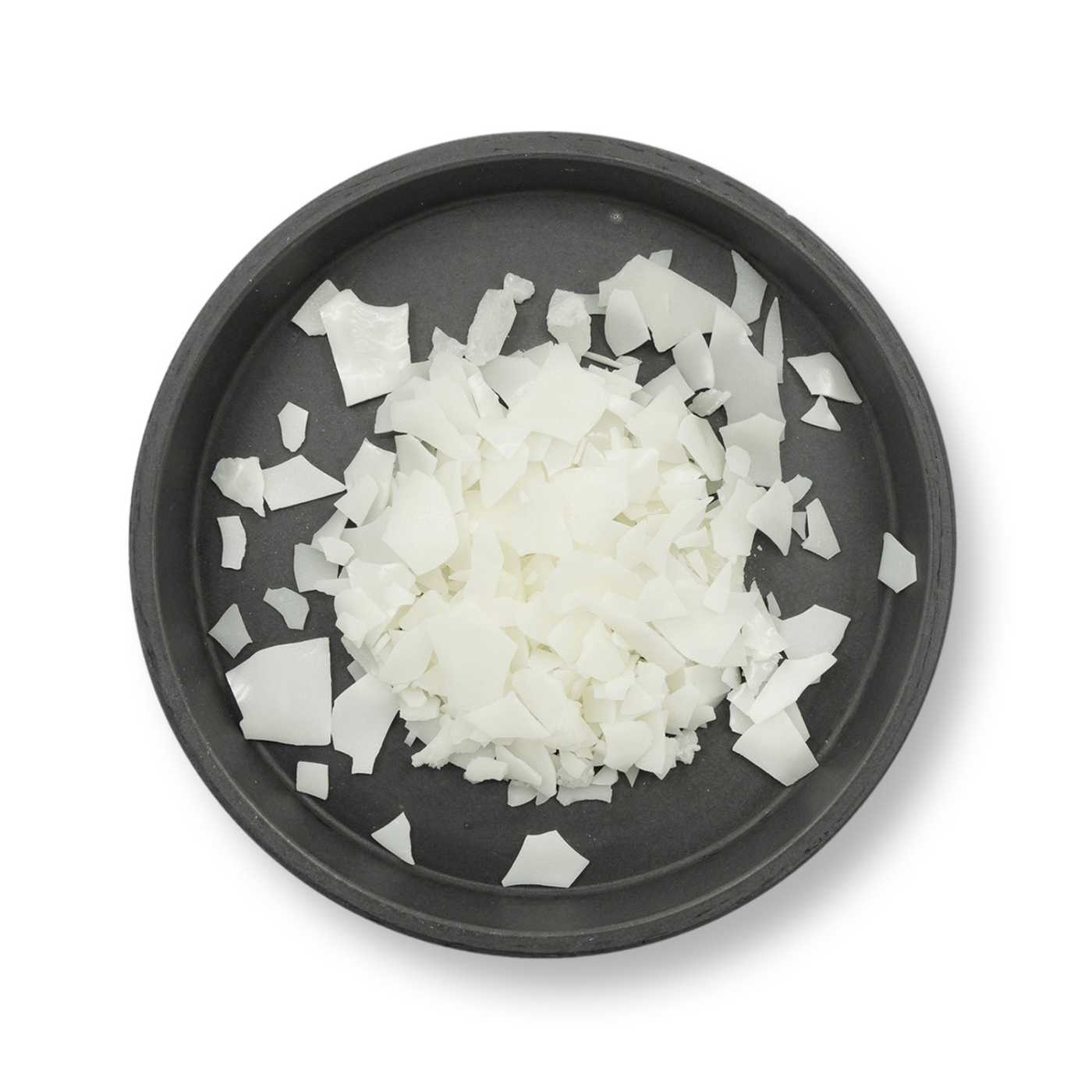 Emulpharma K10 (Beautyderm), 50 guses 6 gin stock€5.24
| Phase / raw material | Content in % |
|---|---|
| Phase A — water bath | |
| Neutral oil MCT caprylis | 85.50 |
| Beautyderm K10 | 6.00 |
| Phase B — below 40 °C | |
| Tocopheryl acetate | 0.50 |
| Two-tone pigment, gold | 8.00 |
| Packaging | |
| Glass bottle clear, dropper | — |
Variant 2 — Olivem 1000 and silver glitter
Shop the ingredients for this recipe
Untick what you already have
| Phase / raw material | Content in % |
|---|---|
| Phase A — water bath | |
| Neutral oil MCT caprylis | 88.50 |
| Olivem 1000 | 3.00 |
| Phase B — below 40 °C | |
| Tocopheryl acetate | 0.50 |
| Fine cosmetic glitter silver | 8.00 |
| Packaging | |
| Glass bottle clear, dropper | — |
Variant 3 — Polyaquol-2W and mica powder
Polyaquol-2W is currently not in our range, so the shopping list contains only the available raw materials; we give the formulation exactly as it was tested.
| Phase / raw material | Content in % |
|---|---|
| Phase A — water bath | |
| Neutral oil MCT caprylis | 85.50 |
| Polyaquol-2W | 3.00 |
| Phase B — below 40 °C | |
| Tocopheryl acetate | 0.50 |
| Mica powder Nearly nude | 8.00 |
| Packaging | |
| Glass bottle clear, dropper | — |
Method
The preparation procedure was the same for all three products.
- Disinfection
Disinfect all tools, containers and packaging that will come into contact with the product or the raw materials, for example with ethanol. Make sure that all tools are dry and that there is no residual water on them.
- Oil and emulsifier in a water bath Phase A
Into a heat-resistant container weigh the oil and the emulsifier, and place it in a water bath until the emulsifier has melted.
- Cooling and adding the pigment Phase Bbelow 40 °C
Remove the mixture from the water bath and wait until its temperature drops below 40 °C, then add tocopheryl acetate and the respective pigment (mica powder/glitter, etc.).
- Stirring and filling
Thoroughly stir and pour into the selected container.
Comparison of emulsifiers
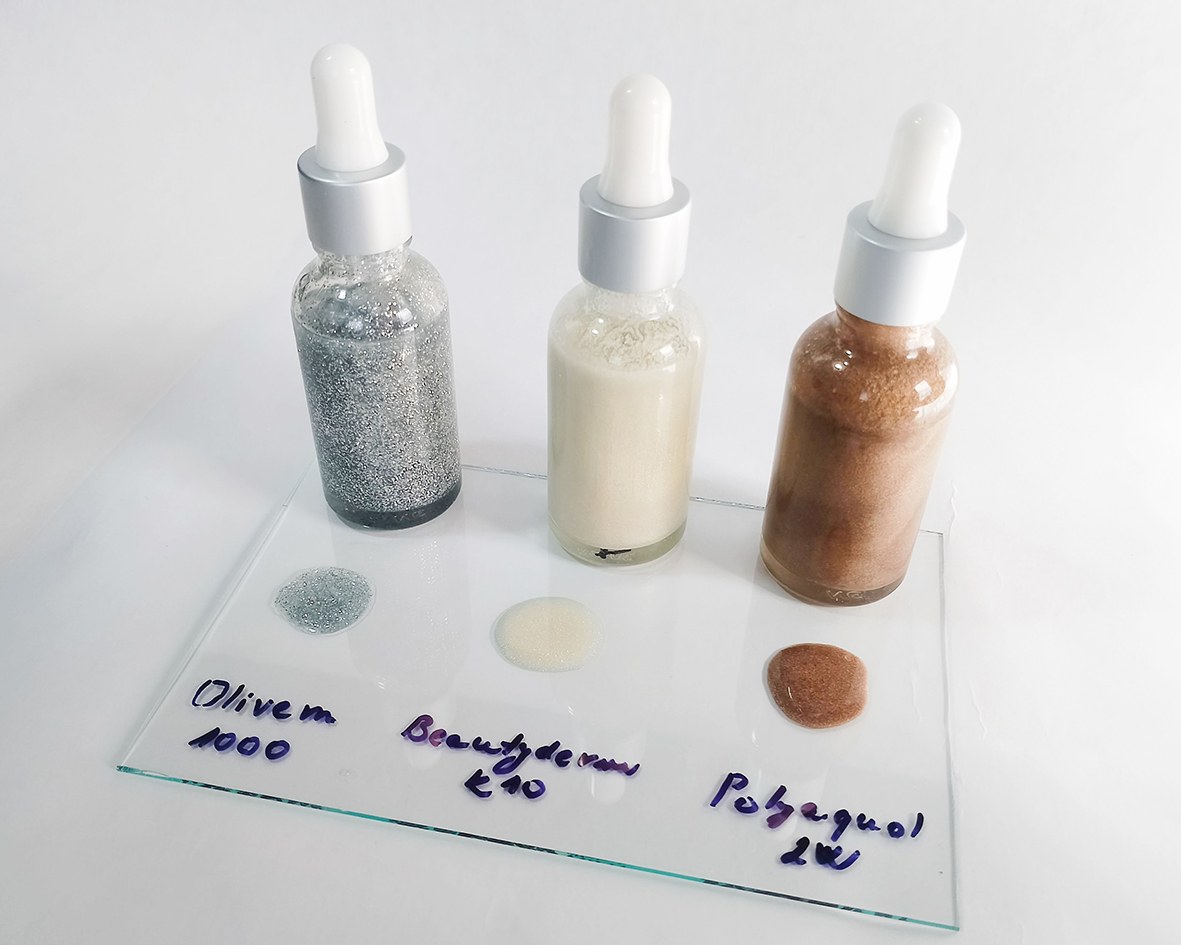
Below you will find our observations when comparing the different emulsifiers that were used for the production of the shimmering body oil. Of course, the emulsifier can also be completely omitted — in which case, however, the mica powder or glitter will settle straight to the bottom and the product must always be shaken before use. If this does not bother you, you can simply combine only your favourite oil and the selected pigment to create a quick and simple shimmering body oil.
Beautyderm K10
The greatest disadvantage of Beautyderm K10 was that this emulsifier kept the used pigment suspended the weakest. After 24 hours the pigment had sunk to about half of the container and remained there even after several days. Therefore, the use of Beautyderm K10 turned out to be rather unnecessary in terms of keeping as much pigment as possible in suspension. On the other hand, it helped quite well to keep the pigment on the skin and reduced its rubbing off onto clothing.
Olivem 1000
Olivem 1000 kept the glitter in suspension quite well — the glitter sank by only about one fifth in 24 hours, which is fairly normal considering the amount of pigment and the concentration of emulsifier. As for resistance to rubbing off, it was rather low; on the other hand, glitter of larger particle size was used, which adheres to the skin less easily than mica powder. The advantage is that the glitter remained dispersed in the mixture even after several days and did not sink to the bottom.
Polyaquol-2W
The last tested emulsifier was Polyaquol-2W. This emulsifier also had to be used at a concentration of 3%, since at 6% it formed a solid mixture with the oils. At 3% a slight milky cloudiness formed, as with the other emulsifiers, which, however, did not disturb the pigments used. Polyaquol-2W dissolved somewhat more slowly than Beautyderm K10, but still relatively quickly, and after dissolving it formed a homogeneous mixture with the oils.
Polyaquol-2W kept the mica powder in the mixture very well, comparably to Olivem 1000. After 24 hours the mica powder had also sunk by only about a quarter. At the same time, Polyaquol-2W helped reduce the rubbing off of the mica powder onto clothing after application to the skin. On the other hand, after several days the mica powder began to settle more markedly to about half of the container, even after repeated stirring.
How to choose an emulsifier
We looked at a more detailed comparison of the properties of the individual emulsifiers above. We will just summarise that the choice of emulsifier depends on the properties of the product you prefer. The emulsifier can also be completely omitted — in which case, however, you must always shake the product before use so that the pigments are brought into suspension.
Warning
As mentioned, you can experiment with homemade recipes to achieve the desired properties. However, the final result can be influenced by many factors, such as humidity, temperature, the quality of the raw materials or their storage.
Before using any raw material for the production of a cosmetic product, familiarise yourself with its properties, recommended dosage, storage conditions and safe handling. Every raw material can have the potential to cause an allergic reaction in sensitive individuals, therefore before using the product we recommend finding out whether you suffer from an allergy to any of the raw materials or to the product as a whole, for example by a patch test.
If you have very sensitive or very acne-prone skin, or if you have other skin and health problems, we recommend that you consult a medical professional before applying a new product to the skin, whether it is a homemade cosmetic product, a pure raw material or a commercially available product.
Frequently asked questions about the recipe
Practical questions about shimmering body oil — the emulsifier, its dosage, oil substitutions and the role of vitamin E.
Do I have to add an emulsifier to shimmering oil?
You do not — the emulsifier can be completely omitted. In that case, however, the mica powder or glitter will settle straight to the bottom and the product must always be shaken before use. If this does not bother you, simply combine your favourite oil and the selected pigment.
Why is Beautyderm K10 used at 6% and the other emulsifiers at 3%?
When preparing a 6% mixture of emulsifier in oil, the mixture with Beautyderm K10 remained liquid even after cooling, whereas the mixture with Olivem 1000 solidified. At 6% both Olivem 1000 and Polyaquol-2W form a solid mixture unsuitable for application, so their content was reduced to 3%.
Which emulsifier keeps the pigment in suspension best?
Olivem 1000 and Polyaquol-2W performed best — with Olivem 1000 the glitter sank by only about one fifth in 24 hours, and with Polyaquol-2W the mica powder by only a quarter. Beautyderm K10 kept the pigment suspended the weakest: after 24 hours it had sunk to about half of the container.
Can I replace MCT caprylis with a different oil?
Yes, in full. Suitable oils are those that are colourless or have minimal colour, such as fractionated coconut oil. Do not use oils with too many pigments, such as rosehip, raspberry or carrot macerate — they can affect the final colouration of the product. A mixture of your favourite oils can also be used.
Is tocopheryl acetate compulsory in the recipe?
It is not an essential component of the product, but as an antioxidant it slows down the oxidation of oils, so you will enjoy the shimmering body oil for longer. Add any form of vitamin E only after the mixture has cooled — these are heat-sensitive substances.
When should fragrance and active ingredients be added?
Only after the mixture has cooled. This applies to essential and fragrance oils, CO2 extracts and coenzyme Q10 — heat would destroy them. With coenzyme Q10, prefer the liquid form so that the colouration of the product does not change.
Conclusion
With a shimmering body oil you will highlight and prolong your summer tan even during the Indian summer. It will give your skin shine and at the same time nourish it. Have you already made your own? We thank the wonderful Ivana Jačalová for this contribution with comparison and instructions.
If you have any observations, ideas or experiences that would complement our knowledge or tutorials, be sure to write to us. We look forward to your notes and messages at [email protected].
We will see you in the next blog post.
You will find the neutral oils, emulsifiers, mica powders, two-tone pigments and cosmetic glitter from this recipe in the Handymade raw material range.